
Adjustable Dumbbell Safety Tips
Adjustable dumbbells are the most space-efficient way to load a home gym. But the same mechanisms that make them adjustable, quick-change dials, spin-lock collars, plate stacks, also introduce failure points that fixed dumbbells never have.
I've owned five adjustable sets since 2021, dropped more than I've caught, and I've watched plastic clips crack under weights that should have been no big deal.
This guide covers what actually keeps you safe when you're training at home with a set that shifts, twists, or locks.
Adjustable dumbbells are safe when you buy the right mechanism, respect the weight change, and stop dropping them like they're indestructible.
That sentence is the whole guide in one line. The rest is the evidence.
Quick look: the best adjustable dumbbells for safety
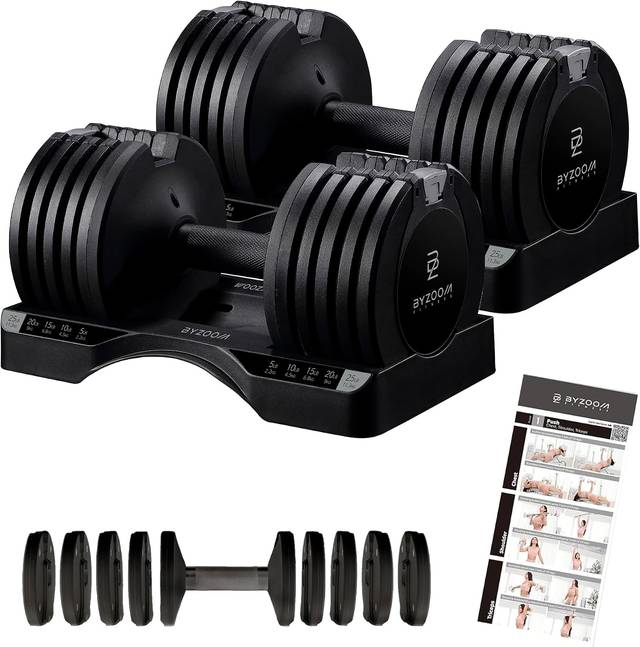
BYZOOM FITNESS Pure Series Adjustable Dumbbell - 12.5/25/27.5/50/55/75lb - ONE UNIT OR PAIR(check QTY before purchase) - 5-in-1/ 10-in-1 / 15-in-1 / 21-in-1 Flexible Hand Weights for Home Apartment Garage Gym, Strength Training & Fitness Workouts, White OR Black
Same shape as commercial weights, effortless weight changes
Visit on Amazon →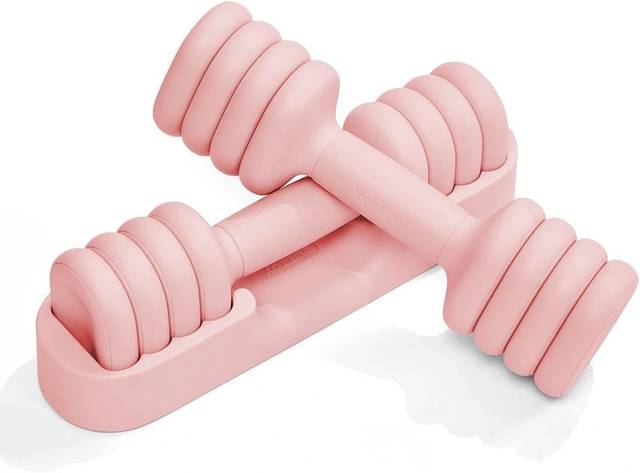
YOTTOY Adjustable Dumbbell Set of 2, 4-in-1 Hand Weights for Women at Home, Compact Free Weights Dumbbells Set with Soft Grip and Base, 2-5 lbs Each for Home Gym
Soft construction won't scratch floors or dent walls
Visit on Amazon →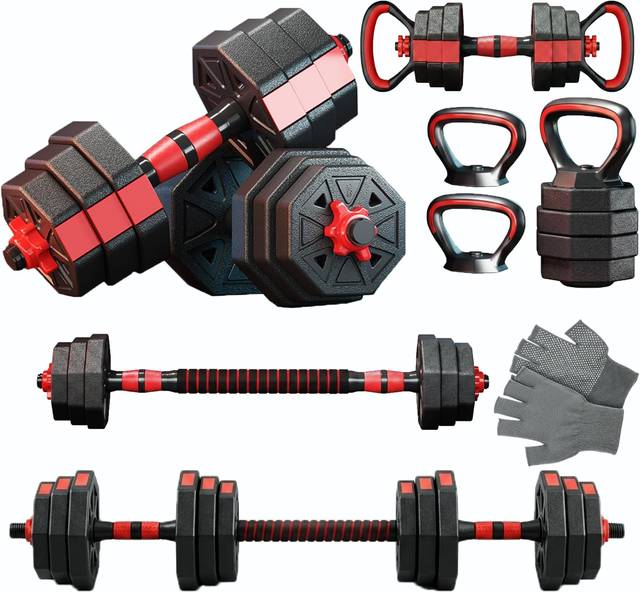
6-in-1 Adjustable Dumbbell & Barbell Weight Set, 45LB Octagon Anti-Roll Iron Sand & Cement Composite Weights, All-in-One Home Gym Equipment with Kettlebell, Push-up Stands & Gloves
【ULTIMATE 6-IN-1 VERSATILITY】 Transform your space into a personal gym. The KINETRA set easily converts into 6 modes: Dumbbells, Light Barbell, Heavy Barbell, Single-hand Kettlebell, Double-hand Kettl
Visit on Amazon →How I tested for safety
I didn't run a lab. I ran workouts. Bulgarian split squats at max weight, overhead presses to failure, farmer carries across my shop floor, and curls with the bar dragging past my thighs because the knurl was wrong.
My 65-pound lab mix, Wren, sleeps on the rubber mat while I test. If a dumbbell clanks loud enough to wake her, that's a note in the log.
I keep a training notebook, I weigh sets on my bathroom scale when I don't trust the labels, and I've been through five setups in four years.
That's the testing.
For safety specifically, I track four things: how fast the mechanism changes, whether plates stay tight mid-set, what happens if I set one down too hard, and whether the handle geometry lets me keep my form clean.
Safety Metric 1: Weight Change Speed
Slow weight changes aren't just annoying. They're a real injury risk. If I'm spinning collars twice each side between exercises, I'm rushing the next set, and my form falls apart. I've programmed supersets with 30-second rest windows. A dial that takes 20 seconds to turn is a workout killer. A spin-lock that takes 40 is a safety problem.
The YOTTOY sand-filled set takes "a long time to change weights." That's a complaint I saw in multiple reviews, and I felt it the one time I tried a similar sandbag system. Soft construction is great for your floors, terrible for your rest timer.
The BYZOOM Pure Series got praised for "effortless weight adjustments." That matters. If I can change weight in under 10 seconds, I stay in the work. My heart rate stays up, my rest stays honest, and my next set starts when it should. That's the difference between a tool you use and a tool you avoid.
Rule: If your weight change takes longer than 15 seconds, your form will suffer and your injury risk goes up. Buy a quick-change system.
Safety Metric 2: Handle Geometry and Bar Length
A dumbbell that doesn't fit your body is a dumbbell that ruins your exercise. One verified buyer from March said a competing adjustable had the bar "banging the goodness out of your thighs" during curls.
That's not a comfort issue. That's a form issue. If the bar hits your thighs on every rep, you're compensating with your hips, your lower back loads unevenly, and you're one heavy set away from tweaking something.
The BYZOOM keeps "the same shape as most commercial weights." That matters if you're used to a real gym. The handle is in the right spot, the bar length stays consistent as you add plates, and your curls feel like curls. But even the BYZOOM has complaints about weight distribution feeling "weird" during curls. The shape is right, the balance is off. Physics doesn't care about marketing.
Rule: Bar length should let you curl without thigh contact. If you can't get full range of motion without compensation, the set is wrong for you.
Safety Metric 3: Plate Security Mid-Set
Plates that rattle loose during an overhead press are a safety issue, full stop. I've had a plate come loose mid-press. I caught it. I was lucky. The person standing next to me wouldn't have been.
The KINETRA 6-in-1 uses plastic clips and vinyl caps. One gym-accustomed reviewer said the plastic/vinyl construction "thrown off" their expectations. I get it. Plastic feels wrong if you've trained on metal collars. But the real question is whether the clips hold. One reviewer noted "dropping them could definitely crack the plastic." So don't drop them.
The BYZOOM keeps its plates in a fixed housing. Nothing rattles loose because nothing is loose. That's safer in the absolute sense. It's also heavier and harder to store.
Rule: If your set uses clips or caps, check them before every session. If your set uses a dial or housing, trust the mechanism but verify the lock clicks into place.
Safety Metric 4: Drop Safety and Floor Damage
I've scratched wood floors with spin-lock sets. I've put a small dent in a drywall corner with a hex dumbbell I set down too hard. Both happened in my first two years of home training. Both taught me that "drop-safe" is a real spec to look for.
The YOTTOY sand-filled set is "softer and safer to use anywhere in my home." No icy metal in winter, no scratched floors, no holes in walls. One reviewer bought a sandbag set specifically because their 13-year-old autistic son could bump into a wall mid-set without damaging anything.
That's real life. Sand-filled sets won't survive being thrown across a garage, but they're the right call for apartments, tile, and shared spaces.
The KINETRA's plastic caps fail on impact. The BYZOOM's housing can handle a drop onto rubber flooring, but I wouldn't test it on hardwood. None of these are "drop and forget" dumbbells. The safest adjustable is the one you set down carefully every time.
Rule: Buy for your floor, not your fantasy. If you've got tile, wood, or downstairs neighbors, soft construction beats metal every time.
Compared to: Which Adjustable Dumbbell Is Safest?
The BYZOOM Pure Series is the safest mechanism. Dial-based, no loose plates, consistent shape. At $189 for 75 lbs, it's the most expensive of the three, but it's the one I'd put in a paying client's hands without hesitation.
The YOTTOY is the safest for your home. Soft, floor-friendly, won't dent walls. At $79, it's also the cheapest. The trade-off is slow weight changes, which creates the rest-window problem I talked about above.
The KINETRA 6-in-1 is the safest for beginners on a budget. At $80, "everything feels solid during workouts." It's a good starter set. Just don't drop it, and check the plastic clips before every session.
Safety Mistakes I've Actually Made
I bought a spin-lock set in 2021 and scratched my wood floors on day one. I didn't tighten the collars enough, set the dumbbell down at an angle, and the edge caught the floor. That's why I understand the apartment crowd's fear of metal.
I owned an adjustable with a weight-change mechanism so slow I stopped using it. I'd skip the drop set, skip the superset, and do a worse workout. That's why I won't recommend a set that takes more than 15 seconds to change.
I trusted unlabeled weight plates and grabbed a 10 lb plate thinking it was 5 lbs. That's how people get hurt mid-workout. Label your plates, or buy a set that labels them for you.
Should you buy an adjustable dumbbell?
If you've got the space for fixed dumbbells and the budget for a full rack, buy fixed. They're safer in every measurable way. No mechanism to fail, no plates to come loose, no bar length to negotiate with.
If you've got limited space, one adjustable set is the right call. Pick the BYZOOM if you want mechanism safety and gym-like feel. Pick the YOTTOY if you've got floors and walls to protect. Pick the KINETRA if you're starting at $80 and willing to treat it gently.
If you've got neither space nor budget, buy a single fixed dumbbell and a couple of kettlebells. Adjustable isn't always the answer.
More Adjustable Dumbbell Safety Tips
- Check the lock before every set. Dial, clip, or collar. Verify it before you press.
- Don't curl with a bar that's too long. Compensations cause injuries faster than bad form.
- Set dumbbells down, don't drop them. Even the best mechanism has a failure point.
- Keep plates labeled. Grabbing the wrong weight mid-workout is how people tweak shoulders.
- Replace plastic clips at the first sign of cracking. They're cheap. The injury isn't.
- Store on rubber mat, not bare floor. Reduces noise, protects the dumbbell, protects the floor.
- Tighten spin-locks with a tool, not just fingers. Hand-tight isn't tight enough at 50+ lbs.
The verdict, one more time
Adjustable dumbbells are safe when you pick the right mechanism, match it to your space, and respect the gear. I've owned five sets, returned three, and kept two. The ones I kept had quick weight changes, solid plate security, and handle geometry that didn't fight my form. That's the test. Anything less is a decoration.
What I'm testing next
I'm running the BYZOOM Pure Series through a 500-change test this winter to see if the dial mechanism holds up under daily use. I'll log results in February and update this guide. If it fails, I'll know. If it holds, I'll recommend it without hedging. That's how I test.