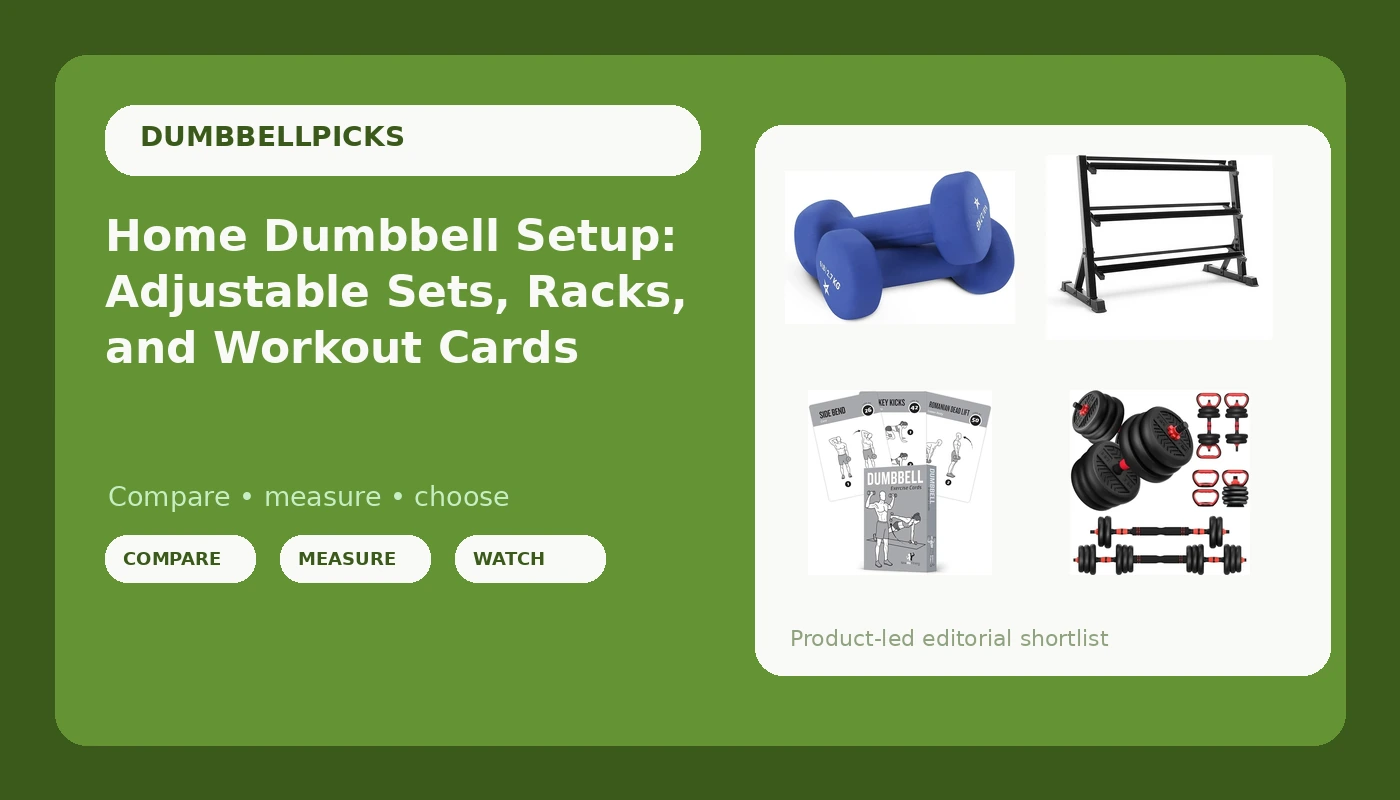
I've been coaching in Denver for twelve years, and I've built and rebuilt a garage gym that eventually grew into a 4,000-square-foot facility. The question I get more than any other is some version of "I have a corner of a room and a couple hundred dollars, what do I actually buy?" The honest answer is that a home dumbbell setup is not one purchase. It is four separate jobs: something heavy that changes weight, something light that stays put, something that keeps the floor clear, and something that tells you what to do on a Tuesday morning when you don't feel like training.
The four products below cover those four jobs, and none of them substitutes for another. That matters, because most "best dumbbell" comparisons are really asking which of four identical things is cheapest. This one is asking which piece your setup is missing.
If you can only buy one item this month, buy the adjustable set. It replaces the most equipment per square foot, and it is the only product here that can carry you from your first push-up to a genuinely heavy working set. Everything else on this list makes the adjustable set easier to live with. Nothing else on this list replaces it.
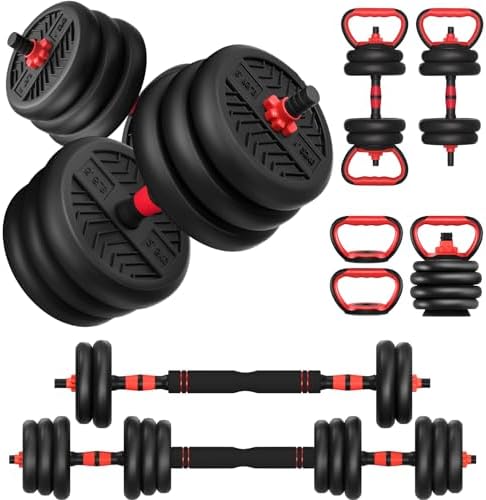
Adjustable Dumbbell, 20/30/45/70/90lbs Dumbbells Set, 4-in-1 Free Weights
Replaces a rack of fixed pairs and doubles as a barbell, kettlebell, or push-up stand
The mechanism is the entire product. If it jams, the weight range means nothing

Yes4All Neoprene Dumbbells, Pairs and Sets with Rack for Home Workouts
Coated heads that won't scar a floor or a shin, in the light ranges adjustables handle badly
Caps out long before you get strong, and the included rack is convenience, not storage
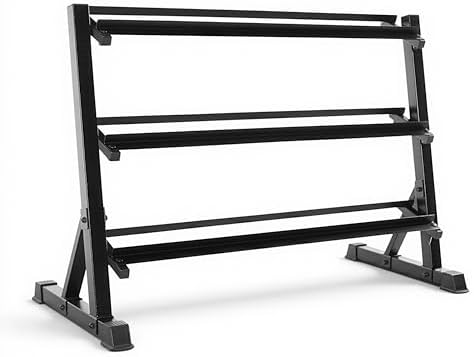
CAP 2-Tier & 3-Tier Dumbbell Rack for Home Gym, Heavy-Duty Steel Weight Storage Rack for Hex Dumbbells
Keeps hex heads off the floor and off your toes, with tiers sized to common pair ranges
It is furniture. It does nothing for your training, and it commits you to a footprint
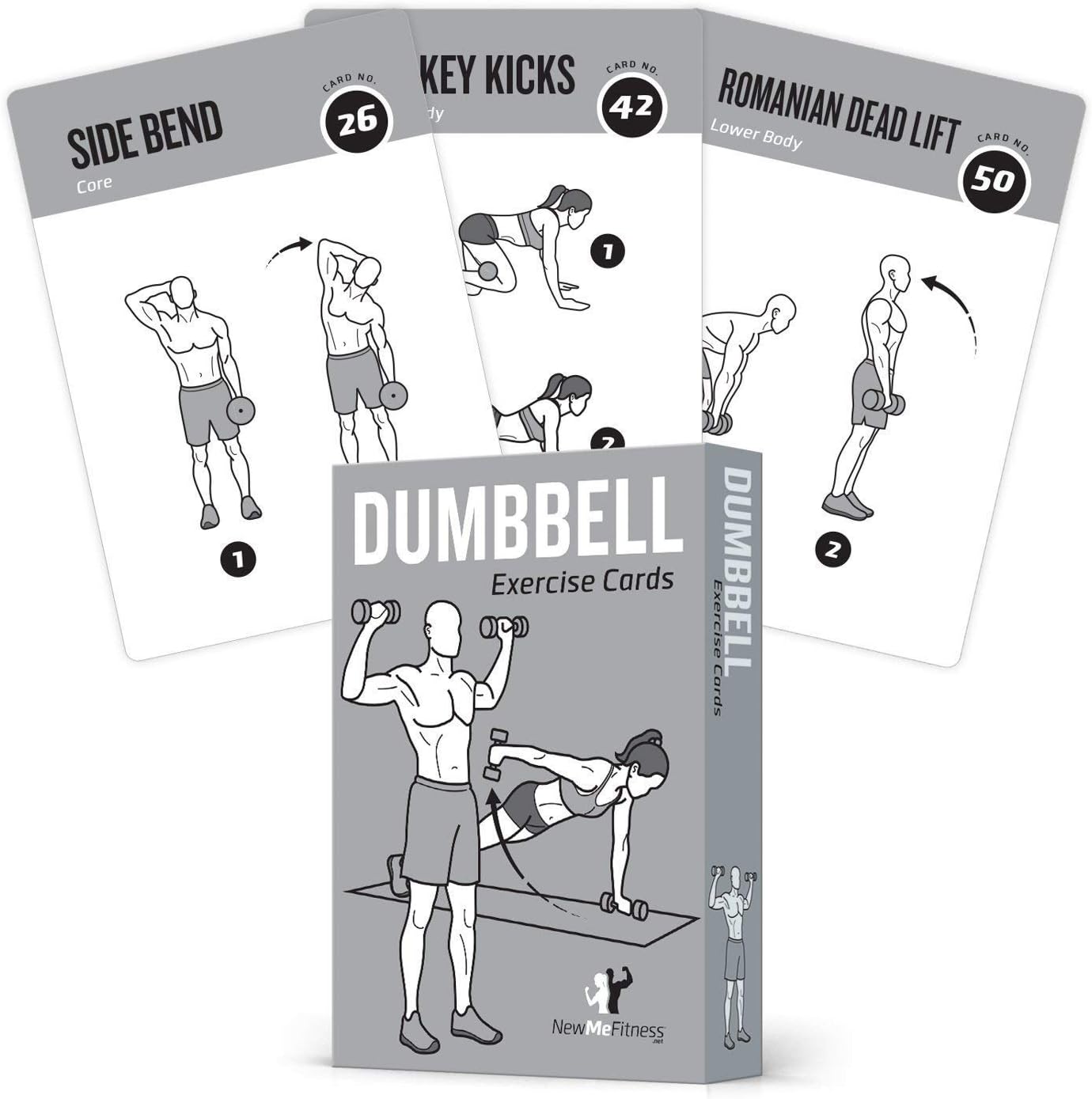
NewMe Fitness Dumbbell Workout Cards, 50 Card Exercise Deck
Fifty cards means you never stand in the garage wondering what to do next
A deck is a starting point, not a program. It does not progress load for you
Prices and availability were captured from Amazon Creators API and may change.
The four jobs, and why they do not overlap
Think about how a session actually runs. You warm up with something light, you work with something heavy, you set the weight down between sets, and at some point you decide what the next exercise is. Those are four different problems, and a single product that solved all four would be a gym, not a purchase.
The adjustable set handles the heavy work. The neoprene pairs handle warm-ups, rehab, lateral raises, and the light end of the range that adjustables are clumsy at. The rack handles storage and safety. The card deck handles programming. Buy them in the order that matches the gap in your current training, not the order that looks best in a photo of someone else's garage.
How I judge dumbbells
Four things, in this order.
First, does the knurling hold chalk and skin, or is it cosmetic? A handle that looks textured and grips nothing is worse than a smooth handle, because you trust it. Second, does the weight-change mechanism survive repetition? I care about the dial, the collar, the lock, not the number printed on the side. Third, do the plates stay tight mid-set? If they wobble, the welds are lying to you, and a wobbling plate at rep eight is how people get hurt. Fourth, would I put it in a paying client's hands? That last one is the only test that matters, and it filters out most of the category.
Notice what is not on that list: total weight range, color, and how the product looks on a rack. Those are the things listings lead with.
The adjustable set: the piece that does the most work
This is the product that changes what your room can do. A 4-in-1 design that runs 20, 30, 45, 70, and 90 pounds and can be configured as a barbell, a kettlebell, or a push-up stand is doing the job of a fixed rack, a bar, and a floor stand at once. For a home setup, that consolidation is the whole value proposition. One footprint instead of ten.
The honest trade-off is that everything depends on the mechanism. Fixed dumbbells fail by getting scratched. Adjustables fail by refusing to change weight, usually at the worst moment, usually because chalk and dust found their way into the moving parts. That is the thing I would think hardest about before buying: not the range, not the price, but whether the change mechanism feels like it was built to be used a thousand times or twenty.
My advice for any adjustable: keep it off the floor, keep chalk out of the tracks, and change the weight deliberately instead of dropping it into position. Treat the mechanism like the precision part it is and it will outlast your enthusiasm.
The neoprene pairs: light weight, done properly
Neoprene dumbbells get dismissed as beginner gear, which is a mistake. The coating is genuinely useful: it does not chew up hardwood, it does not clang on tile at 5:45 a.m., and it does not take a divot out of your shin when a set of lateral raises goes sideways. Pairs and sets with a rack also solve the smallest, most annoying problem in a home gym, which is where the 5s and 8s live.
Where this category wins is the light end. Warm-up circuits, shoulder health work, high-rep finishers, and the ramp-up sets before your working weight. Where it loses is everything above moderate weight. Neoprene is not a material for heavy pressing or farmer carries, and no rack included with a light set is a substitute for real storage. If you are new, this is a fine first purchase. If you are already strong, it is a supplement, not a foundation.
The rack: the piece everyone buys last
A heavy-duty steel rack with two or three tiers, sized around common pair ranges like 5-35, 5-50, and 5-75, is the least exciting product in this article and the one that prevents the most injuries. Not from lifting, from stepping. Dumbbells on the floor are a trip hazard in a room that also contains a treadmill, a bench, and a dog.
There is a real training argument too. If every set requires a full hip-hinged pull off the floor, you will skip the last set more often than you think. Storage within arm's reach at working height is a small convenience that quietly adds reps over a training year.
The trade-off is honest: this is furniture. It does not make you stronger, and it takes up permanent floor space. Buy it when your collection has outgrown a corner, and buy the tier count that matches the pairs you actually own rather than the pairs you plan to own someday.
The card deck: programming for the un-coached
The most common reason a home gym goes unused is not equipment. It is standing in the middle of the room with no idea what to do next, and doing nothing. A 50-card exercise deck fixes that specific problem. You draw, you do the movement, you move on. For someone training alone without a coach, that structure is worth more than another pair of dumbbells.
What a deck cannot do is progress your load. It gives you exercises, not a plan for adding weight over twelve weeks, and it will not tell you when to back off. Use it as a template for variety and as a travel option, then layer a simple progression on top: same movements, slightly heavier or slightly more reps, week over week.
The trade-offs nobody puts in the listing
Every one of these products is a bet on a different kind of convenience, and the listings all sell the upside.
An adjustable set bets that you would rather have range than reliability. You get one footprint and a huge weight span, and you accept that a mechanism can fail. A neoprene set bets that you will actually use the light weights, which is true for most people and false for some. A rack bets that you own enough pairs to need one, and that you value floor space less than convenience. A card deck bets that your bottleneck is decisions, not discipline.
None of those bets is wrong. They are just different, and the reason a comparison like this is useful is that it forces you to name which one you are making.
How I would sequence the four purchases
If you are starting from nothing: adjustable set first, card deck second, rack third, light neoprene pairs last. That order gets you training the fastest, and the rack only becomes necessary once you own something to store.
If you are returning to training after time off, or you are rehabbing a shoulder: light neoprene pairs first, card deck second, adjustable set third, rack last. The light end is where you rebuild, and you will get more out of a pair of 8s than a 90-pound adjustable in month one.
If you already own a decent set of hex dumbbells scattered across the floor: rack first, and nothing else on this list is urgent.
What I am watching in 2026
Adjustable mechanisms are getting cleverer and, in several cases, more fragile. The dial systems that made the category popular are being replaced by designs that look sleeker in photos and feel worse after the three hundredth weight change. That is the direction I would watch if you are buying this year: not the weight range on the box, but how the change mechanism is built and what it is made of.
The rest of this category is stable, and that is a compliment. Hex heads do not roll. Neoprene does not scratch floors. Steel racks do not tip if you load them sensibly. The boring products here will still be doing their jobs in ten years, and the exciting one is the one you should read the fine print on.