Twelve years of coaching in Denver taught me that the dumbbell is only the tool and the rep quality is the workout, but the tool still has to survive the workout. My garage gym grew into a 4,000-square-foot facility, and in that time I have watched more home gyms stall because of a rattling adjustable set than because of any other single purchase. When someone asks me to name the best adjustable dumbbells for home gym training, I do not hand them a weight range and a smile. I hand them a mechanism test, a handle test, and one question about whether the plates stay tight at rep eight. This comparison covers the four sets I would actually put on a short list in 2026: two from the Nuobell family and two multi-configuration sets that try to be more than a pair of dumbbells.
Related: Fixed Dumbbells vs Adjustable Dumbbells for a Garage Gym
For most home gyms, the Nuobell 580 in the 5 to 80 lb set of two is the adjustable pair I would buy first, because the quick-change mechanism feels like a real dumbbell instead of a gadget, and 5 to 80 lb per hand covers more than a decade of training. Everything below is about why the other three sets exist, who they fit, and where each one gives something up.
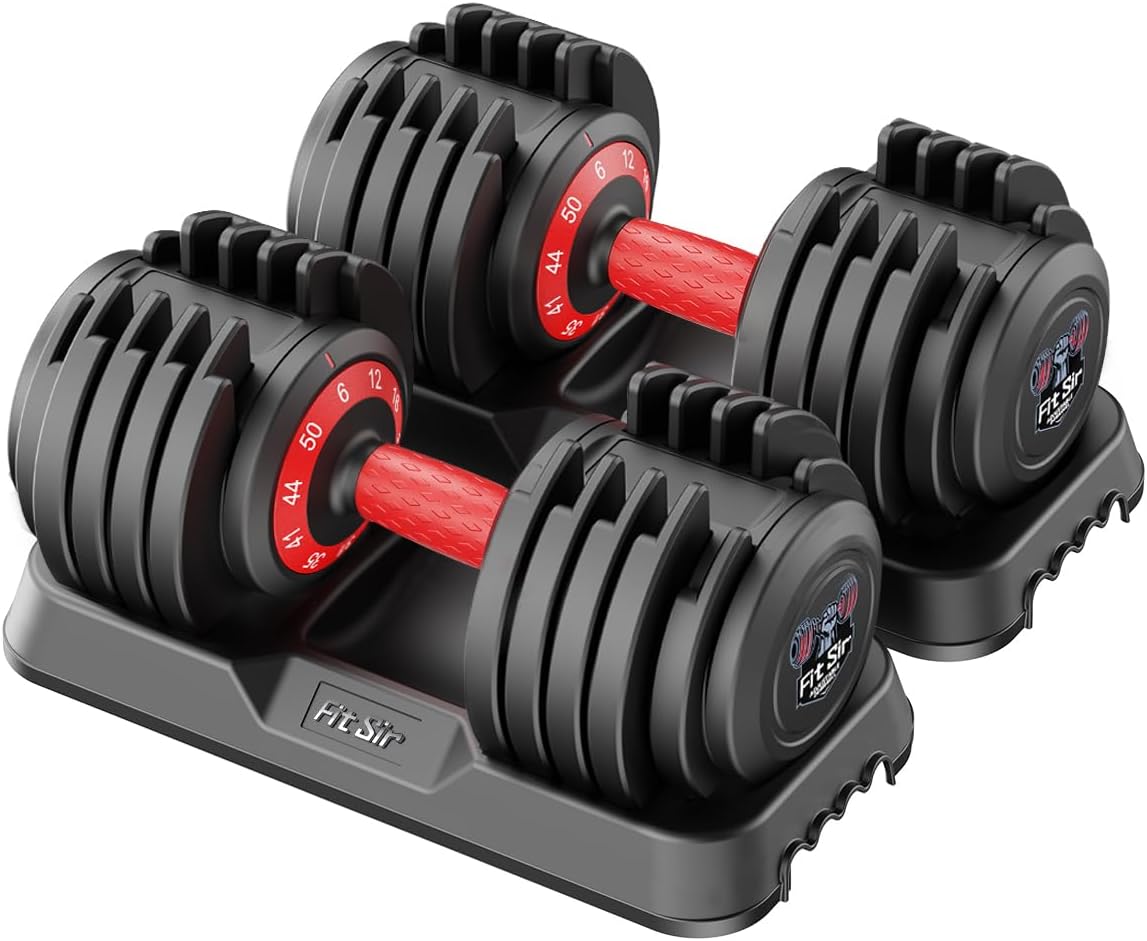
Adjustable Dumbbell Set, 10-in-1 25/50/90 lb with locking system and enclosed storage tray
A one-second adjustment claim, a locking system a beginner can verify by feel, and an enclosed tray that keeps the set complete
A lock is deliberate rather than quick, the tray needs floor space, and the textured grip favors comfort over bite
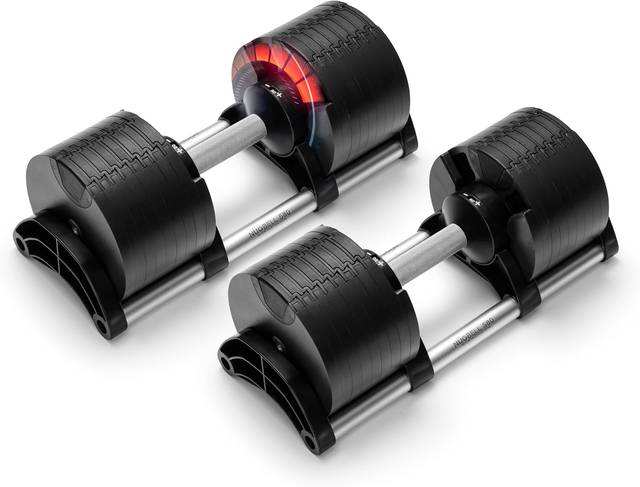
Nuobell 580 Adjustable Dumbbells, 5-80 lb, Set of 2 Free Weights
The quick-change mechanism feels like a real dumbbell, and 5 to 80 lb per hand in a set of two covers years of training
The biggest commitment of the four, and more range than a lifter who trains in the 8 to 15 rep range ever needs
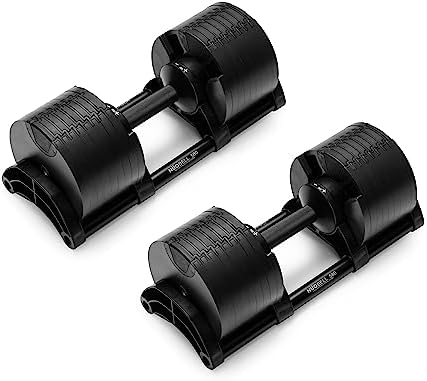
Adjustable Dumbbells Bells of Steel, Nuobell 5 to 50 or 80 lb Pair Set
The same Nuobell mechanism with a 5 to 50 or 5 to 80 lb pair choice, so you buy only the ceiling you need
Two configurations to choose between, and the 5 to 50 pair leaves heavy pressing and carries uncovered
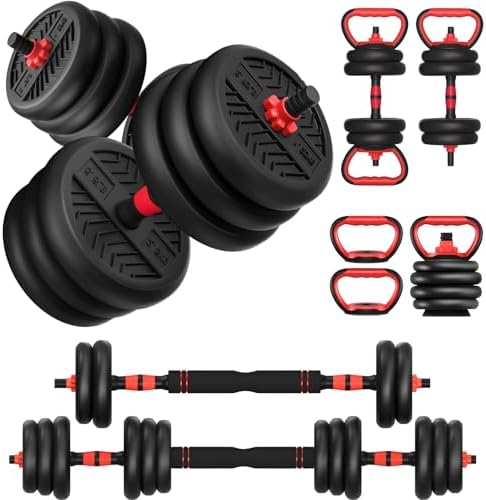
Adjustable Dumbbell, 20/30/45/70/90 lbs, 4-in-1 Free Weights for Home Gym
One purchase covers dumbbell, barbell, kettlebell, and push-up stand duty, and the range runs to 90 lb
Convertible gear compromises in every mode, and mode changes cost time in a superset
Prices and availability were captured from Amazon Creators API and may change.
How I judge an adjustable dumbbell
Four checks decide it for me, and none of them have anything to do with the number printed on the box.
Does the handle hold chalk and skin? A knurl is not decoration. If the handle is smooth enough to look pretty in a product photo, your forearms will be doing gripping work that your back should be doing on a row. If it is sharp enough to shred a palm on a farmer carry, you will quietly stop doing farmer carries. Somewhere between those two extremes is the answer, and you only find it with your own hands.
Does the mechanism survive repetition? The dial, the crank, the lock, whatever changes the weight, is the part that fails. A set that changes in a second is a set you will actually use for drop sets and supersets. A set that fights you at changeover is a set you will leave at one weight for the whole session.
Do the plates stay tight mid-set? Wobble is the tell. If the plates shift when you press a pair overhead, the tolerances are loose, and loose tolerances eventually become rattles.
Would I put it in a paying client's hands? That is the real test. A 70-year-old grandmother doing a goblet squat and a 14-year-old athlete doing loaded carries both need the same thing: a set that does not surprise them.
Two Nuobell listings, one mechanism family
The Nuobell 580 listing is the straightforward one: a set of two free weights, 5 to 80 lb per hand, built around the quick-change mechanism that made the Nuobell name. That mechanism is why serious lifters gravitate to it. A selectorized dumbbell is supposed to feel like a fixed dumbbell in the hand, not like a piece of equipment you are operating. When the change is fast and the handle is solid, you stop thinking about the dumbbell and start thinking about the set. That is the entire point, and it is worth paying for.
The Bells of Steel listing is the same mechanism sold with a choice: a 5 to 50 lb pair or a 5 to 80 lb pair. That choice matters more than it looks. A 5 to 50 pair handles pressing, rowing, curling, and most accessory work for a lifter who lives in the 8 to 15 rep range. A 5 to 80 pair handles heavy dumbbell presses, one-arm rows, and loaded carries without you running out of weight in month three.
So why pick the second listing over the first? Two reasons. If you know you will never press or row above 50 lb per hand, the smaller pair is the honest purchase, and honesty about your ceiling saves money and floor space. Second, the 5 to 50 pair is easier to move around a room without a plan.
The trade-off runs in both directions: the 5 to 50 pair leaves heavy days uncovered, and the 5 to 80 pair costs more and takes up more room. The one caution I give every client about any quick-change adjustable is simple. Treat the mechanism like a mechanism. It is not a rubber hex dumbbell, and it does not want to be dropped from overhead. Set it down, rack it, and it will outlast your program.
Check the Nuobell 580 set: Visit on Amazon →
Check the Bells of Steel pair: Visit on Amazon →
The 10-in-1 set with the locking system and the enclosed tray
This is the set I hand to people who want a home gym that looks like furniture instead of a pile of iron. The listing covers a set with a fast adjustment claim, a safe locking system, an enclosed storage tray, and a comfortable non-slip textured grip, in 25, 50, and 90 lb configurations.
The locking system is the interesting part. A lock is not as fast as a dial, and it is not as satisfying as a mechanism that feels machined, but a lock gives a beginner something a dial does not: confirmation. You can see that the pin is seated. You can hear it engage. For someone who has never pressed a dumbbell overhead, that confidence is worth more than half a second at changeover.
The enclosed tray is the second reason to consider it. Plates that live in a tray do not roll under the couch, do not get stepped on, and do not vanish when a teenager borrows one. In a shared garage, the tray is the difference between a set that stays complete and a set that quietly loses a small plate every month.
Where it gives ground is feel. A textured grip is comfortable and forgiving, which is great for high-rep work, but comfortable is not the same as aggressive. If you are chasing grip strength with heavy carries, you will want more bite than a comfort-first handle offers. The other trade-off is the deliberate changeover. It is quick, but it is a lock, and a lock asks you to pay attention.
Check the 10-in-1 set: Visit on Amazon →
The 4-in-1 set that becomes a barbell, a kettlebell, and a push-up stand
Not everyone wants a pair of dumbbells. Some people want a single purchase that covers a whole workout, and that is what this listing promises: a set that works as a dumbbell, a barbell, a kettlebell, and a push-up stand, in 20, 30, 45, 70, and 90 lb configurations.
For a small apartment or a spare bedroom, that is a real argument. A convertible set takes one footprint instead of four, and it lets a beginner rotate through movement patterns without buying four pieces of equipment. If your plan is built around variety and your space is a corner of a living room, a 4-in-1 set gets you training tonight.
The honest trade-off is that convertible equipment compromises somewhere, and you should decide in advance where you can live with that. The push-up stand mode is a convenience, not a replacement for a proper pair of handles. The kettlebell mode is not going to swing like a competition bell. The barbell mode will not replace a bar and plates for heavy squats. What it will do is give you a wide weight range, up to 90 lb, in one box that fits in a closet.
There is also a time cost. Every mode change is a changeover, and changeovers are where home workouts die. If you do one exercise for five sets and then move on, you will be fine. If you superset four movements, you will spend more of your session building equipment than using it.
Check the 4-in-1 set: Visit on Amazon →
Where the money actually goes
Four things separate these sets: the change mechanism, the range, the footprint, and the grip.
Mechanism first. The Nuobell family wins on feel. A quick change that seats solidly is the closest thing to grabbing a fixed dumbbell, and that matters most when you are moving fast, running drop sets, or training a client who does not want a lecture on equipment. The locking set is slower and more deliberate, but it is also more legible to a beginner. Neither approach is wrong. They suit different temperaments.
Range second. The 5 to 50 pair and the 5 to 80 pair are the same mechanism with different ceilings. If your training is pressing, rowing, curling, and lunging, 50 lb per hand is a long runway. If you plan to press dumbbells overhead for reps or load one arm for carries, the 80 lb pair is the one that will not embarrass you in month six. The 90 lb configurations on the other two sets reach higher still, but they reach it through a different style of mechanism, and mechanism quality is not something a weight range can promise.
Footprint third. A tray set owns a rectangle of floor. A quick-change pair can live on a stand, a shelf, or the floor beside a bench. In a 10 by 10 spare room, that rectangle is real estate, and you should measure before you buy.
Grip is the fourth thing, and the only one a spec sheet cannot settle. Get your hands on a handle before you commit, or buy from a seller with a return window you actually intend to use.
Who should buy which
Most home gyms: the Nuobell 580 set of two in 5 to 80 lb. It covers pressing, rowing, curling, and loaded carries, and the quick-change mechanism is the one that keeps a session moving. If you have a single adjustable purchase in your budget, this is where I would put it.
If you know your ceiling is 50 lb per hand: the Bells of Steel pair in the 5 to 50 lb configuration. It is the same mechanism with a lower ceiling, which is a feature if you never plan to press heavy dumbbells and a problem if you do.
If space is the binding constraint and variety is the plan: the 4-in-1 set. It gets you a dumbbell, a barbell, a kettlebell, and a push-up stand in one footprint, and the 90 lb configuration gives you room to grow. Go in knowing that convertible gear trades precision for range.
If you are new, training alone, and want a set that tells you it is locked: the 10-in-1 set with the locking system and the enclosed tray. The tray keeps the set complete, and the lock keeps a beginner honest about setup.
What I tell clients before they click buy
The set does not make the workout. A pair of light dumbbells and a program you actually follow will beat a 90 lb set that never leaves the tray. But the wrong set ends a program early, because a mechanism that jams, a plate that wobbles, or a handle that shreds your palm is a reason to skip Tuesday.
So buy the mechanism you will not fight, in the range you will not outgrow, in the footprint you actually have. Then put it to work. And whatever you choose, get the stand or rack that goes with it, because you do not need 5 to 50 in one set. You need a set that does not rattle and a rack that does not tip.