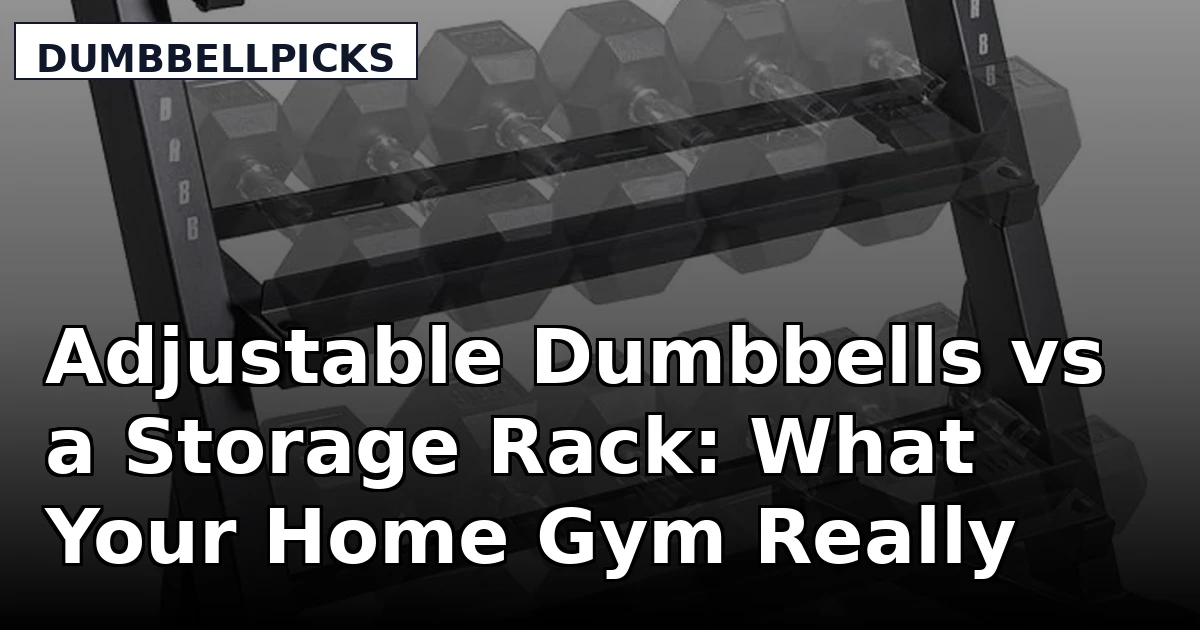
Buying an adjustable dumbbell set for home gym training is really three purchases wearing one receipt. You are buying a mechanism that has to change weight hundreds of times without jamming, a handle you have to grip when your forearms are already cooked, and a place for the plates to live when the set is not in your hands. Most people research the first one, ignore the second, and forget the third entirely, then wonder why the spare room floor looks like a scrap yard by March.
I have spent twelve years coaching lifters out of garages and small commercial spaces, and the pattern is always the same. The set is usually fine. The storage is usually the problem. This breakdown covers four options that solve different parts of that problem: two dial adjustable pairs, one connector based set that changes shape as well as weight, and one rack that keeps everything off the floor.
Related: How to Store Home Gym Weights Without Wrecking the Floor →
Quick answer
The short version: the ALTLER 25/52LB dial set is the adjustable dumbbell set for home gym use that most people should look at first, because a dial selector and a tray cover the widest spread of everyday lifts with the fewest parts to manage between sets. The 20/30/40/60/80lb connector set is the one to look at if you want your weights to change shape, not just weight. The Marcy organizer rack is the purchase to make if you already own fixed dumbbells, kettlebells, or loose plates and you are tired of stepping over them. Two ALTLER listings appear below because the same set shows up twice; check both before you buy. No listing tells you how a selector feels after a year of use, so treat any spec sheet as a starting point rather than a verdict.
Four useful options
| Model | Best fit | What stands out |
|---|---|---|
| ALTLER Adjustable Dumbbell Set, 25/52LB Pair with Tray | One pair that covers most pressing, rowing, and curling | Dial weight selection, 25 to 52 lb per dumbbell, tray included, anti-slip handle |
| Adjustable Dumbbells, 20/30/40/60/80lbs Free Weight Set with Connector | Training in several shapes from a single purchase | Connector allows barbell, kettlebell, and push-up stand configurations |
| ALTLER Adjustable Dumbbell Set, 25/52LB Pair with Tray (second listing) | Buyers comparing the two ALTLER listings | Same stated set and stated features as the first ALTLER listing |
| Marcy Weight Storage Organizer Racks | Keeping fixed dumbbells, kettlebells, and plates organized | Rack built for dumbbells, kettlebells, and weight plates |
The dial pair: ALTLER Adjustable Dumbbell Set, 25/52LB Pair with Tray
Here is the trade-off with any dial set. You get speed and a clean footprint, and you give up the right to treat the dumbbell like a chunk of iron. A dial mechanism is a precision part. It does not want to be dropped from waist height onto a garage slab, and it does not want chalk dust packed into the selector channel. If your training style ends with the weights falling out of your hands, this is the wrong category for you, and a rubber hex fixed set is the honest answer.
If you set them down under control and keep the tray where it belongs, the dial is the fastest way to move between weights inside a superset. The anti-slip handle deserves more attention than the weight range, because the handle is the part you actually touch on every rep. A smooth handle and a 52 lb plate is a worse training tool than a good handle and 35.
The shape changer: Adjustable Dumbbells, 20/30/40/60/80lbs Free Weight Set with Connector
The connector is the interesting part of this set, and also the part to inspect. A connector joins two dumbbells into a barbell, which means the load now travels through a joint rather than through a single handle. That is fine for pressing and rowing at moderate weight, and it is a genuinely useful way to get a barbell movement out of a set that stores under a bed.
The trade-off is time and attention. Every configuration change is another chance for a collar to be a quarter turn loose, and a loose collar mid-set is how plates end up on your foot. Check the connection before every set, not after the first rep. Sets like this are also sold in several weight tiers, so the 20 lb version and the 80 lb version are not the same purchase even though they share a listing page. Buy the tier that matches the lift you plan to train, not the number that sounds impressive.
The second listing: ALTLER Adjustable Dumbbell Set, 25/52LB Pair with Tray
Two listings, one set. The name, the stated range, and the stated features match the first ALTLER entry exactly, but the record carries a different identifier and a different listed price. That happens constantly with imported fitness gear: the same set gets listed more than once, and the price, shipping, and return terms can differ even when the product does not.
The practical move is to open both listings, compare what each page says is actually in the box, and buy from the one you can verify. Do not assume a lower number means a smaller or lighter set. It usually means a different seller.
The storage anchor: Marcy Weight Storage Organizer Racks for Dumbbells, Kettlebells, Weight Plates
A rack is the least exciting purchase in this article and the one that most changes how a room feels. Loose dumbbells on the floor are a trip hazard, a shin hazard, and the reason your plates end up kicked under a shelf. A rack gives every implement a home at a fixed height, which means you pick up and put down in the same place every set, and your setup time drops.
Two things to check before you commit. First, the footprint, because a rack that does not fit the wall you had in mind is a rack in the middle of the room. Second, the load path, because a rack loaded unevenly or placed on a sloped slab is a rack that wants to tip. Put it on the most level patch of floor you have, and load the heaviest items low.
Prices and availability may change. Product images, names, and retailer links must be matched by verified ASIN. Do not state a current price, rating, stock status, or measured result without current evidence.
How an adjustable mechanism actually earns its keep
A dial adjustable dumbbell is a stack of plates sitting in a cradle, with a selector that reaches through the stack and grabs only the plates you asked for. Turn the dial, and a pin or a link engages a different combination. Pick the dumbbell up, and the plates you did not select stay behind in the tray. That is the whole trick, and it is also the whole vulnerability.
Everything depends on the selector lining up with the plate it is supposed to hold, every single time, including the time you are rushing because your rest timer is running. Dust, chalk, and a tray that has been kicked half an inch out of position are the three things that turn a smooth dial into a jam. A mechanism that takes two seconds when the tray is square can take twenty when it is not.
The connector based set solves a different problem. Instead of hiding plates in a cradle, it uses plates you add and remove, which means the failure point is the collar or clamp rather than a selector. Threaded collars loosen. Clamps wear. Both give you warning signs if you are paying attention, and both are cheap to replace when they finally give out.
What none of these mechanisms give you is the feel of a solid fixed dumbbell. A dial set is a compromise that buys you a whole rack of weights in two square feet. The question is not whether it compromises, because it does. The question is whether it compromises on something you care about.
Handles, knurling, and the part your hands remember
Run your hand down a handle and you learn more about a dumbbell than any spec sheet will tell you. Knurling is the textured grip pattern cut into the handle, and it comes in two broad flavors: diamond and straight. Diamond bites harder and holds chalk better. Straight is gentler on the skin and more forgiving on high rep work. Neither is automatically right. It depends on how much you sweat and how many sets you plan to do.
Too smooth and you are fighting grip on every row. Too sharp and you are bleeding through your calluses by week three. The middle ground is a handle that feels almost aggressive dry and stops feeling aggressive the moment you start working. Adjustable sets often use a coated handle rather than a cut knurl, which is easier on the hands but holds less chalk. That is a real difference, and it is the difference you notice on your tenth set of farmer carries.
Handle diameter matters too. A thicker handle turns any pull into a grip exercise, which is useful until it is not. A thinner handle lets you load more weight on the movement you actually came to train. If you have small hands, a thick coated handle on a wide dumbbell is a bad combination, and no amount of weight range fixes it.
A few more things worth knowing before you buy:
- Measure the space first, including the swing room you need to press overhead.
- Decide whether you want one pair that does everything or several shapes from one set of plates.
- Match the mechanism to your training style: dial for speed, plates and collars for durability, fixed sets for abuse.
- Budget for storage in the same purchase, because loose weight migrates to the worst possible spot.
- Confirm what the listing says is in the box, especially when the same set appears twice.
Setting up a small home gym without wasting money
- Put the rack or tray in its final position before you unbox anything, and make sure that spot is level.
- Keep chalk away from selector channels and tray rails, because chalk plus a precision mechanism is a maintenance bill.
- Set dial dumbbells down under control. They are not built to be dropped, and the tray is not a landing pad.
- Check collars and connectors before every working set, not once at the start of the session.
- Buy the weight tier that matches the movement you actually train, then add plates or a second pair later.
Which option should you choose?
Choose the ALTLER Adjustable Dumbbell Set, 25/52LB Pair with Tray when you want one pair that covers pressing, rowing, and curling with a fast dial change and a tray that keeps the plates contained. Choose the Adjustable Dumbbells, 20/30/40/60/80lbs Free Weight Set with Connector when you want the same purchase to give you a barbell, kettlebell, and push-up stand configuration as well as dumbbells. Choose the Marcy Weight Storage Organizer Racks for Dumbbells, Kettlebells, Weight Plates when the weights you already own are living on the floor and the room has stopped working. If you are comparing the two ALTLER entries, treat them as one product with two listings and pick the one whose page tells you clearly what arrives.
A caveat worth repeating: nothing here substitutes for putting your hands on the handle and cycling the mechanism yourself. Grip feel, selector smoothness, and how a set sits in your space are personal, and no listing page can answer them for you. If a set arrives and the mechanism binds out of the box, that is a return, not a project.
The bottom line
The dumbbell is the tool, and the rep quality is the workout, but the tool still has to survive your garage. A dial adjustable pair like the ALTLER 25/52LB set buys you range and speed in a footprint that fits a closet, as long as you are honest about not dropping it. A connector based set like the 20/30/40/60/80lb option buys you shapes instead of speed, and asks for collar discipline in return. A rack like the Marcy organizer buys you neither, and it is the purchase that keeps the other two usable.
Start with the mechanism you will actually maintain, add storage in the same order, and skip the weight range you will not touch for two years.