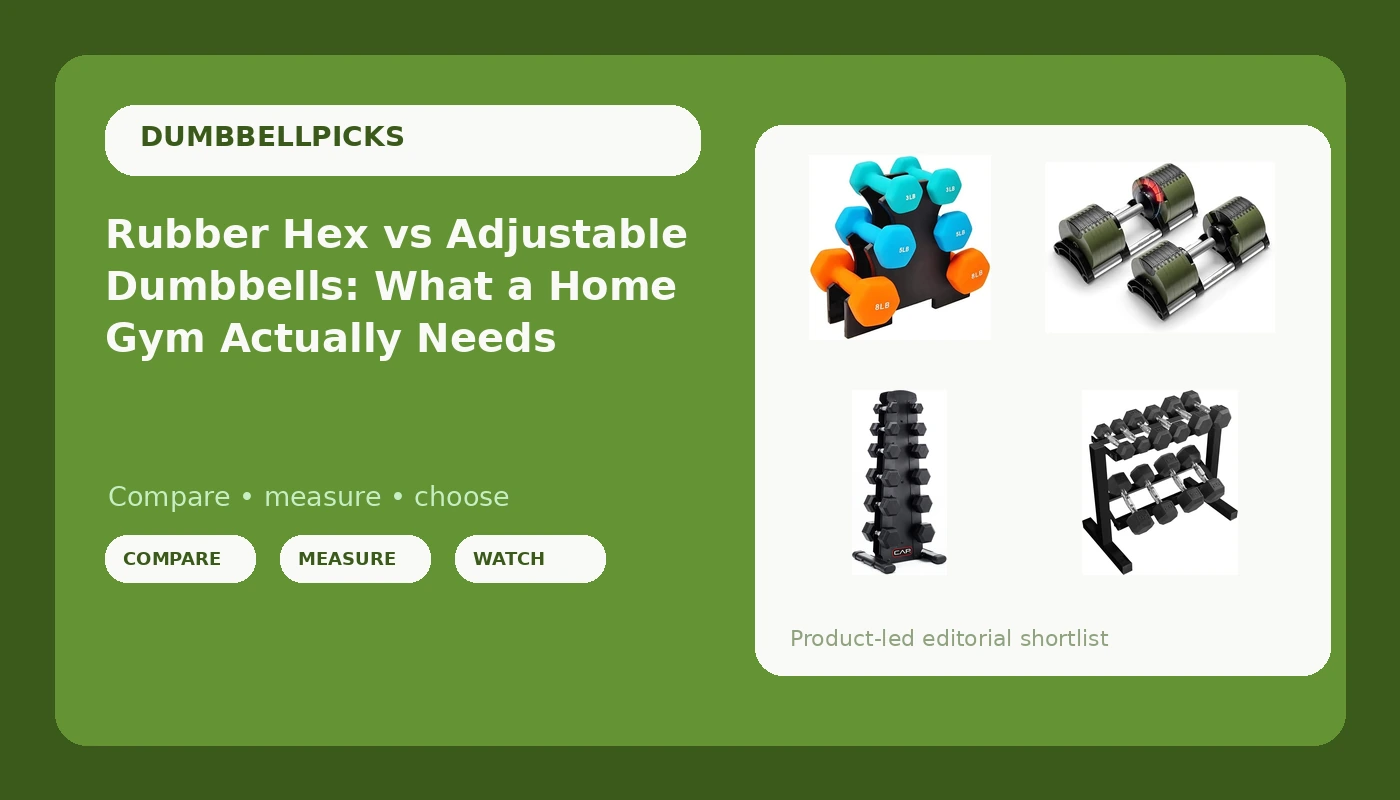
Buying dumbbells for a home gym is rarely a weight problem. It is a shape, storage, and mechanism problem. Most lifters start by picking a number and only later realize the number was the easy part. A 5 to 80 lb adjustable pair, a 150 lb rubber hex set with a rack, and a light neoprene set with a stand all promise the same thing on a product page and all behave completely differently once they are living on your floor. The real question behind most home gym dumbbell sets is not how much iron you can afford. It is whether you want one pair that changes weight, or a fixed set that never changes and never asks anything of you.
Related: How to Program a Garage Gym Around One Pair of Dumbbells →
Quick answer
There are two sensible paths, and they are genuinely different purchases. A quick-change adjustable pair covers a wide weight range in the footprint of a single set, which makes it the practical answer for small spaces and full-body programming. A fixed rubber hex set with a rack covers a narrower range per pair but gives you grab-and-go loading, no mechanism to learn, and nothing to fiddle with between sets. Light neoprene sets are a third category: useful for warm-ups, rehab, and true beginners, but not a way to load heavy compound work. Pick the path that matches how you train, then pick the specific set inside that path.
Four useful options
| Model | Best fit | What stands out |
|---|---|---|
| Nuobell 580 Adjustable Dumbbells, 5-80 lb, Set of 2 Free Weights | Small spaces, full-body programming | Adjustable from 5 to 80 lb per dumbbell in one pair |
| Fitvids Set of 6 Neoprene Dumbbell Hand Weights, Set with Rack: 3/5/8 Pairs | Warm-ups, rehab, beginners | Six dumbbells in three light pairs, rack included |
| CAP 150 LB Dumbbell Set with 2-Tier Rack, Rubber Hex Free Weights Set | A fixed set with low, easy storage | Rubber hex heads on a two-tier horizontal rack |
| CAP Rubber Coated Dumbbell Weight Set with Vertical Rack | Heavier fixed sets in a tight footprint | 100, 150, and 210 lb options on a vertical rack |
The adjustable option: Nuobell 580 Adjustable Dumbbells, 5-80 lb, Set of 2 Free Weights
An adjustable pair earns its place by solving two problems at once: floor space and weight range. A 5 to 80 lb pair replaces a rack that would otherwise take up a wall. The trade-off is the mechanism. Every adjustable dumbbell puts a moving interface between your hand and the weight, and that interface is the part that decides whether you still like the set in year three. The things to watch are how the change feels under load, whether chalk or garage dust gets into the mechanism, and whether the plates lock tight enough that nothing shifts mid-set. Adjustables also ask you not to drop them. If your training style involves dumping a pair at the end of a set, a fixed set is the honest answer.
The light starter set: Fitvids Set of 6 Neoprene Dumbbell Hand Weights, Set with Rack: 3/5/8 Pairs
This is the set people buy for someone else, or for a specific job: warm-up circuits, rotator cuff work, high-rep shoulder and hip work, and the first few months of a beginner's program. It is also what a lot of older clients should start with, because the jump from nothing to a 15 lb dumbbell is bigger than it looks. What it is not is a loading tool. Eight pounds is not a working weight for a row, a press, or a goblet squat for very long. If you buy this set, buy it knowing it is a complement to something heavier, not a replacement. The included rack is a bigger deal than it sounds, because loose light dumbbells migrate across a garage floor and end up under a car.
The mid-size fixed set: CAP 150 LB Dumbbell Set with 2-Tier Rack, Rubber Hex Free Weights Set
A fixed set like this is the opposite philosophy from an adjustable pair: fewer weights, no mechanism, no decisions. You walk over, pick up the pair you need, and train. That simplicity is worth real money if you train in short sessions or lift early in the morning, because there is nothing between you and the first set. The 150 lb total matters, but the individual pair sizes matter more. Check what the set actually contains before you commit, because a 150 lb set built from small jumps is more useful than the same total weight in a few large pairs. The horizontal rack is a deliberate design choice: it takes more floor length than a vertical rack but keeps the lighter pairs at arm height, which is friendlier for warm-ups and for anyone who does not want to bend to the floor between sets.
The heavier fixed set: CAP Rubber Coated Dumbbell Weight Set with Vertical Rack
This is the set for someone who has already decided that fixed dumbbells are the plan and needs the heaviest option that still fits a garage. The 210 lb configuration is the one that supports real pressing and rowing progress for a long stretch, while the 100 lb version makes more sense for a lighter training style or a shared household. Vertical racks are efficient, but they change how you use the set: you are pulling weights up and out rather than bending over a low shelf. That is easier on the back and harder on nothing, as long as the rack is stable and the dumbbells seat properly. Check that the rack does not tip when the heaviest pairs come out, and check that the heads sit flat rather than resting on a rounded edge. Rubber coating is the standard for a reason: it protects a concrete floor and takes the edge off the noise, which matters if anyone sleeps above your gym.
Prices and availability may change. Product images, names, and retailer links are matched to verified listings. No current price, rating, stock status, or measured result is stated here without current evidence.
How an adjustable mechanism actually fails
The mechanism is the whole product. A dumbbell that changes weight has to hold that weight through a rep, and the failure modes are predictable. The first is contamination. Chalk dust, garage grit, and rust particles get into the interface and the change gets stiff, then sticky, then unreliable. If you use chalk, that clock starts earlier. The second is plastic fatigue. Any part of the change system made from plastic will eventually wear at the contact points, and the symptom is a weight that no longer seats with a clean click. The third is misuse. Adjustable dumbbells are not designed to be dropped, and a drop loads the mechanism in a direction it was never built to take.
What you can control is how you treat it. Set the dumbbell down rather than dropping it. Change weight on the rack or on the floor, not in mid-air. Keep the mechanism clean and dry. And before you buy, think about how many changes a week you will actually make. A lifter running a program with five different working weights across four sessions is making a lot of changes, and every one of them is a small test of the mechanism. That is the number that matters, not the maximum weight on the label.
Why hex heads and a rack matter more than the finish
Round dumbbells roll. That single fact is why hex heads became the home gym standard. A hex head set down on a floor stays where you put it, which means you are not chasing a dumbbell across the garage with your hands full. It also means a dropped pair tends to stop rather than travel, which is safer around cars, kids, and bare feet.
The rack is the other half of the decision, and it gets less attention than it deserves. A rack does three things: it keeps the set organized, it keeps weights off a cold floor, and it decides how much room the set claims in your space. Horizontal racks are easier to load and unload and better for lighter pairs. Vertical racks store far more weight in the same square footage but ask you to lift each pair up and out. Either way, the question to ask is whether the rack is stable when the heaviest pairs are removed, because a top-heavy rack with two heavy dumbbells left on one side is a tipping hazard.
Then there is the part you cannot see. Plates should not wobble. If a head shifts or clicks against its handle when you set it down, the connection between the two is not tight, and that looseness will show up as noise, rattle, and eventually a head that works free. Run a hand along the handle too. A knurl that is purely cosmetic gives you nothing once your hands get sweaty, and a knurl that is too sharp will tear calluses on high-rep sets.
- Write down the heaviest weight you will actually press, row, or carry for working sets, not the heaviest you might touch once.
- Measure your available floor space, including the space the rack needs and the clearance to pull dumbbells out of it.
- Choose adjustable or fixed based on whether you drop weights and whether you want to change weight mid-session.
- Check the pair sizes in any fixed set, since the spread between pairs matters more than the total weight number.
- Plan the upgrade path now, because most people outgrow a starter set before they outgrow the habit.
Practical guidance before you buy
- Match the set to the lift. Light neoprene pairs are for warm-ups, rehab, and beginners. Fixed and adjustable sets are for loading.
- Weigh the mechanism against your habits. If you drop dumbbells at the end of a set, buy fixed. If you need range in a small space, buy adjustable and treat it carefully.
- Count your changes per week, not your maximum weight. The mechanism wears on the change, not on the label.
- Look at rack footprint and stability first. A set that stores badly will end up on the floor, and a rack that tips is worse than no rack.
- Check handle texture and head tightness on anything you can see in person, and read closely if you are buying online.
- Leave room to grow. A set that covers your next twelve months of training is worth more than one that fits only today's numbers.
Which option should you choose?
Choose the Nuobell 580 Adjustable Dumbbells, 5-80 lb, Set of 2 Free Weights when space is tight and you need one pair to cover everything from warm-up sets to heavy work. Choose the Fitvids Set of 6 Neoprene Dumbbell Hand Weights, Set with Rack: 3/5/8 Pairs when you need light weights for warm-ups, rehab, or a beginner who is starting from scratch. Choose the CAP 150 LB Dumbbell Set with 2-Tier Rack, Rubber Hex Free Weights Set when you want fixed weights at an easy reach and do not mind a longer rack footprint. Choose the CAP Rubber Coated Dumbbell Weight Set with Vertical Rack when you want a heavier fixed set and need it to store in a narrow strip of floor.
One caveat applies to all four: the useful information lives in the details of the listing, not in the headline weight. Pair sizes, rack dimensions, handle finish, and what the coating is made of all change how a set feels after a month. Nothing here should be read as a claim about how any of these specific sets performed in a gym, because the honest version of that answer takes a full training block and a lot of changes.
The bottom line
There is no single right answer, only a right answer for your floor and your program. Adjustable dumbbells trade mechanism risk for range and space, and they reward careful handling. Fixed rubber hex sets trade range for simplicity, durability, and the ability to drop a weight without ruining it. Light neoprene sets fill a specific, useful role at the bottom of the weight range and should never be asked to do more than that. Decide which of those three jobs you are hiring for, check the rack and the pair sizes in the listing, and buy the set that fits the training you will still be doing next year.