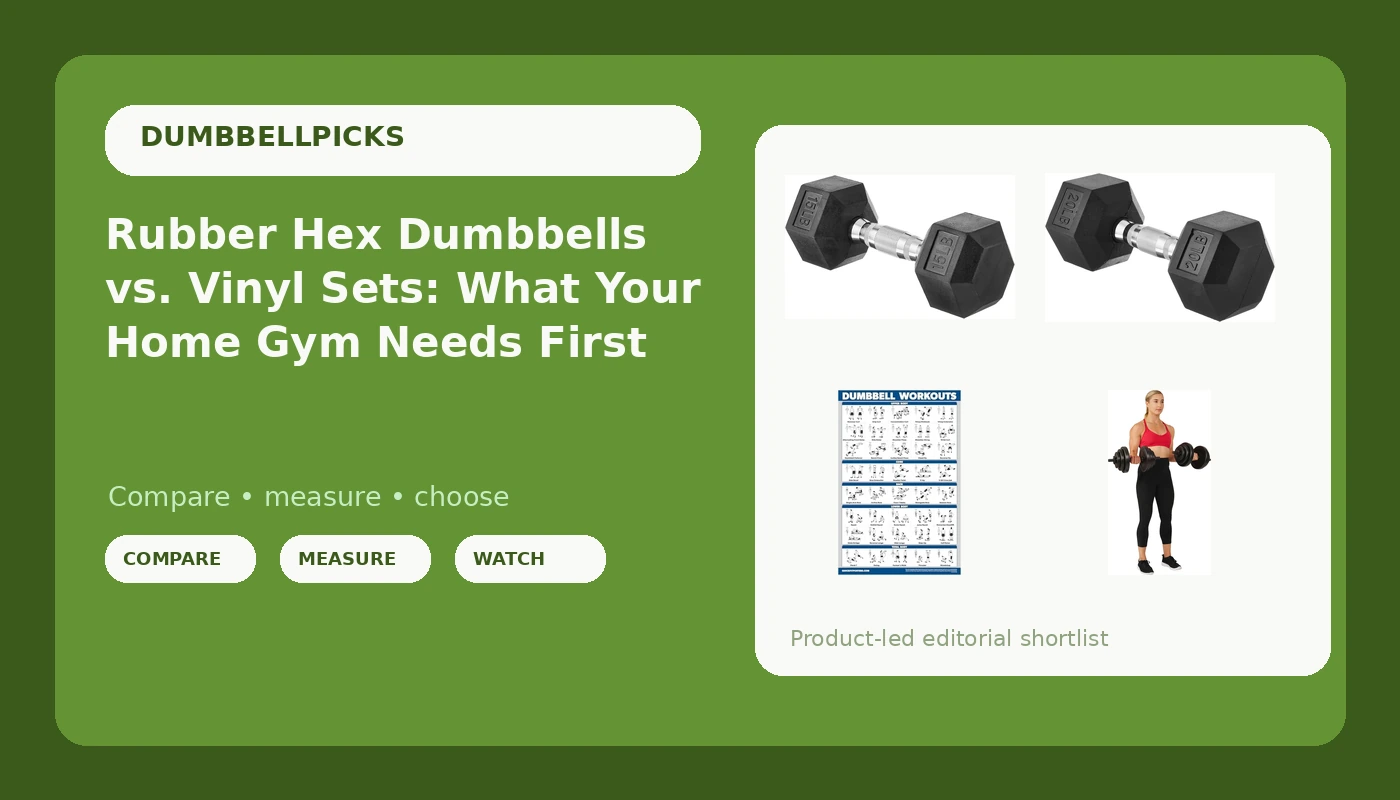
Most home gyms get built in the wrong order. The rack shows up before the floor is protected, a big weight set shows up before anyone knows which loads they actually train with, and the dumbbell, the piece of equipment that gets touched every session, gets chosen last. Rubber hex dumbbells solve the two problems that annoy home lifters most: heads that roll across the garage floor when you set them down, and bare metal that chews up whatever is underneath. Not every lifter needs the same format, though. A fixed single, a coated starter set, and a printed training chart do different jobs, and buying the wrong one first is how a garage ends up full of equipment nobody touches. This guide sorts out what each of the four options is actually for.
Related: How to Pick Adjustable Dumbbells Without Regret →
Quick answer
For a first home strength setup, a fixed rubber hex dumbbell is the most practical single purchase: the hex head keeps it from rolling, and the rubber coating is kinder to floors than bare metal. Buy the size that matches the weight you train with, not the heaviest one you can move once. A vinyl-coated set makes sense when the training is light, high-rep, and shared with other people in the house. A laminated workout chart is a programming aid rather than equipment, and it earns its place only if you already own weights and keep guessing what to do with them.
Four useful options
| Model | Best fit | What stands out |
|---|---|---|
| Amazon Basics Rubber Hex Dumbbell Hand Weight | A single fixed weight for the lift you do most often | Rubber-coated hex head in the standard home gym shape |
| Amazon Basics Rubber Hex Dumbbell Hand Weight, second listing in the same line | The next weight step above your first single | Sold as an individual weight, so you pick the load |
| Sunny Health & Fitness Exercise Vinyl 40 Lb Dumbbell Set | Light, high-rep work and shared household use | A complete 40 lb set with vinyl-coated heads |
| Palace Learning Dumbbell Workout Exercise Poster | Lifters who own weights but need a plan | Laminated 18" x 24" chart built around free weight training |
Fixed hex dumbbell, listing one: Amazon Basics Rubber Hex Dumbbell Hand Weight
A fixed dumbbell is the least complicated piece of strength equipment you can own. There is no mechanism to jam, no dial to misread, and nothing to adjust between sets. The trade-offs are cost and storage. Rubber hex singles are usually priced by weight, and once you own six or seven of them you need somewhere to put them, because a floor pile of hex heads is still a trip hazard even when the heads themselves do not roll. If your training only ever uses two or three loads, buying singles is efficient. If you need a different weight on every set, a fixed collection gets expensive quickly and an adjustable set starts to make more sense.
Fixed hex dumbbell, listing two: Amazon Basics Rubber Hex Dumbbell Hand Weight
There are two Amazon Basics listings in this guide because the line is sold as individual hand weights rather than as a packaged set, and each listing covers a different weight option. That matters more than it sounds. A set forces you to accept the weights the manufacturer chose, including the ones you will never touch. Buying singles lets you build the ladder you actually use: a working weight, one step up for heavy sets, one step down for warm-ups and drop work. The downside is that singles are easy to buy impulsively, one at a time, until you have spent more than a set would have cost. Decide your three or four key loads first, then buy toward them.
Light starter set: Sunny Health & Fitness Exercise Vinyl 40 Lb Dumbbell Set
A vinyl-coated set is the format most beginners meet first, and it is not a bad place to start. The coating is smooth, the heads are usually round or lightly shaped, and the set arrives as a matched group, which means no hunting for the missing weight mid-session. The limits show up later. Vinyl is a softer surface than rubber, and it is happiest on light, controlled work: higher-rep sets, arm work, step-ups, and anything where the weight goes down gently. If your training involves heavy pressing, rows, or anything you might set down hard, a rubber-coated dumbbell will hold up better over the years. In a household where the weights get shared, though, a matched set with clear weights is easier to manage than a pile of mismatched singles.
Programming aid: Palace Learning Dumbbell Workout Exercise Poster
A chart is not a dumbbell, and it should not be bought in place of one. What a laminated poster does well is remove the blank-page problem. If you own a couple of fixed weights and keep defaulting to the same three exercises, a printed dumbbell routine gives you structure to follow and a way to see which movements you have covered. Lamination matters in a garage, where humidity and handprints destroy paper quickly. The trade-off is that a printed chart cannot adapt. It will not progress your loads, and it cannot know that your left shoulder feels different this week. Treat it as a starting template, not a coach.
Prices and availability may change. Product images, names, and retailer links are matched to verified listings. No current price, rating, stock status, or measured result is stated here without current evidence.
Why hex heads and rubber coatings matter more than brand
The head shape decides how the dumbbell lives in your space. Round heads roll, and a rolling 40 rolls into whatever is on the garage floor, including your foot. Hex heads have flat faces, so they sit still when you set them down between sets or park them on a rack. That single geometry choice is why rubber hex became the default in home gyms, and why it shows up in commercial floors too.
The coating decides how the dumbbell treats everything around it. Bare steel or chrome on cast iron will chip concrete, dent hardwood, and announce every rep to the rest of the house. Rubber is the middle ground: quieter, grippier against a floor, and forgiving when a weight comes down harder than you planned. Vinyl sits on the softer end, pleasant for light work but less tolerant of abuse. Urethane sits at the premium end and is priced accordingly.
Two details are worth checking on any dumbbell before you commit to a full set. First, the handle. Run your eye down the shaft in the listing photos and look for actual texture rather than a decorative pattern; a smooth handle turns a heavy set into a grip contest, and a sharply cut one can tear calluses. Second, the plates and welds. A head that rotates or clicks against the handle means the assembly is loose, and a loose head only gets looser with drops. A dumbbell that rattles at rep five is a dumbbell you stop trusting at rep fifty.
Five decisions that set your home dumbbell setup
Work through these in order and the shopping list mostly writes itself.
- Find your real working weight. Not your one-rep maximum, the load you can control for eight to twelve clean reps on a press or a row. That number anchors everything else.
- Decide fixed or adjustable. Fixed singles are simpler and tougher; adjustables cover more loads in less space but add a mechanism that can wear. If you train two or three loads, go fixed. If you need ten, go adjustable.
- Decide singles or a set. Singles let you build the exact ladder you use. A set gets you a matched group at a lower cost per pound, with weights you may never touch. Match the format to your training, not to the sale banner.
- Pick the coating by your floor and your neighbors. Concrete slab and a detached garage: rubber is plenty. Apartment with downstairs neighbors: quieter surfaces and controlled reps matter more than anything printed on the box.
- Plan the increments before the heavy weights. Most home lifters get more use out of the step below their working weight than the step above it. Warm-ups and drop sets live there.
What to do before you add anything to the cart
- Measure the space and the storage. A dumbbell you have to step over is a dumbbell you will stop using, and hex heads only solve rolling, not clutter.
- Check whether a number refers to the whole set or to one dumbbell. A 40 lb set and a 40 lb dumbbell are very different purchases.
- Confirm whether you are buying a single or a pair. Two listings that look identical in a search result can differ on this.
- Budget for the floor as well as the iron. A rubber mat costs less than refinishing a garage floor or replacing a dropped weight.
- Write your first four weeks of training before you buy. If the plan only needs two weights, buy two. If it needs six, you have learned something useful before spending.
Which option should you choose?
Choose the Amazon Basics Rubber Hex Dumbbell Hand Weight (the first listing) when you want one dependable fixed weight for your most-used lift and you would rather buy exactly the load you need. Choose the second listing in the same line when your working weight is covered and you need the next step up for heavy sets or the step down for warm-ups. Choose the Sunny Health & Fitness Exercise Vinyl 40 Lb Dumbbell Set when the training is light, the reps are high, and more than one person in the house will use the weights. Choose the Palace Learning Dumbbell Workout Exercise Poster when you already own weights and the missing piece is a plan you can read from the bench.
Nothing here replaces handling a dumbbell before you commit to a full set. Handle diameter, surface texture, and how a coating feels in a sweaty hand vary between lines, and those are the details that decide whether you reach for a weight or avoid it. Buy one, train with it for a few weeks, and let that experience set the standard for everything you add afterward.
The bottom line
A home gym does not need a wall of weights. It needs one or two fixed dumbbells you genuinely train with, a coating that protects the floor underneath them, and a plan for what to do with them. Rubber hex dumbbells cover the first two requirements at a reasonable cost per pound, and a laminated chart covers the third for less than most people spend on a single accessory. Start with the load you use most, add the next step once the first one gets easy, and let the collection grow out of your training rather than out of a sale. Check current Amazon price and availability on each listing before you buy, since both change.