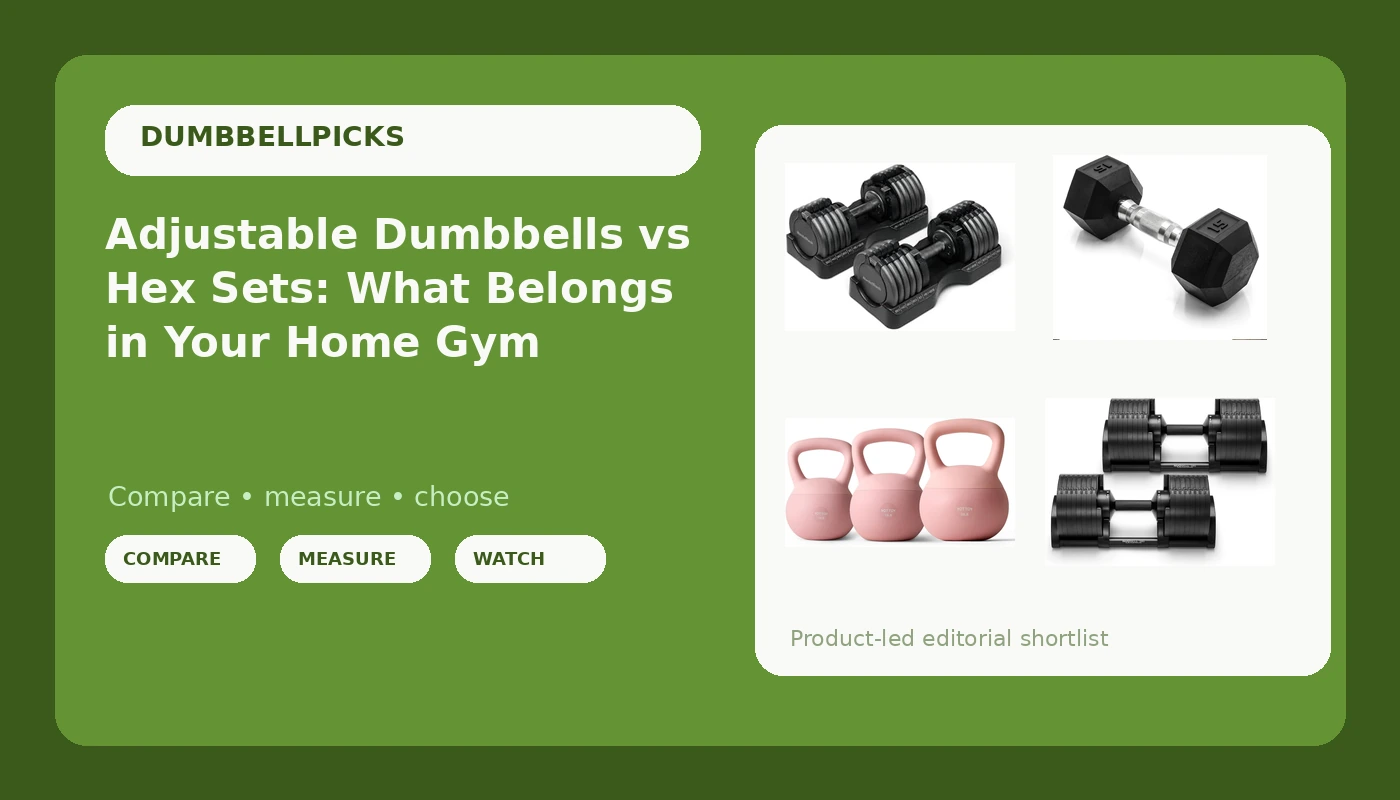
Buying home gym dumbbells is really two decisions stacked on top of each other: how the weight gets into your hands, and how much floor space you are willing to surrender to it. A single adjustable pair can stand in for a rack of fixed weights. A set of rubber hex heads never asks you to trust a mechanism. A kettlebell loads the body in a way neither of them can. The frustrating part is that the marketing for all three sounds identical, while the details that decide whether you still like the equipment in two years, things like grip texture, head shape, and how the weight actually changes, sit buried in the fine print.
Related: Why Your Adjustable Dumbbells Rattle Mid-Set →
Quick answer
There is no universal winner, because the right tool depends on the lift. If you want one pair that covers a wide spread of loads in a small footprint, an adjustable set is the practical route, and the NÜOBELL set is the one built around an easy twist mechanism with a 5-50 LB or 5-80 LB configuration depending on the model you pick. If you would rather not depend on a mechanism at all, rubber coated hex dumbbells in the weights you actually use give you a dumbbell with no moving parts to fail. And if your training includes swings, carries, or single-arm pressing, a kettlebell covers ground a dumbbell cannot. Match the tool to the movement first, then to the space you have.
Four useful options
| Model | Best fit | What stands out |
|---|---|---|
| NordicTrack Select-a-Weight Adjustable Dumbbells | Replacing a rack in a small room | Adjustable pair that selects weight instead of loading loose plates |
| NÜOBELL Adjustable Dumbbell Set | Lifters who change loads every set | Easy twist adjustment, sold as a pair, offered in 5-50 LB or 5-80 LB |
| CAP Rubber Coated Hex Dumbbells | Building a fixed set over time | Anti-roll hex heads, rubber coating, chrome comfort grip handles, sold as singles |
| YOTTOY Soft Kettlebell | Swings, carries, single-arm work | Soft-shell kettlebell with an anti-slip grip, offered as a set |
The space-saving adjustable: NordicTrack Select-a-Weight Adjustable Dumbbells
The trade-off with any adjustable is that the mechanism becomes the part you depend on. It is also the part that wears, collects chalk dust, and decides whether the set feels solid in year three. Adjustables are not built to be dropped the way a rubber hex dumbbell is, so if your training style involves setting weights down hard, that matters more than the weight range printed on the box.
The quick-change adjustable: NÜOBELL® Adjustable Dumbbell Set
The twist mechanism is the whole story here. A smooth dial that indexes cleanly is worth more than a wider weight range, because you will change weights dozens of times per session and the mechanism is what you touch every time. The heavier configuration costs more and takes up more space, so only pay for the top end of the range if you genuinely press, row, or hinge at those loads. Keep chalk and grit out of the mechanism and it stays consistent far longer.
The fixed-set workhorse: CAP Rubber Coated Hex Dumbbells
Because these are singles, building a matched pair means buying two, and a full run of weights adds up fast. The upside is that you buy only the loads you actually train with instead of paying for a range you will never touch. Fixed heads also let you set the dumbbells down between sets without worrying about a locking mechanism, which is why they remain the default in commercial gyms.
The kettlebell add-on: YOTTOY Soft Kettlebell
A soft kettlebell is a quiet, floor-friendly tool rather than a chalk-and-steel competition bell. The shell absorbs contact, which is useful in a garage or an apartment where a dropped bell would wake the house or crack a tile. If your training is built almost entirely around dumbbell pressing and rowing, this is an add-on, not a replacement.
Prices and availability may change. Product images, names, and retailer links must be matched by verified ASIN. Do not state a current price, rating, stock status, or measured result without current evidence.
How adjustable dumbbell mechanisms actually work
Every adjustable dumbbell answers one question: how does the handle decide which plates come with it? The common designs use a dial you rotate, a selector you slide, or a twist collar that locks plates onto the handle. Each of those designs puts a moving part between your hand and the load, and that part is what fails first.
That matters because the mechanism is the one component you cannot inspect from a product photo. What you can judge is how the change feels: whether it indexes to a definite stop, whether it moves with one hand, and whether it needs a firm grip or a delicate touch. A mechanism that needs both hands and a wiggle to change is a mechanism you will stop using by week three.
The other failure mode is contamination. Chalk, dust, and skin oil work into the gaps where the plates meet the handle. When that happens, the selection can feel vague or the plates can shift mid-set. This is also why adjustable sets should not be dropped. A rubber hex dumbbell absorbs that impact with a solid head. An adjustable absorbs it with a mechanism, and mechanisms are not built for it.
Finally, think about the range you actually need. A wide range is only useful if you train at both ends of it. If your working sets live between 20 and 40 pounds, paying for a set that climbs to 80 buys space and cost you will not recover.
Hex heads, rubber coating, and grip texture
Head shape is the most underrated detail in a home gym. Round heads roll. That sounds trivial until a 40 pound dumbbell rolls off a bench or across a garage floor while you are mid-set. Hex heads have flat faces, so they sit where you put them. That single property is why hex dumbbells became the standard for home training.
Rubber coating does two jobs. It protects the floor from steel, and it deadens the ring of metal on concrete. The trade-off is that rubber compound quality varies, and a low-grade coating can feel slick or carry an odor for a while after unboxing.
Grip texture is the part you feel every rep. Knurling is the crosshatched pattern cut into the handle. Too smooth and your hands slide as you fatigue. Too sharp and you lose skin on high-rep sets. Most home dumbbells sit in the middle, which is why the chrome comfort grip pattern on a fixed hex dumbbell is a reasonable compromise for mixed training.
Handle diameter matters too. A thicker handle is harder to hold, which is fine for grip work but tiring for pressing. If you have smaller hands, a fat handle turns a manageable weight into a grip test.
- Decide whether you want one adjustable pair or a fixed set, since that choice drives everything else.
- Count the loads you actually use in a normal week, then buy for that range rather than the widest range available.
- Handle the grip before committing. Texture, diameter, and knurling depth decide whether you enjoy the set.
- Check how the weight changes. If the mechanism needs two hands or a precise alignment, it will slow every set.
- Confirm head shape and coating match your floor and your training style, especially if you set weights down hard.
Practical guidance for a small home gym
- Put the heaviest, most-used pair at waist height so you are not lifting it off the floor between sets.
- Leave a clear zone around wherever you set dumbbells down, because a dropped weight rolls or slides further than you expect.
- Wipe adjustable handles and selection points regularly to keep chalk and dust out of the mechanism.
- If you train in an apartment or over a shared floor, a rubber coated head or a soft-shell kettlebell is the quieter choice.
- Buy fixed singles in the weights you use most and skip the ones you only touch once a month.
- If you are building a set over time, add pairs in the ranges you press and row first, then fill gaps later.
Which option should you choose?
Choose the NordicTrack Select-a-Weight Adjustable Dumbbells when you want a single pair that covers several loads in a small room. Choose the NÜOBELL® Adjustable Dumbbell Set when you change weights constantly and want a twist mechanism, and when your training actually reaches the top of the 5-50 LB or 5-80 LB range. Choose the CAP Rubber Coated Hex Dumbbells when you want no mechanism at all and would rather buy fixed weights as you go. Choose the YOTTOY Soft Kettlebell when your program includes swings, carries, or single-arm work, or when you need a quieter tool for a shared floor.
One caveat applies to all four: the right answer depends on your training, not on a spec sheet. Nothing here is a substitute for handling the equipment, and no weight range or grip pattern can tell you how a mechanism will feel in your hands after a hundred changes. Treat the features as filters, not as verdicts.
The bottom line
Adjustable dumbbells trade a mechanism for space, fixed hex dumbbells trade space for simplicity, and a kettlebell trades a conventional grip for a different loading pattern. If your room is small and your loads vary, an adjustable pair earns its footprint. If you want equipment that simply works every time you pick it up, a rubber coated hex set in the weights you actually use is the low-drama choice. And if your program includes swings and carries, a soft kettlebell covers work the other two cannot. Pick the tool that matches the lift, then let the space you have decide the rest.