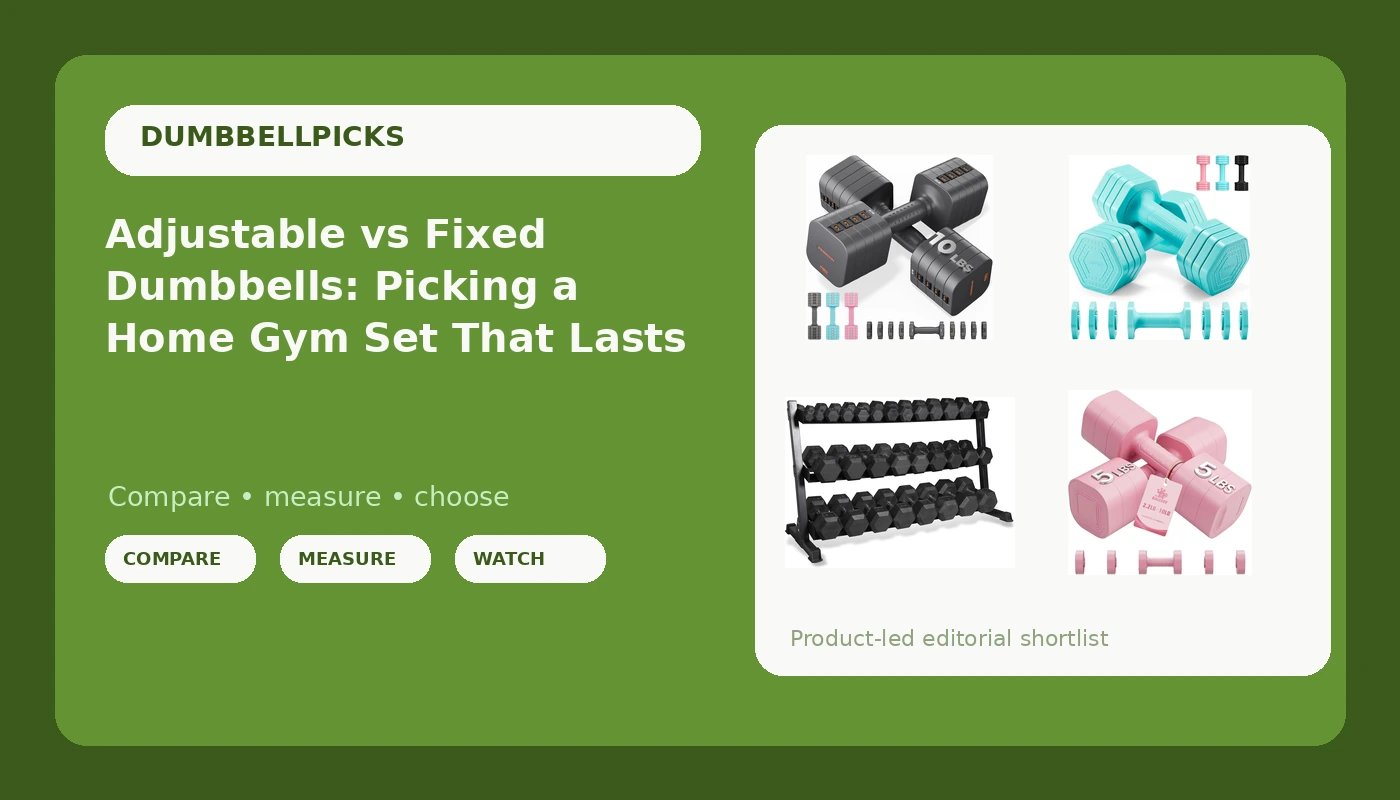
Most people shopping for an adjustable dumbbell set are solving a space problem, not a strength problem. There is a corner of a room, a budget, and a training plan that will change three times in the next two years. The set you buy today has to survive all three.
The confusion comes from how wide the category is. "Adjustable dumbbell" covers everything from a 2 pound toning pair to a rack of rubber hex iron that costs more than a used car. Those products are not really competing with each other. They are built for different jobs, and the job decides the purchase.
This explainer walks through four dumbbell setups that sit at very different points on that spectrum: a light 5-in-1 adjustable pair, a 4-in-1 set built around small increments, a budget pair sold for both men and women, and a full rubber hex set that ships with its own rack. The goal is not to rank them. It is to show you which one fits the training you will actually do, and which details to check before you spend anything.
Related: How to Build a Small Home Gym Without Losing Floor Space →
Quick answer
Buy for the heaviest set of 8 to 12 reps you expect to perform in the next two years, then check the locking mechanism and the storage footprint. If your ceiling is a 10 pound dumbbell, a small adjustable set with soft TPU handles is plenty. If you plan to press, row, and farmer carry heavy, a rubber hex fixed set with a rack is the setup that will not run out of weight. Everything between those two ends is a compromise on range, space, or cost, and you should decide which compromise you can live with before you compare listings.
Four useful options
| Model | Best fit | What stands out |
|---|---|---|
| FEIERDUN DB3 5-in-1 Adjustable Dumbbell Set | Light loads, quick changes, soft grip | 5-in-1 adjustment with dual locking and a TPU soft handle, sold as a 6LB/10LB pair |
| EQUIPRO Adjustable Dumbbell Set | Small hands and very small increments | 4-in-1 set covering 2lb, 3lb, 4lb, and 5lb with a TPU soft rubber handle |
| Ragebby Adjustable Dumbbell Set of 2 | A budget pair for a shared household | Sold as a pair of adjustable dumbbells for men and women training at home |
| CAP Rubber Hex Dumbbell Set with Rack | A permanent home gym that needs real weight | Rubber hex heads offered in 280LB, 550LB, and 1200LB sets with a horizontal 2 or 3 tier rack |
The all-round light adjustable: FEIERDUN DB3 5-in-1 Adjustable Dumbbell Set
The case for this set is simple: it is the middle of the light range, and the middle is where most home training actually happens. Lateral raises, rear delt work, curls, rotator cuff progressions, and the first month back after a layoff all live between 5 and 15 pounds per hand. A dual locking collar is also the direct answer to the oldest complaint about adjustable dumbbells, which is that spin collars back off mid-set. Two locking stages instead of one is a meaningful design choice, but it is not a guarantee. Locking hardware still has to be checked before every set, and any collar that threads onto a sleeve can collect chalk and grit over time. The trade-off here is the ceiling. A light adjustable pair is a tool for a specific band of loading, and if you outgrow that band you will be buying a second set.
The lightest entry point: EQUIPRO Adjustable Dumbbell Set
Small increments are underrated, and this is the set that delivers them. If you have ever tried to move from 5 pounds to 10 pounds on a shoulder exercise and felt the joint complain, you understand why 2, 3, 4, 5 matters. The progression is smoother and the shoulder tolerates it. The honest trade-off is the load ceiling. A 5 pound maximum per hand covers rehabilitation, mobility, and high rep conditioning, and it does not cover pressing, rowing, or anything a lifter would call a working set. That is not a flaw, it is the design brief. Buy this if your goal for the next six months is range of motion and consistency, not strength. If you want one set that grows with you, look further up the range.
The budget pair: Ragebby Adjustable Dumbbell Set of 2
The appeal of a budget pair is straightforward. Two adjustable dumbbells in one purchase, no mismatched singles, no waiting for a second order to arrive. For a shared household where one person wants lighter work and another wants heavier, an adjustable pair covers more ground than a fixed pair at the same spend, because the plates can be redistributed. What you give up at this price point is certainty about the details. The listing does not spell out a weight range, plate material, or collar type, so the configuration needs to be confirmed on the product page before you commit. Check what plates ship in the box, what the handle diameter is, and whether the collars have a positive lock. If those answers are not on the page, ask before you buy.
The long-term fixed set: CAP Rubber Hex Dumbbell Set with Rack
This is the opposite philosophy from everything above. There is no mechanism, so there is nothing to jam, nothing to re-tighten, and nothing to fail at 6 AM when a client is mid-set. The plates are what they are, and the set either has the weight you need or it does not. That reliability is the entire argument, and it comes with two costs: money, and floor space. A 1200 pound set with a rack is a permanent installation, not something you tuck behind a couch. It also means 5 pound jumps between dumbbells rather than the 1 pound jumps a small adjustable set can offer. Choose a fixed hex set when your training has already settled into a pattern and you know the weight range you live in. Choose it after the adjustable experiment, not before it.
Prices and availability may change. Product images, names, and retailer links must be matched by verified listing identifiers. Do not state a current price, rating, stock status, or measured result without current evidence.
How adjustable mechanisms actually work
Almost every adjustable dumbbell on the market uses one of three systems. The first is a threaded collar that spins onto a handle sleeve, sometimes with a second locking stage that adds a set screw or a cam. The second is a selectorized dial or pin that grabs a stack inside a cradle, so the handle never separates from the plates. The third is a plate-loaded sleeve with a clip or spring collar, which is really a barbell system scaled down.
Each one fails differently. Threaded collars loosen under vibration and grit, and the threads are the first thing to collect chalk dust. Dials and pins can jam if debris gets into the track, and the plastic parts inside a selectorized handle are the parts that break first. Spring collars slip under a heavy lateral load. None of that makes any system bad, it just tells you what to inspect. A collar with a positive stop is better than one that relies purely on friction. A handle sleeve with a flat machined section holds a set screw better than a smooth cylinder. And a mechanism you can change with one hand while holding a phone in the other is a mechanism you will actually use between sets.
The other half of the mechanism question is feel. A selectorized handle is often thicker and squarer than a fixed dumbbell handle, and some lifters never get comfortable with it. If you can, put your hand on the handle before you buy. A 32 millimeter handle with a soft rubber coating and a 28 millimeter handle with a sharp knurl are different tools for different hands.
Why fixed hex sets and racks still exist
There is a reason commercial gyms do not run adjustable dumbbells as their primary rack. A fixed dumbbell has no failure point between your hand and the weight. It gets dropped, it gets re-racked, it gets used by a hundred people a day, and the only thing that wears out is the rubber and the knurl.
Hex heads are the home gym standard because of geometry. A round head rolls. A hex head stops where it lands, which matters when you set a pair down between sets on a sloped garage floor. Rubber coating protects the floor and takes the noise down a notch, which matters more than people admit in a house with shared walls. And a horizontal rack is not just storage, it is a loading aid. Pulling a pair off a tiered rack saves your lower back compared to deadlifting them off the ground every set.
The cost of all that is measured in dollars per pound and in square footage. A large fixed set with a rack is a commitment, and it is the last dumbbell purchase most home lifters make, not the first.
- Write down the heaviest weight per hand you have used for 10 clean reps in the last six months.
- Add 20 to 30 percent to that number to cover the next two years of progress.
- Decide whether your training needs 1 to 2 pound jumps or whether 5 pound jumps are fine.
- Measure the storage space you are willing to give up, and compare a corner pair against a rack footprint.
- Confirm the locking mechanism, handle material, plate configuration, and rack rating on the listing before you order.
Practical guidance before you buy
- Check the handle diameter and material first, because that is the part you touch every rep and the part no spec sheet photographs well.
- Look for a locking mechanism with a positive stop rather than one that depends entirely on friction.
- Read the listing for the exact plate configuration, since the same model name can ship in more than one weight range.
- Weigh the set when it arrives if you own a scale, and treat any label that is off by more than a couple percent as a reason to return it.
- Plan the rack before you buy the plates, and confirm the shelf spacing and the weight rating if you are stacking heavy pairs.
- Keep adjustable collars clean and dry, because chalk and garage grit are what turn a smooth thread into a stubborn one.
Which option should you choose?
Choose the FEIERDUN DB3 5-in-1 Adjustable Dumbbell Set when you want a light pair with a soft handle and a dual locking system for rehab, Pilates, yoga, and light strength work. Choose the EQUIPRO Adjustable Dumbbell Set when small increments matter more than maximum load and you want 2, 3, 4, and 5 pound steps. Choose the Ragebby Adjustable Dumbbell Set of 2 when you want a budget pair for a household with two different training levels and you are willing to confirm the details on the listing. Choose the CAP Rubber Hex Dumbbell Set with Rack when your training has settled, you know your weight range, and you want a fixed set that will not need replacing.
The caveat that applies to all four: weight ranges, plate configurations, and rack specifications come from the product listings, and listings change. Confirm the current configuration, the handle dimensions, and the warranty terms on the retailer page before you buy, and treat any claim about durability that is not backed by a written warranty as marketing rather than a specification.
The bottom line
The right dumbbell purchase depends on a number you already know: the heaviest weight you realistically train with per hand. Below 15 pounds, a light adjustable pair with soft handles and small increments does everything you need and stores in a closet. Above that, adjustability starts trading reliability for convenience, and a fixed rubber hex set with a rack becomes the better long-term answer. Buy for the lifter you will be in two years, confirm the mechanism and the plate configuration on the listing, and check the collars before every set. That is the whole method.