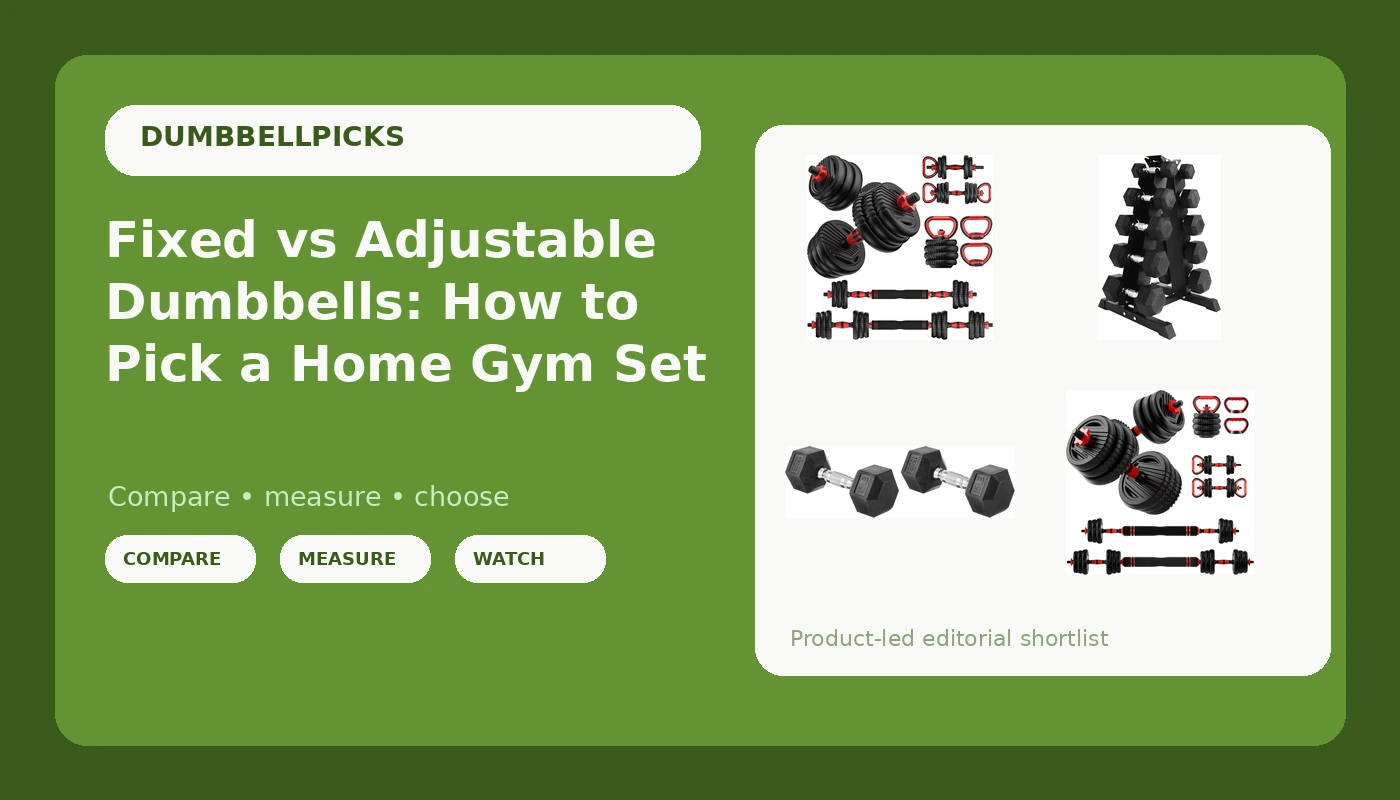
Buying dumbbells for a home gym is really a decision about mechanism and geometry, not about weight. The numbers on a product page tell you what a set can load. They do not tell you whether the plates stay tight at rep ten, whether the handle holds chalk, or whether the heads roll away between sets. When most people compare adjustable vs fixed dumbbells, they compare price per pound and stop there. The more useful question is how the set gets used over the next five years: a pair of heavy weights for presses and rows, or a wide spread of lighter weights for warm-ups, laterals, and arm work. The four options below cover both ends of that spectrum, and the trade-offs are different for each one.
Related: How to Build a Home Gym Around One Pair of Dumbbells →
Quick answer
Fixed hex dumbbells make sense when you want a small number of heavy pairs that never need adjusting and never rattle. Adjustable sets make sense when floor space and budget are the constraint and you need a broad weight range from a single pair of handles. A racked fixed set, a single pair of rubber hex hand weights, and two adjustable designs solve different versions of the same problem. The right choice depends on how wide a weight range you need and how often you plan to change the load in the middle of a workout.
Four useful options
| Model | Best fit | What stands out |
|---|---|---|
| BalanceFrom Rubber Coated Hex Dumbbell Weight Set with Storage Rack | A dedicated corner of the gym that needs several pairs | Rubber coated hex heads, sold in 100, 150, and 200 pound sets with a storage rack |
| Amazon Basics Rubber Hex Dumbbell Hand Weight | Filling one specific gap in a set you already own | Sold as an individual hand weight in a rubber hex design |
| Adjustable Dumbbell set, 20/30/45/70/90lbs Free Weight Set | Small spaces that need a wide range | Adjustable plates with listed 20, 30, 45, 70, and 90 pound configurations |
| Adjustable Dumbbell Set, 20/30/45/70/90lbs Free Weight with Connector | Lifters who also want the option of one short bar | Adjustable plates plus a connector that joins the two handles |
The racked fixed set: BalanceFrom Rubber Coated Hex Dumbbell Weight Set with Storage Rack
The appeal here is the opposite of an adjustable: nothing changes, so nothing can loosen. Hex heads stay where you set them down, which matters in a garage where a rolling dumbbell eventually finds the car. The trade-off is range. You are buying a fixed ladder of weights, so if your pressing goes up twenty pounds over a year, you either own the next pair or you do not. A racked set like this works well in households where two people train at different levels, because the rack holds several pairs at once instead of forcing everyone onto one load. That convenience costs floor space and a larger single purchase than one pair of adjustable handles.
The single pair: Amazon Basics Rubber Hex Dumbbell Hand Weight
Buying dumbbells one at a time is not glamorous, but it is how most home gyms actually grow. A single pair of rubber hex hand weights fills a gap, gives a training partner a matching weight, or replaces one dumbbell that got left outside in the rain. Rubber hex is the standard shape for a reason: six sides mean the weight sits still when you set it down between sets, and the rubber coating protects a concrete floor from chips. The limit is arithmetic. One pair at a time means a full ladder of pairs adds up, so this route rewards people who know exactly which weights they use and ignore the rest.
The space saver: Adjustable Dumbbell set, 20/30/45/70/90lbs Free Weight Set
Adjustable dumbbells trade one problem for another. You get a broad weight range in the footprint of a single pair, which is often the difference between a home gym and a pile of iron in a hallway. What you give up is instant readiness: every change is a small task, and the mechanism is the part that decides whether the set is pleasant or infuriating by year three. Two things are worth checking on any adjustable. First, do the plates lock tight enough that you cannot feel a shift at the top of a press? Second, does the change mechanism still move cleanly once chalk and floor dust get into it? The range listed here runs from light warm-up weights up to a genuinely heavy single, which covers a lot of ordinary programming.
The connector option: Adjustable Dumbbell Set, 20/30/45/70/90lbs Free Weight with Connector
The connector is the interesting part. Joining two adjustable handles gives you a short bar for movements that are awkward with separate dumbbells, like overhead work where two weights drift apart, or a light row. It is not a replacement for a real Olympic bar, and a joined pair is only as rigid as the connection point, so treat it as a bonus rather than the reason to buy. If you are already deciding between two adjustable sets with the same listed range, the connector is the feature that separates them, and it is worth asking honestly whether you will use it more than twice.
Prices and availability may change. Product images, names, and retailer links are matched to verified listings. No current price, rating, stock status, or measured result is stated here without current evidence.
How an adjustable mechanism earns its keep
Every adjustable dumbbell does the same job in a different way: hold plates to a handle, then let you change how many plates are attached. The mechanism is the part that fails, and the failure modes are predictable. Collars that thread on loosen under vibration. Cradles that hold plates by friction give up once the plates get dusty. Selector systems depend on alignment that has to be correct every single time. None of this is a reason to avoid adjustable sets. It is a reason to care about the mechanism more than the weight range printed on the listing.
Two questions decide most of it. Does the set hold its plates tight when you press it overhead, or can you feel movement at the top of the rep? And does the change still work when your hands are chalky? A mechanism that needs clean hands is a mechanism you will quietly stop using, and an adjustable set you avoid is worse than a fixed pair you actually train with. Weight range sells the product. The mechanism is what you live with.
Hex heads, knurling, and rubber
Fixed dumbbells live or die on three details: head shape, handle texture, and coating. Hex heads exist because round heads roll, and a dumbbell that rolls under a rack or into a wall is a daily annoyance. The six-sided shape also gives you a flat spot for re-racking and for setting the weight down during floor presses and renegade rows.
Knurling is the next thing your hands notice. A shallow, cosmetic pattern looks fine in photos and turns slick the moment you sweat. A deep diamond pattern grips hard but can chew up palms during high-rep work. Straight knurling at a moderate depth is the compromise most people can live with for an hour of training. Rubber coating protects floors and cuts noise, but rubber quality varies. A strong odor that lingers for weeks points to a cheaper compound, and it usually fades gradually rather than overnight.
A five-step way to choose
- Write down the three or four weights you use most in your current program, then check whether one adjustable pair covers all of them or whether you need separate pairs.
- Decide how often you are willing to change the load. If a change takes longer than the rest period it interrupts, you will skip it.
- Measure the space. Fixed pairs plus a rack need real floor area; adjustables need a small footprint and a place to set the handles down.
- Check the handle. Diameter, knurling depth, and whether it holds chalk decide how the set feels at rep fifteen, not rep one.
- Compare cost per pound rather than cost per set, and remember that a rack is part of the price of a fixed set.
Practical guidance for a home setup
- Put a mat or a rack under fixed hex pairs so the heads are not resting on bare concrete.
- Change adjustable loads with clean, dry hands, and wipe dust off the mechanism periodically.
- Buy weights you will still need in six months. A pair too heavy to press safely gets used for nothing.
- If two people train in the same space, favor a spread of lighter pairs over one heavy pair.
- Leave a clear drop zone in front of the rack, and never re-rack a dumbbell by dropping it onto the handle.
Which option should you choose?
Choose the BalanceFrom Rubber Coated Hex Dumbbell Weight Set with Storage Rack when you have the floor space and want several fixed pairs that never need adjusting. Choose the Amazon Basics Rubber Hex Dumbbell Hand Weight when you only need to add one or two specific weights to a set you already own. Choose the Adjustable Dumbbell set,20/30/45/70/90lbs Free Weight Set when space and range are the priority and you want the smallest possible footprint. Choose the Adjustable Dumbbell Set,20/30/45/70/90lbs Free Weight with Connector when you also want the option of joining the handles for short-bar work.
None of these listings is a substitute for getting a handle in your own hands. Weight tolerance, mechanism feel, and long-term durability are things a product page cannot show you. Check the current listing for the exact configuration as well, since several of these products ship in more than one weight range under the same name.
The bottom line
If you have the floor space and the budget, a racked set of rubber hex dumbbells is the simplest thing to live with, because nothing about it changes and nothing about it can loosen. If space is tight, an adjustable pair buys you a range that would otherwise take several pairs of fixed weights, and the mechanism is what you are really paying for. A single rubber hex hand weight is the cheapest way to fill a gap without rebuilding the whole setup. Pick the range you will actually use, check the handle before you commit, and treat the rack as part of the purchase rather than an afterthought.