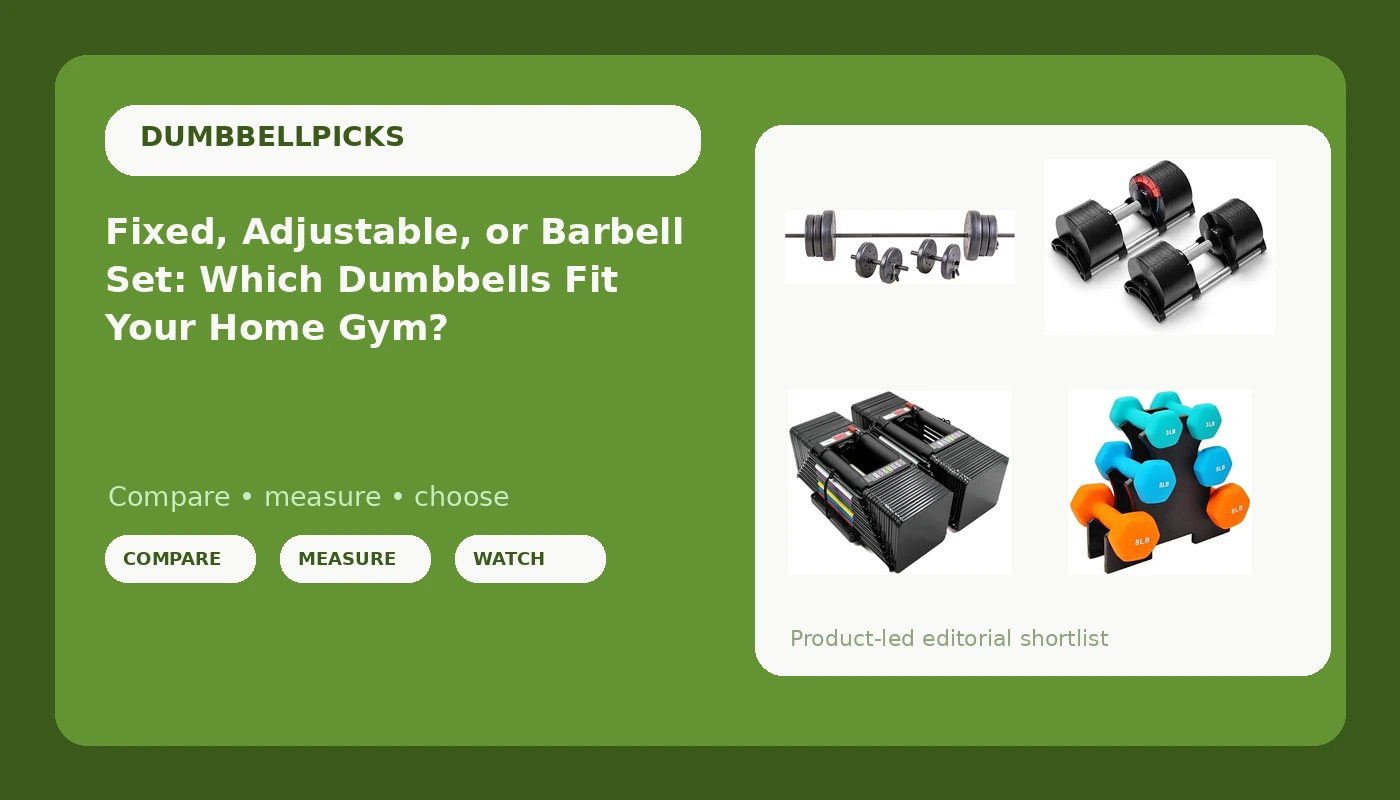
Buying dumbbells for a home gym usually starts with a simple question and ends in a spreadsheet. Fixed pairs are durable and instinctive, but a full run from 5 to 50 pounds takes a rack, a footprint, and a budget most garages cannot spare. Adjustable dumbbells for home gym training solve the space problem, but only if the mechanism survives the way you actually lift: fast set changes, supersets, and the occasional drop at the end of a hard set.
The four sets below cover the real spread of what people buy. There is a barbell-based starter set, two adjustable pairs with different weight ceilings, and a light neoprene set that comes with a rack. They are not interchangeable. Each one fits a different room, a different program, and a different conversation about money.
Related: How to Build a Home Gym on a Budget →
Quick answer
If you want one purchase that covers the widest range of pressing, rowing, and carrying loads in a small footprint, start with an adjustable pair and pick the weight ceiling that matches your program: the Nuobell 580 at a stated 5 to 80 lb per dumbbell, or the PowerBlock Elite USA 90 at a stated 5 to 90 lb per dumbbell. Choose the US Weight 105 Pound Weight Set with Barbell when you want a bar and plates for squat and bench work, and choose the Fitvids Set of 6 Neoprene Dumbbell Hand Weights when the training is light, high-rep, or shared with someone smaller.
Four useful options
| Model | Best fit | What stands out |
|---|---|---|
| US Weight 105 Pound Weight Set with Barbell | A first barbell and plate setup in a small garage | A 105 pound set that includes a barbell rather than a pair of dumbbells |
| Nuobell 580 Adjustable Dumbbells | Lifters who want a wide per-hand range without a rack | Adjustable pair with a stated 5 to 80 lb range per dumbbell |
| PowerBlock Elite USA 90 Pound Adjustable Dumbbells | Home gyms that want the highest per-hand load in this group | Adjustable pair sold in pairs with a stated 5 to 90 lb range |
| Fitvids Set of 6 Neoprene Dumbbell Hand Weights | Light, high-rep, and shared training | Six dumbbells in 3, 5, and 8 pound pairs, with a rack |
The barbell starter: US Weight 105 Pound Weight Set with Barbell
A loadable set is a different purchase from an adjustable pair, and the difference shows up in your training week. With a bar and plates you can squat, bench, and deadlift, which is programming a pair of dumbbells cannot match on its own. The trade is setup time and floor space. When you load plates, seat them so the collars sit tight against the stack and check them between sets. Loose plates clang, shift, and change how the bar travels, and no amount of chalk fixes a wobble that starts at the collar.
The wide-range adjustable: Nuobell 580 Adjustable Dumbbells
The appeal of a wide-range adjustable pair is that one purchase covers warm-up sets through working sets. That only holds if the mechanism keeps its rhythm after a few thousand changes. Two things decide that: whether the change happens with the dumbbell sitting in its cradle or in your hands under load, and whether chalk dust has somewhere to go besides the moving parts. Wipe the mechanism down, keep a brush near the rack, and store the pair in its cradle rather than on the floor. Adjustables reward a small amount of housekeeping.
The high-ceiling adjustable: PowerBlock Elite USA 90 Pound Adjustable Dumbbells
The compact format is why this pair takes up less floor space than a run of fixed dumbbells, and it is also why some lifters never warm to it. A caged handle feels different from a round head, especially on curls and lateral raises where the head passes close to your forearm. That is a preference, not a defect, and it is usually obvious inside one session. If the ceiling matters more to you than the handle feel, the higher 5 to 90 lb range is the reason to pick this pair over the other adjustable here.
The light set: Fitvids Set of 6 Neoprene Dumbbell Hand Weights
Light neoprene pairs are not a substitute for heavy loading, and treating them as one is how people end up disappointed. What they are good for is everything around the heavy work: warm-up raises, shoulder and cuff circuits, high-rep finishers, and the kind of training a household shares across very different levels of strength. The rack matters more than it looks. Light dumbbells spread across a floor become a trip hazard, and the set is only convenient if it goes back in one place.
Prices and availability may change. Confirm the details on the retailer page before you buy. Nothing in this guide states a current price, rating, or stock status for any product.
What actually fails on an adjustable dumbbell
Adjustable mechanisms fail in predictable ways. The first is tolerance drift: the selector fits a little looser after thousands of changes, the plates start to rock inside the handle, and what felt solid in month one feels like a rattle in month twelve. The second is contamination. Chalk, skin, and garage dust get into the moving parts, and a mechanism that changes cleanly on day one starts to bind. The third is the drop. Adjustables are designed to be set down, not thrown, and a hard drop on a concrete floor transfers force into the one part of the dumbbell that was engineered to move.
You cannot inspect most of this from a product photo, but you can influence it. Change weights with the dumbbell in the cradle, not overhead in your hands. Brush the mechanism monthly. Store the pair where it lives during a session so you never carry it across a room just to put it down.
There is also the question of handle feel, which is where most people form their real opinion. Knurling that holds chalk and skin without cutting is worth more than a slightly wider weight range, because you will notice it on every single rep. Knurling that looks aggressive in a photo but flattens out after a month is the most common disappointment in the category. Run your hand down the handle the moment it arrives and decide then, while a return is still easy.
Reading the weight range: what 5 to 80 and 5 to 90 actually buy you
Weight ranges on adjustable dumbbells are stated per hand, and that is the number that matters. A pair of 80s is 80 pounds in each hand, which is far more total load than the 105 pound figure in a loadable starter set, where the number describes the whole set rather than one limb. Comparing those two figures directly is the single most common mistake people make when they shop for a first set.
The practical question is not the ceiling, it is where your working sets land. If your heaviest dumbbell bench set is 60 pounds per hand and your heaviest row is 75, a set that stops at 80 covers you with room to spare, and the jump to a 90 ceiling only matters if you are still adding load. Buy the range you will use in the next two years, not the range you might use in ten.
There is also a floor to consider. A stated 5 pound minimum matters for warm-ups, lateral raises, and any pressing you do after an injury, because it lets one pair serve both your easiest and your hardest sets. That is the real value of a wide adjustable range: not the top number, the spread.
Finally, think about how many changes you will make in a session. A five-set workout with two exercises and a warm-up is already a dozen or more adjustments. Fewer moves per set means fewer chances for the mechanism to loosen, which is an argument for pairing an adjustable set with light fixed weights like a neoprene rack for the small stuff.
- Write down the lifts you actually do each week, not the lifts you would like to do.
- Note your heaviest set per hand for bench, row, and shoulder press, then add ten pounds of headroom.
- Check your ceiling against the stated per-hand range, not the total weight of the box.
- Measure the floor space you can give up permanently, then compare a rack of fixed pairs against one adjustable pair and its cradle.
- Decide whether you want a bar for squats and bench or dumbbells only, because that choice changes the set you should buy first.
Matching a set to your space and your program
- Give the set a permanent home before it arrives. Equipment that has no rack ends up on the floor.
- If you train alone, favor the format you can load with one hand between sets.
- If two people share the space, favor weight ranges that overlap, so the light lifter is not stuck with a 5 pound minimum jump.
- Keep a brush and a towel near the rack and clean the handles after sessions that use chalk.
- Treat a drop onto concrete as damage, not a test. Set the dumbbells down.
- Budget for the second purchase. Almost nobody stops at one set, and planning the sequence beats buying a set you outgrow in a season.
Which option should you choose?
Choose the US Weight 105 Pound Weight Set with Barbell when you want a bar and plates for squat, bench, and deadlift work and you are starting from nothing. Choose the Nuobell 580 Adjustable Dumbbells when you want one pair that covers warm-ups through working sets at up to a stated 80 pounds per hand. Choose the PowerBlock Elite USA 90 Pound Adjustable Dumbbells when the higher stated 90 pound per-hand ceiling and the compact format matter more to you than a round handle. Choose the Fitvids Set of 6 Neoprene Dumbbell Hand Weights when your training is light, high-rep, or shared, and you want a racked set of small pairs for warm-ups and accessory work.
One caveat worth stating plainly: the weight ranges and configurations above come from the manufacturer's product descriptions. Handle feel, mechanism durability, and plate behavior are things you judge in person, under your own training load, over months rather than minutes. Any guide that promises otherwise is selling you certainty it does not have.
The bottom line
The right first purchase depends on what you plan to do in the room, not on which set has the biggest number on the box. A loadable barbell set gives you the big compound lifts. A wide-range adjustable pair gives you per-hand loading in about a square foot of floor. A light neoprene rack covers everything that happens before and after the heavy work. Most home gyms end up with two of those three, and the order you buy them in matters less than getting the first one right.