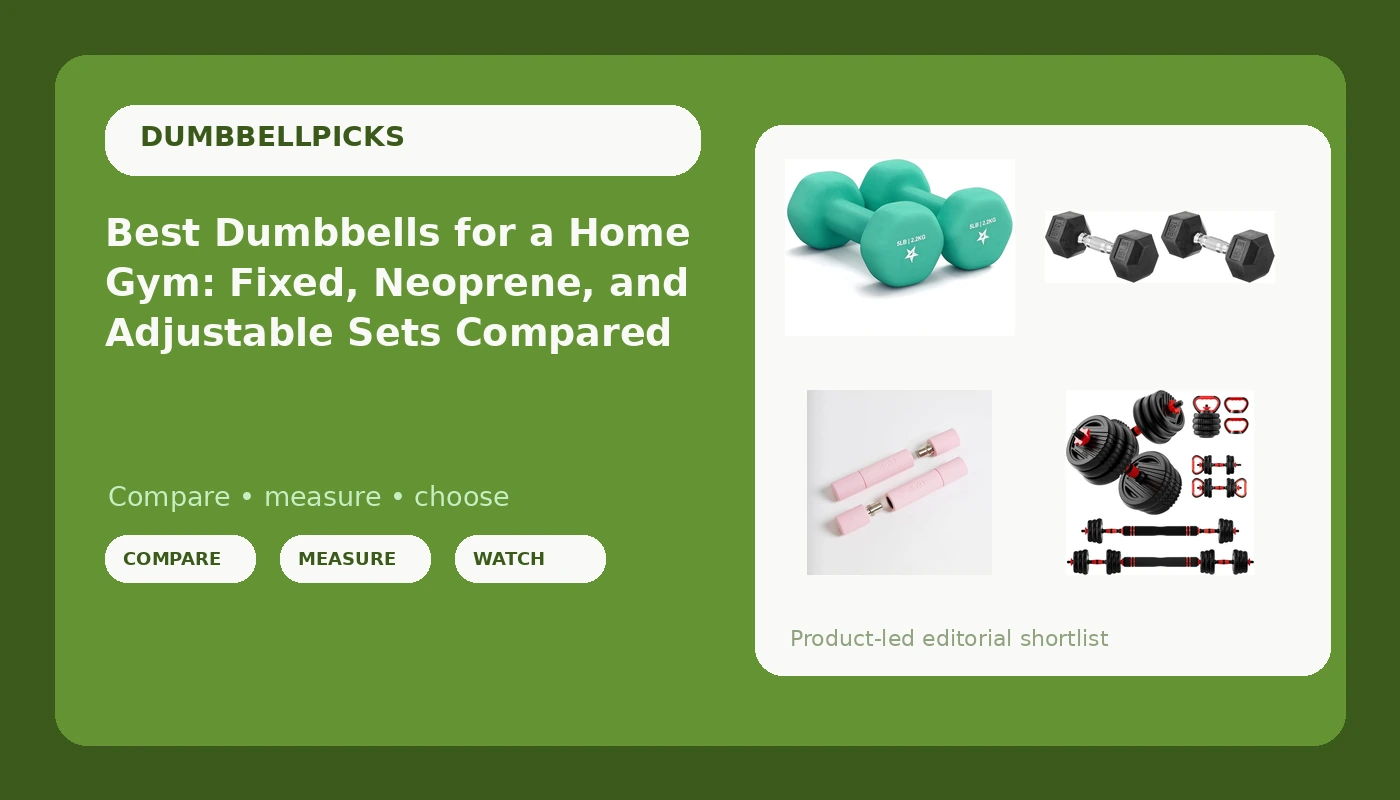
I have spent twelve years coaching, and the garage gym I started in is now a 4,000 square foot facility. Along the way I learned that the equipment question is almost never about the spec sheet. It is about what you will still pick up in week forty. Home gym dumbbells are the clearest example of that. A set that rattles, rolls, or fights your grip gets abandoned, and an abandoned dumbbell is the most expensive thing in the room. This comparison puts four very different designs side by side: a neoprene set with a rack, a rubber hex fixed weight, a compact adjustable hand weight set, and a plate-loaded adjustable that converts into a short bar. None of them is right for everyone. The trick is matching the design to the way you actually train.
The short answer for most home gyms: a rubber hex fixed dumbbell is the right first purchase, because a hex head does not roll across the floor and a fixed handle has no mechanism to fail. Go adjustable only when space or budget forces the trade.

Yes4All Neoprene Dumbbells, Pairs and Sets with Rack for Home Workouts
Comfortable in the hand, quiet on floors and furniture, and the rack keeps a light set organized and visible
Coated heads wear and get slick with sweat, and the range tops out long before you need it to
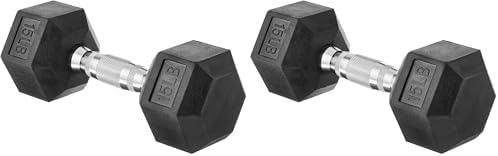
Amazon Basics Rubber Hex Dumbbell Hand Weight
Hex rubber head stays put, knurled handle gives you something to hold, no mechanism to break
Sold one at a time, so a pair is two purchases, and there is no rack included

Stakt Adjustable Hand Weights - 2 4 6 lb Dumbbell Set
One compact unit replaces three pairs, which is a real win in a small space
Tops out at 6 lb, so it is a warm-up and conditioning tool, not a strength tool
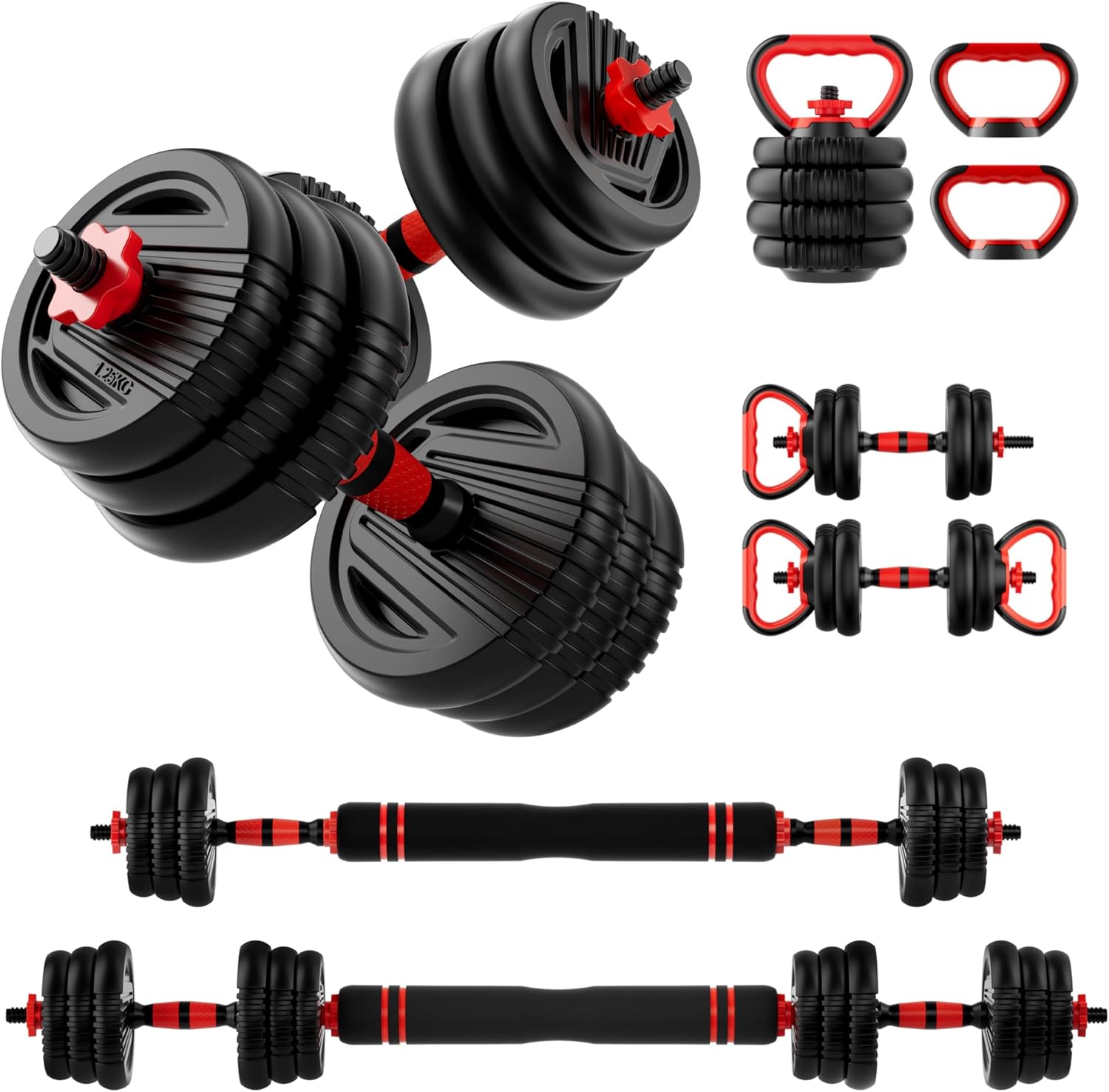
Adjustable Dumbbell Set,20/30/45/70/90lbs Free Weight with Connector
Wide range in one footprint, and the connector turns two dumbbells into a short bar
Plate changes take time, and a connector bar is a compromise, not a real barbell
Prices and availability were captured from Amazon Creators API and may change.
How I judge a dumbbell before it earns floor space
The dumbbell is the tool. The rep quality is the workout, and a tool that hurts your hand or shifts under you degrades both. My checklist is short and unforgiving.
Knurling first. Run a hand down the handle. A real knurl gives traction without shredding skin, and it holds chalk instead of turning into paste. Cosmetic knurling, the kind that looks aggressive in a product photo and disappears under a load, is worse than none at all, because you trust it and it lies to you.
Second, the head. Hex heads do not roll. That matters more in a home gym than in a commercial one, because in a commercial gym someone else picks up after you. Round heads find the gap under the couch and stay there.
Third, the connection between handle and head. Welds and coatings should look like they were made on purpose. If a head spins on the handle out of the box, it will be worse in a year.
Fourth, if there is a mechanism, the mechanism is the product. A dial, a pin, or a collar that jams under chalk is a paperweight with a nice finish.
One caveat before we go further: I do not call anything reviewed until it has a full training block behind it. What follows is the framework I use plus what each design is built to do well and where it gives something up. That is the honest version.
Neoprene sets: comfort first, load second
Neoprene coated dumbbells exist for a reason, and it is not heavy lifting. The coating is soft against the palm, quiet on a floor, and forgiving if you clip a coffee table on the way down. Yes4All Neoprene Dumbbells, Pairs and Sets with Rack for Home Workouts comes as pairs and as sets with a rack, which solves the storage problem that kills most light dumbbell collections. A rack means the light weights live where you can see them, and visible dumbbells get used.
What you give up is ceiling. These are high rep tools: lateral raises, walking lunges, rehab work, warm ups, and anything a beginner does in the first six months. The coating also has a lifespan. Chalk, rough concrete, and a ring on your finger will all take a toll, and a coated head gets slick once your hands are sweaty. That is the trade. Comfort and quiet now, in exchange for not being the set you still own in ten years.
Buy it if you want a light set that is pleasant to handle and easy to store. Skip it if you are already pressing your bodyweight and up.
Rubber hex fixed dumbbells: the home gym standard
Rubber hex dumbbells are the default for a reason. The hex head means the weight sits still between sets instead of drifting toward your shins. The Amazon Basics Rubber Hex Dumbbell Hand Weight follows that formula: a rubber coated hex head, a knurled handle, and a straightforward build with nothing to adjust. If your goal is a set you stop thinking about, this is the shape of it.
The detail people miss is that these are typically sold as single hand weights, not pairs. That changes the math. Two of them is two purchases, and there is no rack in the box. The flip side is flexibility. Instead of buying a matched run you will never fully use, you can buy the weights you actually program: a pair of 15s for pressing, a pair of 25s for rows, a single heavier one for goblet squats. That is how I would build a home set if I were starting over.
Two things to plan for. New rubber can carry an odor for a while, which is normal for the material and worth knowing before you put it in a small room. And a fixed dumbbell is a fixed dumbbell. There is no growing it, so buy slightly heavier than you think you need.
Compact adjustable hand weights: one object, three weights
The Stakt Adjustable Hand Weights - 2 4 6 lb Dumbbell Set covers 2, 4, and 6 lb in one compact unit, and that is the entire pitch. Three pairs of light dumbbells take up three pairs of floor space. One adjustable unit takes up one. In a small apartment, next to a desk, or in a studio where the equipment lives in a closet, that math is hard to argue with.
The ceiling is the catch. Six pounds is a warm up load, a rehab load, or a conditioning load. It is not a strength load. If your training is built on progressive overload with dumbbells, this set is a complement, not a foundation. The other thing to check on any adjustable hand weight is play. Stacked segments should lock tight with no rattle, because a rattle in your hand at rep fifteen is a distraction you feel every session.
The cost per pound is high here, higher than any fixed dumbbell in this comparison. You are paying for the form factor, and the form factor is genuinely good. Buy it if space is the constraint. Do not buy it expecting it to replace a rack.
Plate-loaded adjustable sets: range without a wall of iron
The Adjustable Dumbbell Set,20/30/45/70/90lbs Free Weight with Connector takes the opposite approach to the compact hand weights. Instead of a small unit for light work, it is a plate-loaded system with a connector, which means you can run it as two dumbbells or lock them together into a short bar for pressing and rows. That connector is the interesting part. It turns one purchase into a dumbbell and a bar, and for a garage with limited floor space that is real value.
The listing spans several configurations across that weight range, so read carefully which one you are buying, because the top end you get depends on the version you choose. Higher configurations mean more plates, more storage, and a heavier box at the door.
The honest trade is speed and feel. Changing plates takes longer than turning a dial, and the collars have to be tight or the plates will shift mid set. If you have ever had a collar loosen on rep eight of a set of ten, you know the feeling. A connector bar is also a compromise. It is shorter than a real barbell and it will not live in a rack the same way. Treat it as a bonus, not a replacement.
Buy it if you want range and a bar option in one footprint. Skip it if you want to change weights in two seconds between sets.
The trade-offs nobody puts on the box
Every one of these designs gives something up. Here is the short version.
- Fixed beats adjustable on reliability. No mechanism, nothing to jam, nothing to replace. If you never need to change weights, fixed wins.
- Adjustable beats fixed on footprint and range. One set can cover warm up through working weight, which is why adjustables dominate small spaces.
- Coated beats bare on comfort and floor safety. Neoprene and rubber are quieter and kinder to hardwood. They also wear out.
- Hex beats round on staying put. Round heads roll. That is not a preference, it is physics.
- Singles beat pairs on flexibility and lose on convenience. Two singles means two orders and no matched rack.
- Racks beat leaning weights against a wall. A rack that tips is worse than no rack, so check the base and where it mounts.
The thing I would tell any client is that the weakest link decides. A beautiful adjustable set with a collar that loosens is worse than an ugly fixed pair that never moves. Spend your attention on the part that touches your hand and the part that holds the weight on.
Which one for which lifter
- Rehab, high reps, small hands, or a shared space: Yes4All Neoprene Dumbbells, Pairs and Sets with Rack for Home Workouts.
- First real set, no nonsense: Amazon Basics Rubber Hex Dumbbell Hand Weight, bought in the pairs you actually need.
- Apartment, desk, or closet training with a light ceiling: Stakt Adjustable Hand Weights - 2 4 6 lb Dumbbell Set.
- One footprint, a wide range, and a connector bar you will genuinely use: Adjustable Dumbbell Set,20/30/45/70/90lbs Free Weight with Connector.
What to check before you click buy
- Decide your ceiling weight first. Everything else follows from the heaviest set you will realistically do for reps.
- Measure the space, including the swing room around a rack or a stand.
- Check the handle diameter. A thick handle is harder to hold, which is fine for grip work and annoying for pressing.
- Confirm whether the listing is a single weight or a pair. This is the most common surprise in the category.
- Look at the collar or mechanism. If it is the part that changes the weight, it is the part that fails.
- Check how a rack sits on the floor and whether it mounts to a wall.
- Keep the return window in mind. Ten minutes in your hand tells you more than any listing photo.
The bottom line
If you want one answer, it is the rubber hex fixed dumbbell. It is boring, it does not roll, and nothing about it can break in a way that ruins a session. Build around it with the weights you actually program, and add a light neoprene set if you need something kind for high rep work or rehab.
Go adjustable when the room is the constraint. The compact 2/4/6 hand weights are the right call for a small space and a light ceiling, and the plate-loaded set with the connector is the right call when you want range plus a short bar without giving up half the garage. Pick the one that matches your training, not the one with the best product photo, and then put it somewhere you have to walk past it every day.