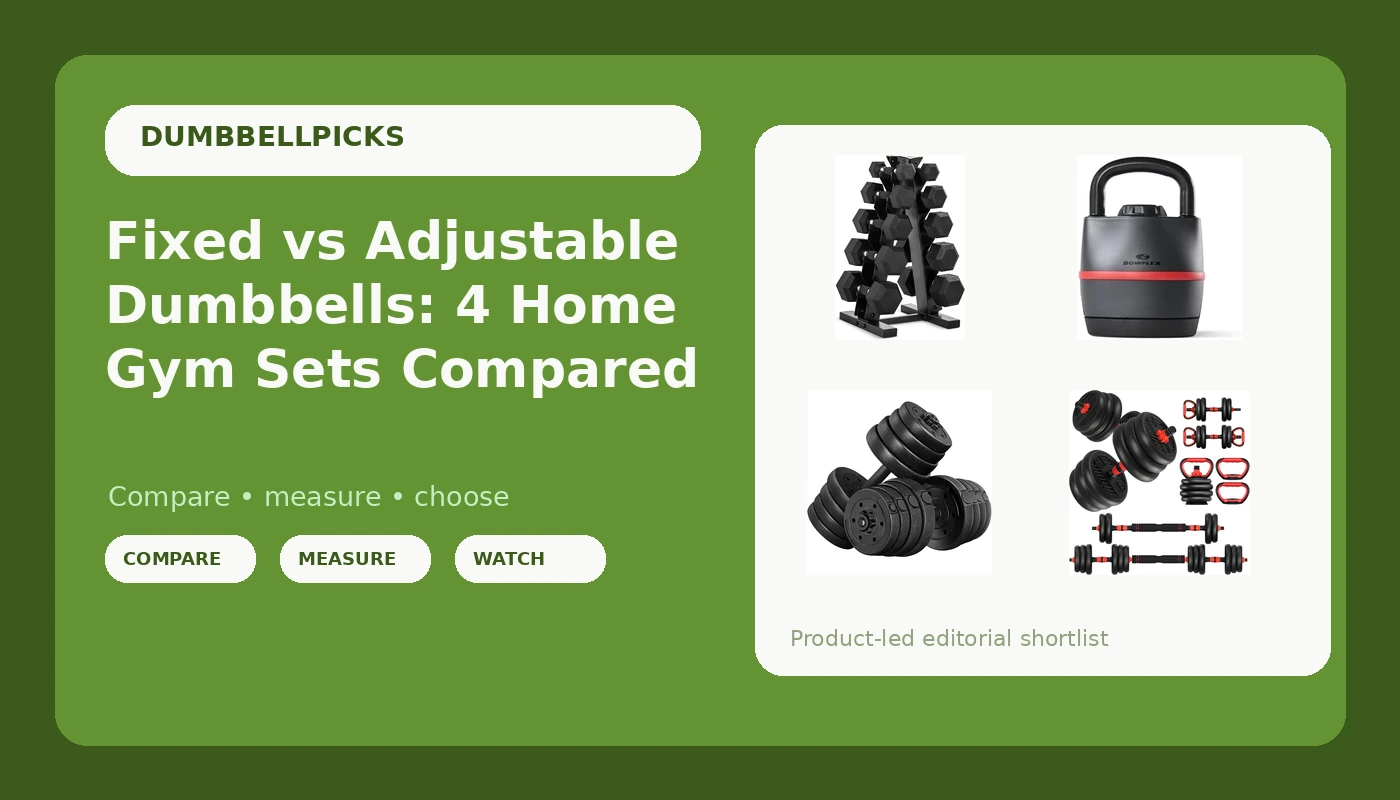
I started coaching in a 200-square-foot garage with a pair of 25s, a bench, and a used Olympic bar that smelled like a wet dog. Twelve years later I run a 4,000-square-foot gym in Denver, and the question I field more than any other from people building a first setup is which home gym dumbbell sets are actually worth the floor space. The category splits cleanly in two. Fixed sets are heavy, simple, and close to indestructible. Adjustables trade some of that certainty for a footprint the size of a milk crate.
This comparison covers four sets that sit on very different points of that line: a rubber-coated hex set with its own vertical rack, a dial-driven adjustable kettlebell, a spinlock adjustable pair, and a convertible kit that becomes a barbell and a push-up stand. None of them is a bad product. They solve different problems, and buying for the wrong problem is how a perfectly good set ends up in a closet by month three.
If you want the short answer: buy the fixed rubber hex set if you have the floor space and want to stop thinking about equipment, and buy one of the adjustables if you do not. Everything under this table is the reasoning, including the parts of each design that fail first.
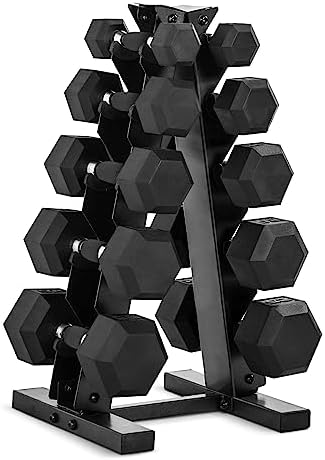
CAP Rubber Coated Dumbbell Weight Set with Vertical Rack
Nothing to fail: solid heads, no collars, no dial, and hex shapes that stay where you set them down
The biggest space and money commitment here, and the loading is whatever the set ships with
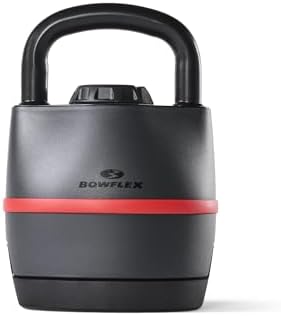
BowFlex SelectTech 840 Adjustable Kettlebell
Replaces a whole rack of bells with one dial and one floor footprint
Kettlebell work only, and the dial is the one component you cannot baby enough
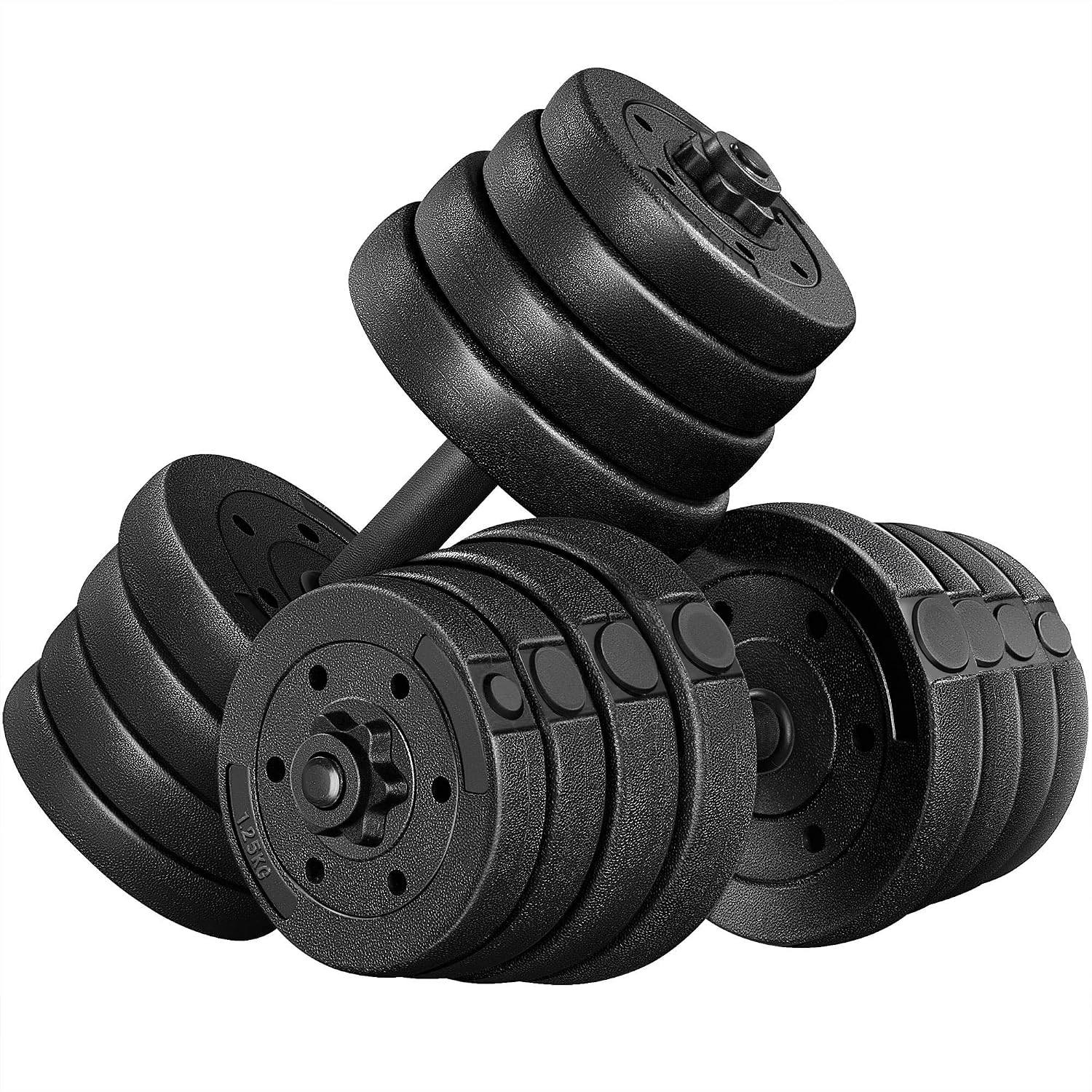
Yaheetech Adjustable Dumbbell Set Free Weights with Spinlock Collars
Cheapest honest way into real loading, and every part is simple and replaceable
Spinlock collars loosen under hard sets, and the long handle changes how pressing feels
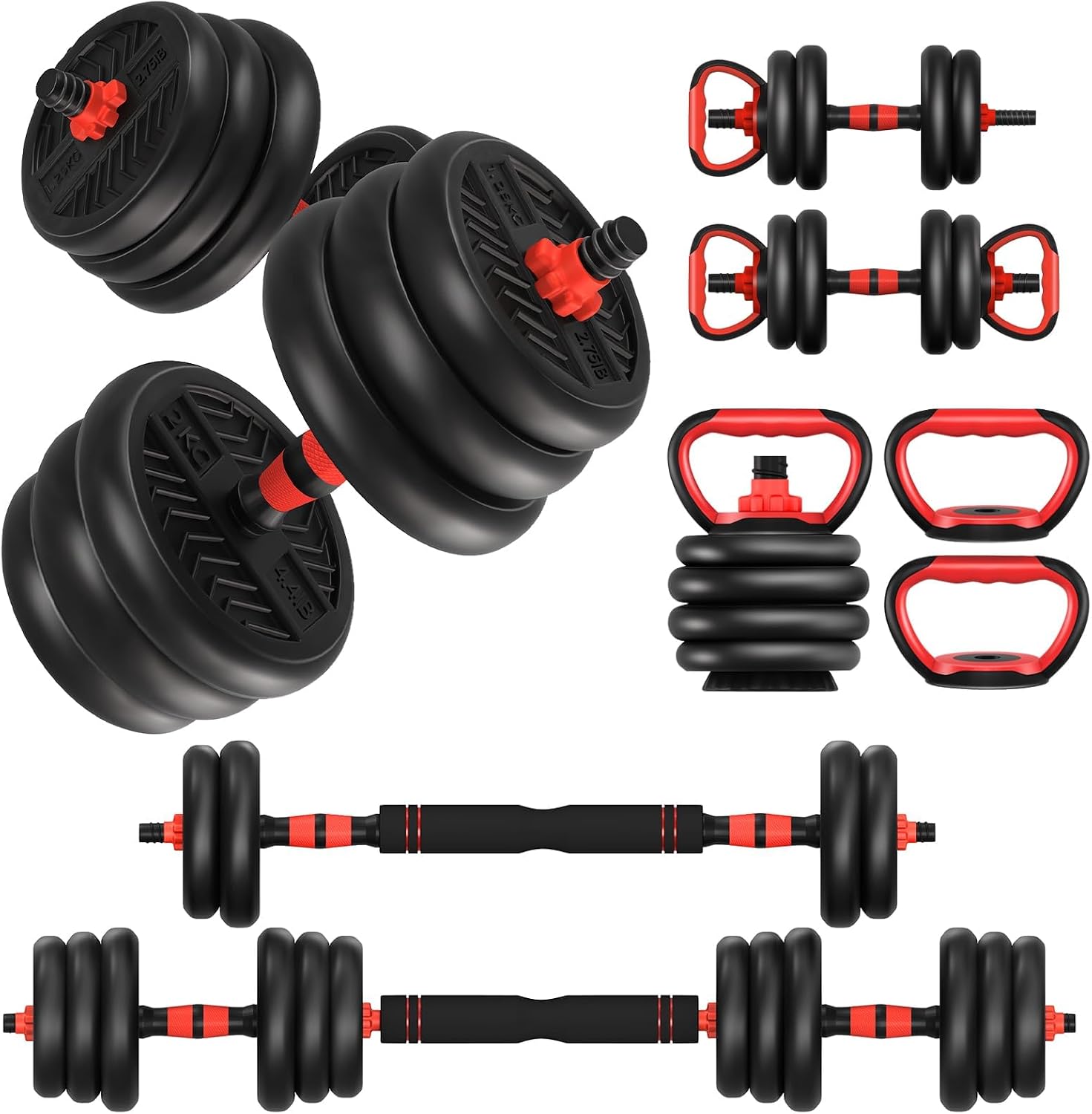
Adjustable Dumbbells, 4 in 1 Set with Connector
Turns into a barbell, a kettlebell, and a push-up stand without a second purchase
Every mode change costs setup time, and the connector is the part carrying all the stress
Prices and availability were captured from Amazon Creators API and may change.
What actually separates these four sets
There are three failure points on any dumbbell, and everything else is marketing copy.
The first is the handle. Knurling that is too smooth makes you fight for grip on heavy rows and farmer carries. Knurling that is too sharp shreds calluses halfway through a high-rep set. The good stuff holds chalk and still feels fine at rep twenty.
The second is the connection. On a fixed dumbbell that means the weld between handle and head. On an adjustable it means the collar, the dial, or the connector. This is the part that decides whether you get two years or ten.
The third is head shape. Round heads roll. Hex heads stay put. In a garage where you set a pair down between sets and turn your back for thirty seconds, that difference matters more than any spec sheet.
The four sets below answer those three questions in very different ways, so instead of ranking them on one scale, here is what each one is built to do.
The CAP rubber set: buy it once, rack it, forget it
The CAP Rubber Coated Dumbbell Weight Set with Vertical Rack comes in 100 lb, 150 lb, and 210 lb configurations, and it is the closest thing here to gym-grade equipment. Rubber coating protects a garage floor and kills most of the clang when a weight comes down hard. The vertical rack is the part I like most. A vertical rack stores a full set in the footprint of one pair lying flat, which is the difference between dumbbells that live in the room and dumbbells that live in a hallway.
The trade-off is commitment. You are buying pairs, and the loading is whatever the set includes, so there are no 2.5 lb jumps to chase a stubborn press. You also need a spot with real floor space and a rack that cannot be tipped by a kid or a dog. Check that the rack sits flat and that the base is wide enough that a shoulder bump does not send it over.
One thing to know about rubber in general: budget compounds can off-gas in a closed, hot garage for a few weeks. It fades. If the smell is the thing you cannot tolerate, keep the box in an open garage or a covered porch for the first week.
A kettlebell on a dial: the BowFlex SelectTech 840
Kettlebell work is the most space-hungry habit in a home gym, because a proper bell selection means five or six cast iron bells per person. The SelectTech 840 compresses that into one unit with a dial. You spin to the weight you want, you swing it, and the rest of the rack never existed.
What it wins is footprint and speed. Loading a bell between sets takes a turn of a dial, not a walk to a shelf. For someone running swings, cleans, and goblet squats in a spare bedroom, that is a real training advantage, because the friction of changing weight is what kills supersets at home.
The honest criticism: this is kettlebell work only. It will not press overhead like a dumbbell pair, and the dial mechanism is the single component that decides the life of the unit. Store it on its base, set it down under control, and keep chalk dust out of the dial track. Kettlebell training traditionally involves dropping bells, and you do not drop a dial mechanism. If dropping is part of your practice, buy cast iron.
Spinlock collars and the Yaheetech set
The Yaheetech Adjustable Dumbbell Set is the classic spinlock design: a threaded sleeve on each end of a short handle, plates slid on, collars screwed down. It is the cheapest honest way into real loading, and the mechanism is so simple that almost nothing on it is permanent. If a collar strips, you buy another collar. If a plate chips, you buy another plate.
The catch is the collar itself. Spinlock collars loosen under hard, fast sets, and a loose collar means plates that shift and clang at the worst moment. My rule with any spinlock set is the same one I gave clients for years: check the collars between every working set, and if you are doing something explosive, use fixed weights instead. This design is for controlled pressing, rowing, curling, and pressing movements, not for snatches.
Second criticism: the handle is long, because it has to hold plates on both ends. A long handle changes the feel of a bench press and can bump your forearm at the bottom of a curl. It is not wrong, it is just different, and it is the reason the set costs what it costs.
The convertible kit: barbell, kettlebell, push-up stand
The Adjustable Dumbbells 4 in 1 Set with Connector is the most interesting design here on paper. It ships in 20, 30, 40, 60, and 80 lb configurations, and a threaded connector joins the two dumbbells into a single barbell. Drop one end and you have a kettlebell. The handles double as a push-up stand, which is a small thing that saves a beginner a purchase.
For a teenager, a small apartment, or someone who wants to try a year of training before committing to a rack, that flexibility is worth a lot. One box covers the movements most people actually do at home.
The trade-off is time and load paths. Every mode change is assembly: plates on, collars tight, connector threaded, collars checked again. That is fine on a planned heavy set and annoying in a circuit. The connector is also the joint taking the entire load when you use it as a barbell, so thread it fully and inspect it. And as with any spinlock design, the plates will rattle if the collars are not tight. Treat the connector and the collars as consumables and check them.
Knurling, collars, and the parts that fail first
Run your hand down a handle before you commit to a set. A good knurl is a texture you can feel with a light pass, not a cheese grater and not polished chrome. If a handle is smooth enough to slide through your hand with no sensation, it will be worse once your palms get sweaty. If it bites hard enough to leave marks on a dry hand, it will tear you up on rep fifteen of a row.
On adjustables, the mechanism is the whole review. A spinlock collar is a wear part. It is supposed to be checked and eventually replaced, and a set that sells spare collars is worth more than a set that does not. A dial mechanism is faster but has more small parts inside, and chalk is the enemy of small moving parts. Keep the unit on its base, wipe it down, and do not store it with plates hanging on the track.
Heads are the quiet third. Rubber over hex is the home standard because a hex head parks where you leave it and rubber protects the floor. Round heads roll under benches, into walls, and toward anything expensive.
Space, safety, and the rack question
Measure your room before you buy, and measure it for the person you will be in two years, not the person you are today. A 210 lb fixed set with a rack needs a dedicated corner. An adjustable pair needs a two-foot square, and that is the entire argument for adjustables in a house with a car in the garage.
Safety rules I would give any client, in order of how often I have seen them broken: the rack goes against a wall and never in a walkway; the base is wide enough that it does not tip when you rack a weight with one hand; plates get checked for tightness before a working set, not during; and nothing with a dial mechanism gets dropped, ever. A dropped hex dumbbell is a bang. A dropped dial is a replacement.
Who should buy which
Buy the CAP rubber hex set with the vertical rack if you have the corner, the budget, and the patience to buy once. It is the set that survives your first home gym and your fifth.
Buy the BowFlex SelectTech 840 if your training is kettlebell-shaped and your space is not. It is the only option here that removes an entire rack of cast iron from your floor plan.
Buy the Yaheetech spinlock set if you want to lift real weight for the least money and you do not mind checking collars. It is the pragmatic beginner pick.
Buy the 4 in 1 convertible kit if you want variety from one box: dumbbells one day, barbell the next, kettlebell the day after. Just accept that some of your session goes to setup.
What I would check before you click
Four questions decide whether any of these lasts. Does the maker sell replacement collars, pins, or covers, or is the whole thing disposable? Is the handle diameter comfortable in your hand, since you will grip it a few thousand times? Does the max load cover your program twelve months out, not just today? And can the mechanism be cleaned, or is it sealed against you?
Ask those before price and you will end up with a set you keep.
The bottom line
The best home gym dumbbell is the one that does not make you think. Fixed rubber hex does that by having no moving parts. A dial adjustable does it by putting a whole rack on one footprint. A spinlock pair does it by costing almost nothing and asking you to check the collars. Pick the failure you can live with, because every one of these sets has one, and none of them is a mistake if it matches how you actually train.