Related: Adjustable vs Fixed Dumbbells: Which Belongs in a Garage Gym
Most people buy their first home gym dumbbell set the same way they buy a mattress. They guess, they overspend on the wrong thing, and they live with it for years. I have coached for twelve years and run a garage gym that grew into a 4,000-square-foot facility, and in that time the equipment that survived was never the fanciest. It was the stuff that stayed tight.
A home gym dumbbell set has three jobs. The heads have to sit still when you set them down between sets, because a round head that rolls under your bench is a rolled ankle waiting to happen. The plates have to stay welded to the handle, because a wobbling plate is a lie told by a weld. And the set has to live somewhere you can reach without stepping over it.
That last part is where most people go wrong. They buy 300 pounds of iron and stack it in a corner, then stop training because loading up for a set of rows takes four minutes. Storage is not a detail. It is half the purchase.
You can cover almost every home gym with three moves: a fixed set that covers your working weights, a rack that holds them, and a way to fill the gaps as you get stronger. Here is how the four pieces I would look at fit together.
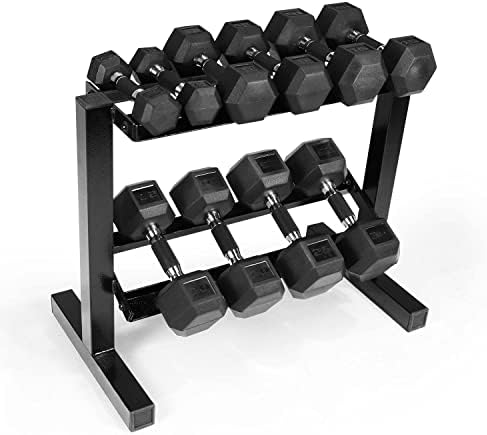
Best Overall: CAP 150 LB Dumbbell Set with 2-Tier Rack
This is the set I would hand someone building a garage gym from nothing. Rubber hex heads are the home gym standard for a reason: they do not roll away when you set them down, they do not chew up a concrete floor, and the rubber takes a beating that chrome and bare steel will not.
The 2-tier rack matters as much as the dumbbells. Horizontal storage means you grab a pair at waist height instead of pulling iron off the floor, and the whole thing tucks against a wall. Two tiers hold the pairs you use most, which is exactly the ones you do not want buried.
What I would check before this earns permanent floor space: grip the handle and spin the head. Any play at the collar and the welds are telling you something. Run a thumb down the knurling, and if it feels like a decorative pattern rather than a grip surface, you will be chalking up every set. Fresh rubber also has a smell, and it fades faster if you let the set air out for a few days before you stack it in a closed room.
The honest limitation is the range. A 150 pound set is built around pairs, and if your working weight on a press or a row climbs past what the top pair offers, you will be shopping again. For a lifter who trains in the moderate range and wants zero fuss between sets, that trade is worth it.
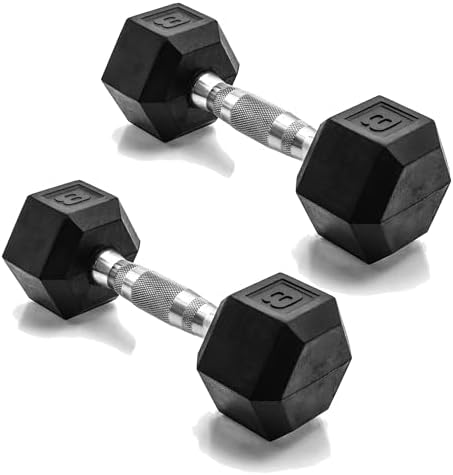
Best for Filling Gaps: CAP Rubber Coated Dumbbell Weights
Nobody buys one perfect set and stops. You buy a base, you get stronger, and suddenly you need a heavier pair for rows and a lighter pair for lateral raises. That is what these are for.
They are the same idea as the set above, sold as pairs and sets instead of a fixed package, with anti-roll hex heads and handle options across black, chrome, and comfort grip. If you already own dumbbells and only need to close a specific gap, buying pairs is cheaper and smarter than replacing everything.
Two things to watch. First, if you are mixing brands on a rack, check that the handle diameters match what you are used to. A set that feels great in one hand and foreign in the other will annoy you every session. Second, rubber coated does not mean identical to rubber hex. The coating protects the floor and the head, but the handle is what you actually grip, and that is where the money should go.
This is also the sane way to build a rack over a year instead of a weekend. Buy the pairs you actually use, skip the ones you think you should use, and let the rack tell you what is missing.
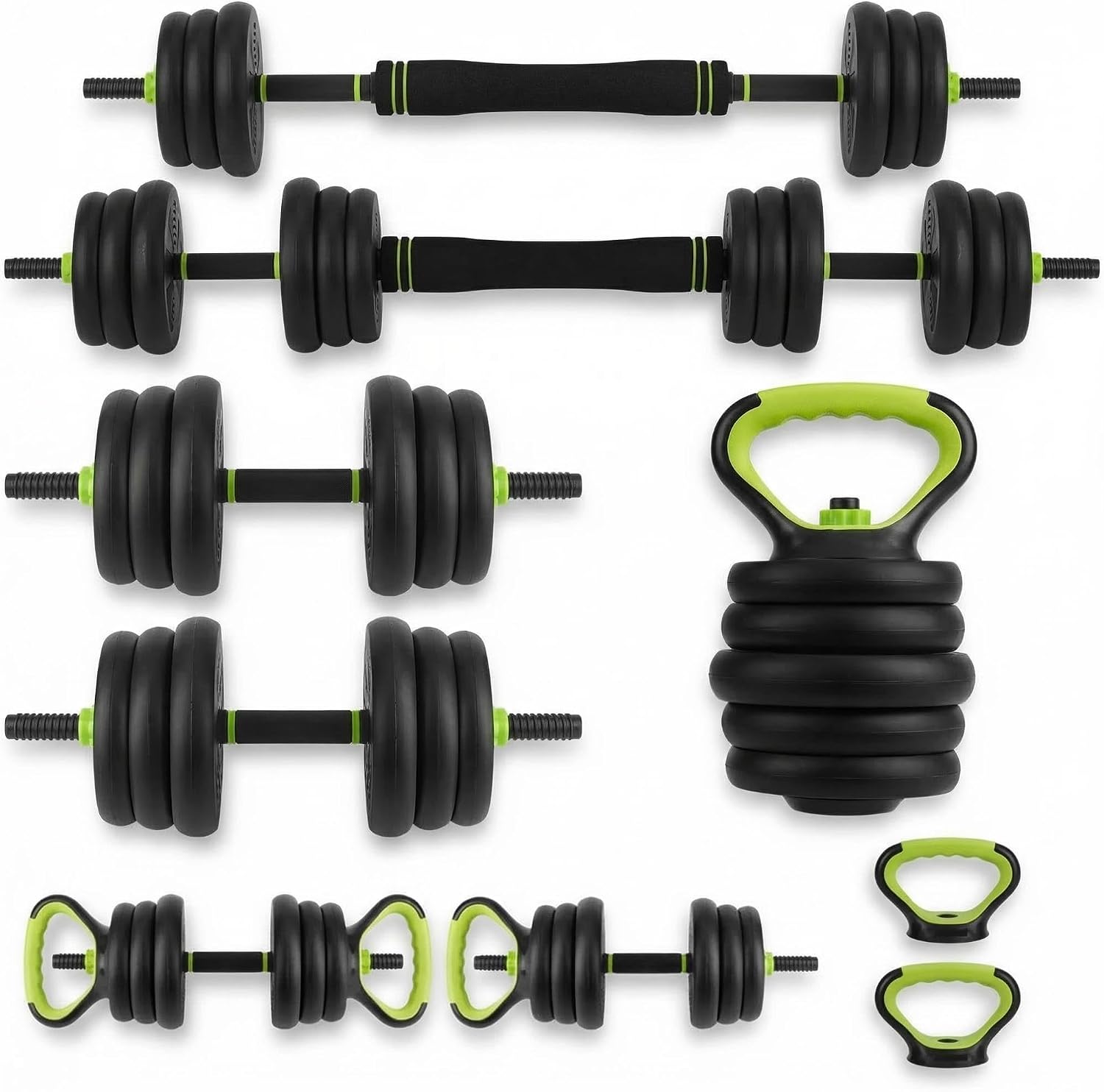
Best Budget All-in-One: 44LB Adjustable Dumbbell Set
If your gym is a corner of a bedroom, this is the piece that gets you training today. It is a 4-in-1 set: dumbbells that convert to a barbell, a kettlebell, and a push-up stand. That is a lot of jobs for one box, and for a beginner working through a full body program, it covers a surprising amount of ground.
The catch is the load. Forty-four pounds total is a starting point, not a destination. A lifter who can already press and row real weight will outgrow it quickly, and that is fine, because this is not the set you keep for a decade. It is the set that gets you moving, teaches you the movements, and tells you whether you actually train at home before you spend real money on iron.
With adjustable gear, the mechanism is the whole story. The collars are the part that fails, and the failure mode is always the same: a plate shifts mid-set because something loosened. Before every session, check the collars by hand. If they spin loose under a light pull, they will spin loose under a heavy one.
Space is the other win. Everything nests and stores in a fraction of the floor area a fixed set needs, which is the entire reason this category exists.
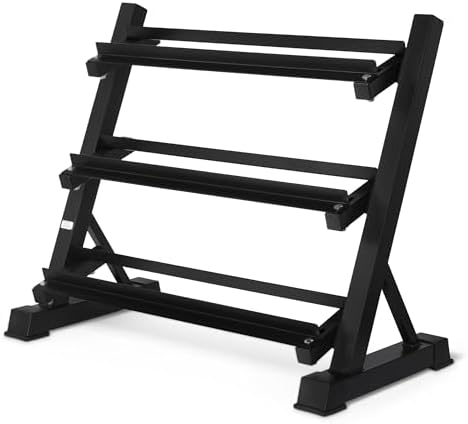
Best Storage: Amazon Basics 3-Tier Adjustable Dumbbell Weight Rack
Read the product name carefully: stand only. No dumbbells included. That sounds obvious until you order one expecting a set.
What you get is a black steel stand with three tiers, and three tiers is the right number for a home gym because it separates light, medium, and heavy pairs without a label. You stop digging. You stop bending over a pile. You stop skipping the set because loading up is a chore.
Stability is the thing to verify before you load it. A rack that tips when you pull the top pair off is worse than no rack at all, so check the listed capacity against your heaviest pair and set the heavy ones low. Steel is steel, but assembly matters: a rack bolted together loosely will wobble forever, so tighten it fully, then recheck after a week of use.
If you already own pairs and they live on the floor, this is the cheapest upgrade to how your gym feels. If you are buying the CAP set above, it comes with its own two-tier rack and you do not need this one.
What to check before you buy anything
Knurling is the soul of a dumbbell. Too smooth and you are fighting grip on every pull. Too sharp and your hands are raw by week two. Run your hand down the handle. If it feels like a cosmetic pattern stamped into metal, you will be chalking up constantly. If it bites, it will hold chalk, and holding chalk is the whole job.
Hex heads beat round heads for home use, every time. Round heads roll, and they roll exactly where you do not want them: under your feet, under the bench, across the garage. Hex heads stay put.
Then there is plate wobble. Spin the head. Any movement between plate and handle means the weld is not doing its job, and a dumbbell that rattles at the top of a curl will rattle louder at the bottom of a row. Labels matter too. If a weight is off by more than a couple of percent, your program is built on numbers that are not real.
For adjustables, the mechanism is the purchase. Dial, crank, or collar, it does not matter which, only whether it survives hundreds of changes without jamming. Chalk makes that worse, not better, so test the change with dusty hands if you can.
Finally, decide where the set lives before you buy it. Floor space is the most expensive thing in a home gym.
The home gym dumbbell reference table
This is the table I keep when clients ask what to buy first. Every row is a different job, not a different quality tier.
| Product | Type | Set size | Best for | Price |
|---|---|---|---|---|
 Visit on Amazon → Visit on Amazon →CAP 150 LB Dumbbell Set with 2-Tier Rack |
Rubber hex fixed set | 150 lb with rack | A complete first purchase | Check current Amazon price |
 Visit on Amazon → Visit on Amazon →CAP Rubber Coated Dumbbell Weights |
Rubber coated hex, pairs and sets | Sold as pairs and sets | Filling gaps in an existing set | $23.38 |
 Visit on Amazon → Visit on Amazon →44LB Adjustable Dumbbell Set |
Adjustable 4-in-1 with barbell, kettlebell, push-up stand | 44 lb total | Small spaces and first programs | Check current Amazon price |
 Visit on Amazon → Visit on Amazon →Amazon Basics 3-Tier Dumbbell Weight Rack |
Storage stand only | Holds three tiers of dumbbells | Getting pairs off the floor | $94.49 |
The pattern is simple. If you want a real set and a real rack in one order, the CAP 150 LB package is the shortest path. If you already own dumbbells, buy pairs as you grow and put them on a stand. If space is the constraint, start adjustable.
Should you buy the CAP 150 LB Dumbbell Set with 2-Tier Rack?
Yes, if you want fixed pairs and you are done thinking about mechanisms. Rubber hex heads do not roll, the horizontal rack keeps the set at waist height, and 150 pounds covers a lot of pressing, rowing, and curling. The tradeoff is a fixed range. If your working weights climb past the top pair, you will add to the rack later. That is a normal thing for a home gym to do.
Should you buy the CAP Rubber Coated Dumbbell Weights?
Yes, if you are filling gaps rather than starting over. Buying individual pairs is how a rack gets built sensibly. Match handle feel to what you already own, and spend your attention on the grip, because that is what your hands meet on every rep.
Should you buy the 44LB Adjustable Dumbbell Set?
Yes, if your training space is small and you want one box that does four jobs. Just go in with clear eyes: 44 pounds is a starting point, and the collars need a check before every session. It is a great first set and a poor forever set, and those are two different purchases.
Should you buy the Amazon Basics 3-Tier Dumbbell Weight Rack?
Yes, if your dumbbells currently live on the floor. Three tiers, steel, black, and a vertical footprint that hugs a wall. Just remember it ships as a stand only, so the weights are a separate purchase, and you should set your heaviest pairs on the lowest tier.