Buying home gym dumbbells looks like a simple math problem: pick a weight, buy two, done. Then you train for three months and the math falls apart. The 20s that felt heavy in week one are warm-up weight by week ten, and now you need 25s, 30s, and something heavier for rows that the pair you own cannot cover. Multiply that by a rack of fixed pairs and you are looking at hundreds of pounds of iron parked in a corner of a garage, plus the floor space it eats and the cost of every jump in weight.
That is the real decision behind home gym dumbbells: not which single pair is heaviest, but which format keeps pace with you as your program changes. There are four honest answers here, and they are not interchangeable. One set changes load, one set never changes load, one set is built for high reps and light work, and one item on this list is not equipment at all. Sorting them out first is what stops you from buying the wrong thing twice.
Related: Adjustable Dumbbell Mechanisms Explained →
Quick answer
For most home lifters, one adjustable set that spans a wide load range does more work per square foot than a wall of fixed pairs, because it is the only format that grows with you without new purchases. Fixed hex dumbbells remain the standard when you want a pair that never needs adjusting and sits flat on a rubber floor. Light coated hand weights cover the high-rep, aerobics, and rehab end of the range, and a laminated chart is a programming aid rather than a piece of equipment. What you should avoid is buying three overlapping cheap sets that cover the same loads badly.
Four useful options
| Model | Best fit | What stands out |
|---|---|---|
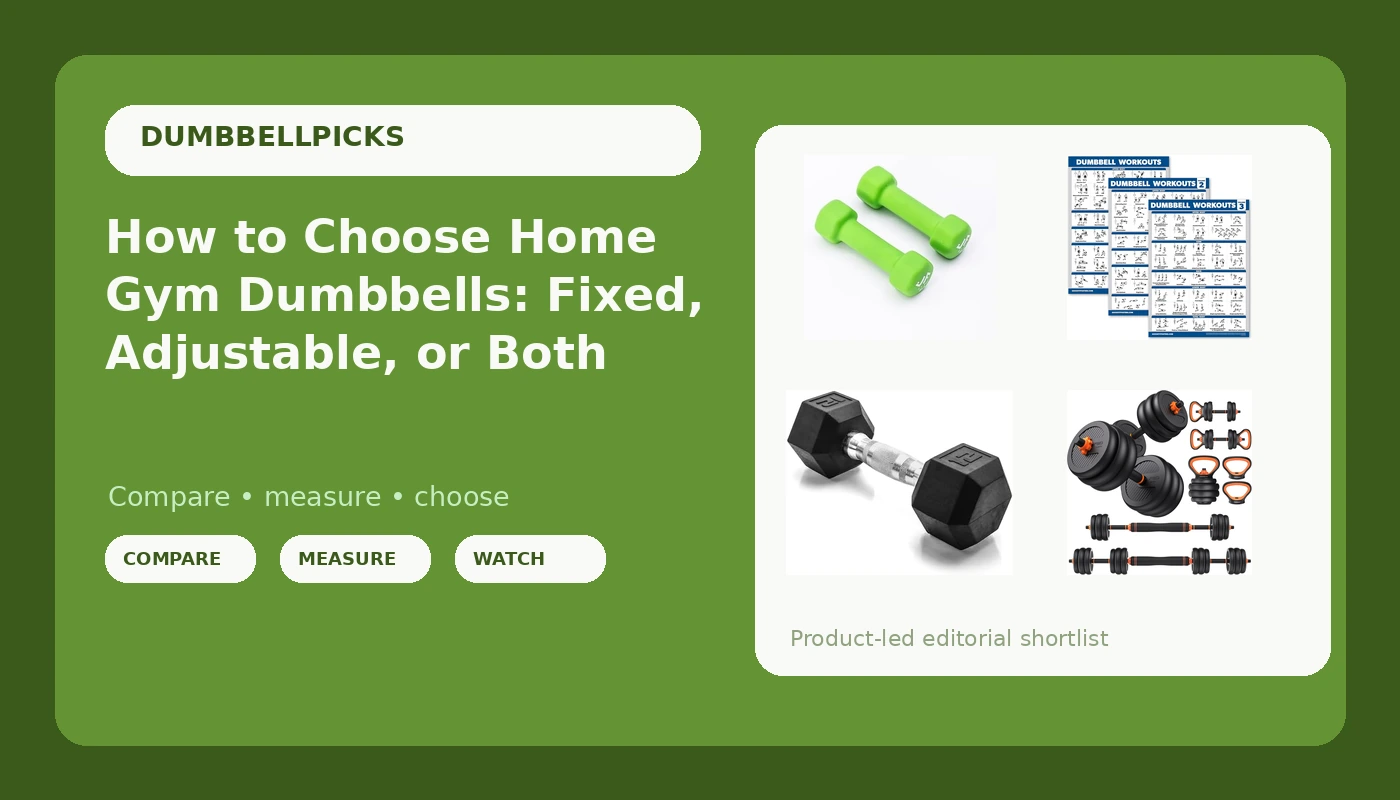
| FEIERDUN DS2 Adjustable Dumbbells | One purchase that covers a wide load range | Adjustable free weight set with a connector and 5 in 1 use as barbell, kettlebells, push up stand, and weight plate |
| JFIT Dumbbell Pairs or Sets | Light, high-rep, and aerobic work | Neoprene and vinyl coated hand weights sold as pairs or sets |
| Palace Learning 3 Pack Dumbbell Workout Posters | Programming reference on the wall | Three laminated 18" x 24" exercise charts covering Volumes 1, 2, and 3 |
| CAP Rubber Coated Dumbbell Weights | A fixed pair that stays put | Anti-roll hex heads with rubber coating and comfort grip handles, sold as singles |
The adjustable set: FEIERDUN DS2 Adjustable Dumbbells
The case for an adjustable set is simple arithmetic. A fixed rack only holds the weights you bought, so a program that calls for 15s on lateral raises and 60s on rows needs both ends of that range sitting on the floor at once. An adjustable set collapses that range into one pair of handles. The trade-off is that you are now trusting a mechanism instead of a solid casting, and mechanisms are where adjustable sets live or die. Before committing, change the load from lightest to heaviest and back several times, checking whether the selector moves smoothly and whether the plates sit tight against each other. A set that rattles at the top of a press is a set you will stop using.
The connector is the part people overlook. Joining two dumbbells into a barbell is genuinely useful for floor presses, hip thrusts, and rows, but only if the joint locks up solid. If the two halves feel like separate objects twisting against each other, treat it as a dumbbell set that happens to have an accessory rather than a barbell replacement.
The light hand weights: JFIT Dumbbell Pairs or Sets
Coated hand weights solve a different problem than an adjustable set does. They are for the high-rep end of training: raises, curls, shadow boxing, step work, and the kind of circuit where you are holding a weight for two minutes rather than pressing it for five reps. The coating matters more than the shape here, because sweaty hands on a bare handle during a fast circuit is how weights end up on the floor. A coated surface also protects wood and laminate, which is often the reason someone buys a set like this in the first place.
The limit is honest and worth stating plainly: light coated hand weights are not a substitute for a heavy set. Once your working weights climb, you will want a pair that can take a drop without the coating cracking. Think of this as the accessory layer of a home gym, not the foundation.
The reference charts: Palace Learning 3 Pack Dumbbell Workout Posters
It would be easy to skip this one, and that would be a mistake in a specific kind of home gym: the one where the dumbbells are the entire gym. When you train in a garage or a spare room, the friction is rarely the weight itself. It is not knowing what to do next, so you default to the same four movements for a year. A laminated chart on the wall does one job well, which is to give you a visible menu of variations without unlocking a phone between sets.
What it cannot do is progress your load for you, correct your form, or replace a written program. It is a reference, not a coach. If you already follow a structured plan, this adds little. If you are the person who walks into the garage and improvises, it is the cheapest fix on this list.
The fixed hex workhorse: CAP Rubber Coated Dumbbell Weights
Fixed hex dumbbells are the baseline that every commercial floor is built on, and the reason is geometry. A hex head does not roll. You set it down between sets and it stays exactly where you put it, which sounds trivial until you have chased a round dumbbell under a car. The rubber coating does the other half of the work, absorbing contact with a concrete or rubber floor and cutting down the clang that makes a garage gym feel like a punishment.
Two details are worth knowing before you buy. First, these are sold as singles, so a working pair means ordering two of the same weight. Second, the handle option is not cosmetic. Black, chrome, and comfort grip handles feel different in the hand, and the one you pick determines how the dumbbell behaves during a long set of farmer carries. The trade-off with any fixed set is that it only holds the weights you bought, so most people pair one or two fixed pairs with an adjustable set rather than choosing between them.
Prices and availability may change. Product images, names, and retailer links must be matched by verified ASIN. Do not state a current price, rating, stock status, or measured result without current evidence.
What an adjustable mechanism actually costs you
Every adjustable set trades something for its range. The obvious cost is money per pound, but the more important cost is time and attention. Changing load on a dial, a pin, or a collar takes seconds, and those seconds add up across a session with short rest periods. That is not a reason to avoid adjustables. It is a reason to test the changeover before you buy, because a mechanism that fights you on rep one will still be fighting you on rep forty.
The second cost is length. Adjustable dumbbells are almost always longer than a fixed dumbbell of the same weight because the plates have to stack somewhere. A longer handle changes where the load sits relative to your wrist, which you will notice most on pressing movements. If your training is built around heavy bench and overhead work, a long adjustable handle is a genuine consideration, not a detail.
The third cost is fragility under chalk and drops. Fixed cast dumbbells tolerate being set down hard. Adjustable sets tolerate it less, which is why the honest rule is that you drop what you can afford to replace. If your program includes heavy dumbbell snatches and you plan to dump the weight, fixed is the format built for that.
Knurling, coating, and handle feel
Grip is the most underrated variable in a home set, because it is the one you feel on every single rep. A handle with no texture forces you to squeeze harder, and that grip fatigue shows up before the target muscle does. A handle with aggressive texture can tear your hands on high-rep sets. The right answer is usually in the middle, and it is personal.
Coating plays a related role. Rubber and urethane coatings protect floors and reduce noise, which matters in a garage or a shared wall apartment. Neoprene and vinyl coatings on lighter weights are easier on hands during fast circuits. Bare metal is the most durable surface and the least forgiving of a concrete floor.
Handle diameter and shape matter too. A thicker handle is harder to hold, which is useful for grip work and annoying for everything else. Comfort grip options exist for a reason, and if your hands are small or your training is high volume, they are worth taking seriously.
Here is a simple way to work through the decision:
- Write down the working weights your current program actually uses, in pounds, for the heaviest and lightest movement.
- Measure the floor space you are willing to give up, including where you will set the weights down between sets.
- Decide whether you will ever drop the dumbbells, because that single answer rules formats in or out.
- Count how often you change weight within one session. Frequent changes favor a fast mechanism; rare changes favor fixed pairs.
- Buy the smallest set of equipment that covers the full range you wrote down, rather than the largest set you can afford.
Setting up a small home gym around one pair
- Start with the range, not the brand. Cover your heaviest and lightest working weights before you worry about finish.
- Put the weights where you will actually use them. A set stored in a closet gets trained less than a set on a stand.
- Protect the floor before you need to. Rubber tiles or mats cost far less than replacing concrete or laminate.
- Keep one light coated set for warm-ups, circuits, and rehab work, and one heavy set for real loading.
- Write the program down or put it on the wall. Equipment without a plan becomes a coat rack.
Which option should you choose?
Choose the FEIERDUN DS2 Adjustable Dumbbells when you want one purchase that covers a wide load range and you are willing to treat the mechanism as the part that matters most. Choose the CAP Rubber Coated Dumbbell Weights when you want a fixed pair that never needs adjusting and you plan to set the weights down hard, remembering that they are sold as singles. Choose the JFIT Dumbbell Pairs or Sets when your training lives in the high-rep, aerobic, and light strength range. Choose the Palace Learning 3 Pack Dumbbell Workout Posters when the dumbbells are your whole gym and you want a visible menu of movements on the wall.
The caveat that applies to all four: this is a format decision, not a ranking. The right format depends on your program, your floor, and how you train, and no product description can settle that for you. Check the specifications on the product page against the numbers you wrote down before you buy.
The bottom line
The dumbbell that keeps pace with you beats the dumbbell that is heaviest on day one. An adjustable set buys range in exchange for a mechanism you have to trust. A fixed hex pair buys simplicity and durability in exchange for a fixed load. Light coated hand weights cover the work that heavy iron does badly, and a laminated chart fixes the problem that equipment cannot, which is not knowing what to do next. Pick the format that matches how you train, buy the smallest set that covers your real range, and spend the difference on floor protection and a plan.