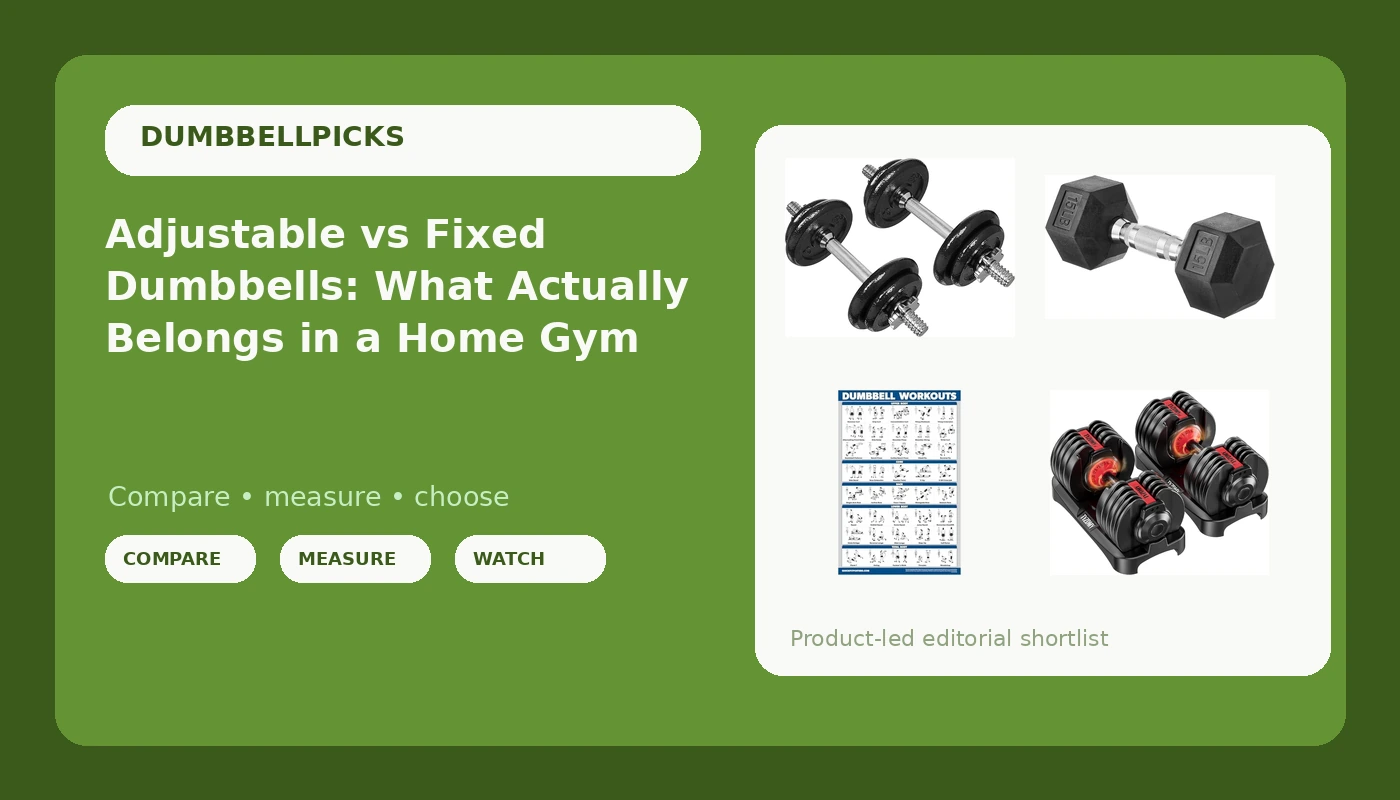
Most home gyms get built backwards. The rack shows up first, then the barbell, then a bench, and only a few months later does it become obvious that the dumbbells are the thing getting used every single session. Sorting out adjustable dumbbells for home gyms is the decision that keeps resurfacing, because the category splits into two clean families: sets that change load through a mechanism, and fixed pairs that never change at all.
Neither family wins outright, and that is the part most buying advice skips. A portable 38-pound set, a pair of adjustable free weights, a single rubber hex dumbbell, and a laminated workout chart answer four different questions. Plenty of people end up needing two of them rather than one. What follows is what each option is actually for, and how to tell which one belongs on your floor.
Related: How Much Dumbbell Weight Do You Actually Need at Home? →
Quick answer
For a first home setup, an adjustable set usually covers the most exercises in the least floor space, and a single rubber hex dumbbell is the simplest way to add fixed load for curls, rows, and carries. A printed chart is a programming aid rather than equipment. The deciding factors are how much space you are willing to give up, whether you want to change weight between sets, and whether you train alone or with someone at a very different strength level.
Four useful options
| Model | Best fit | What stands out |
|---|---|---|
| TYZDMY Adjustable Dumbbells Set of 2,Free Weights Dumbbells Set | Progressive loading in a small footprint | Sold as a pair with adjustable free weights |
| Amazon Basics Adjustable Dumbbell Hand Weight Set with Storage Case, Portable, Secure, 38 Pounds, Black | Portable, contained starter set | 38-pound set that packs into its own case |
| Amazon Basics Rubber Hex Dumbbell Hand Weight | Adding fixed load for curls, rows, and carries | Rubber-coated hex head that resists rolling |
| Palace Learning Dumbbell Workout Exercise Poster - Free Weight Body Building Guide | Home Gym Chart - LAMINATED, 18" x 24" | Programming reference on the wall | Laminated 18 by 24 inch chart |
The adjustable pair: TYZDMY Adjustable Dumbbells Set of 2,Free Weights Dumbbells Set
The part worth inspecting on any adjustable pair is the connection between the handle and the plates. A set that shifts under a fast set of rows or a loaded farmer carry is not a set you will keep using. Think about how long the weight change takes, too. A mechanism you can operate in a few seconds gets used every session, while one that takes a minute per side quietly turns a superset into a rest period. If you share the set with a partner who lifts at a different strength level, changing load per hand matters far more than the top end of the range.
The portable set: Amazon Basics Adjustable Dumbbell Hand Weight Set with Storage Case, Portable, Secure, 38 Pounds, Black
A 38-pound set is a starting point, not a ceiling, and that framing matters more than any spec sheet. It is a genuinely good fit for someone beginning a program, for light pressing and lateral raise work, for rehab-style loading, and for anyone who needs to carry the whole set to another room. It is a poor fit for a lifter already rowing heavy, because the load runs out long before the training does. Buy it for where you are now and accept that a second purchase is likely later.
The fixed hex option: Amazon Basics Rubber Hex Dumbbell Hand Weight
The trade-off with fixed is the mirror image of adjustable. There is no mechanism to check, no collar to tighten, and nothing to wobble between reps. What you lose is range: covering a full program with fixed dumbbells means many pairs, and many pairs mean both money and floor space. The practical middle ground is to own one or two fixed dumbbells at the weights you use most often, usually whatever you curl and whatever you carry, and let an adjustable set handle everything that changes week to week.
The reference chart: Palace Learning Dumbbell Workout Exercise Poster - Free Weight Body Building Guide | Home Gym Chart - LAMINATED, 18" x 24"
A wall chart is a session-management tool, not a program written for you. It keeps a workout moving and it gives a beginner a vocabulary of movements to choose from. What it cannot do is decide that your shoulders need more horizontal pulling than pressing, or that your squat pattern is lagging. Use it as a menu, and keep your own log of what you actually did and how it felt.
Prices and availability may change. Product images, names, and retailer links here are matched to specific models. Confirm current specifications, load ranges, and pricing on the retailer page before you buy.
How an adjustable mechanism changes what a set can do
Adjustable dumbbells are not one product category. They are at least three, and the mechanism is what separates them.
The first family is the selector style, where a dial or a lever moves an internal pin and the handle picks up a chosen stack of plates. These are the fastest to change, often a few seconds per hand, which is why they dominate small apartments. The weakness lives inside the handle. Springs, plastic detents, and sliding pins are the parts that fail, and chalk is the enemy: grit works into the mechanism and the dial starts to stick.
The second family is the plate-and-pin design, where you load plates onto a handle and slide a pin or a locking collar through. Fewer moving parts, generally more durable, and usually slower to change. Watch for plate rattle here. If plates shift on the handle during a set, the load is moving independently of your hand, and that is the same as a loose collar on a barbell.
The third family is the threaded handle with spinlock collars. This is the cheapest to manufacture and the most annoying to live with. Collars back off under vibration, plates clang, and the changeover time kills any superset you had planned.
The weight range on the box is the least important number in this decision. A set rated to a very high number that wobbles at half that load is worse than a modest set that stays tight. Weight labels on budget plates are also worth verifying if precision matters to you; a plate that runs a couple of percent light is not dangerous, but it does quietly corrupt your logbook. If you are chasing a number, weigh the plates once and write the real figure down.
What knurling and head shape tell you before you buy
Run a hand down a handle before you commit to it. Knurling is the grip pattern cut into the steel, and the difference between a good one and a decorative one shows up in the last three reps of a set of rows. Diamond knurling bites in more directions and holds chalk better. Straight knurling is milder and kinder to high-rep work. Too smooth and you are fighting grip the whole session. Too sharp and you are taping your hands by week two. Most home lifters land somewhere in the middle, and a coated handle is a reasonable compromise if your hands are not conditioned yet.
Head shape is the other quiet decision. Round heads roll. Hex heads stop. In a garage or a spare bedroom, a dumbbell that rolls under a shelf every time you set it down is a dumbbell you stop using for anything fast. Rubber coating adds a second benefit: it protects a concrete floor and it protects the dumbbell when it gets set down harder than intended. Some rubber compounds have a strong smell out of the box, and that usually fades with air and time rather than with cleaning.
Handle diameter matters as well, and it is rarely listed clearly. A thicker handle turns a curl into a grip exercise. A thin one is comfortable until the load climbs, then it rolls in your palm.
- Measure the floor space you are actually willing to give up, including the space a set needs when it is sitting idle.
- Write down the working weights from your current program, then buy for those numbers rather than for the numbers you hope to hit.
- Decide whether you need both hands loaded at the same weight at the same time, or whether a single dumbbell covers most of your work.
- Read how the load changes on any adjustable set, because changeover time decides whether you actually use the adjustment.
- Add one fixed dumbbell at your most-used weight and a wall chart for your programming, then fill gaps later.
Practical guidance for a small dumbbell setup
- Store plates low and heavy at the bottom, so nothing tips when you reach for a handle mid-set.
- Hang the chart at eye level near where you start each exercise, not across the room.
- Wipe rubber heads down periodically, since chalk and dust turn into grit that migrates into adjustable mechanisms.
- Treat adjustable sets gently. Dropping a selector-style dumbbell is the fastest way to end its service life.
- Re-check collars and locking pins at the start of every session, before the first working set rather than after.
- Keep a simple log of load and reps. It tells you when a set has run out of range far earlier than your memory will.
Which option should you choose?
Choose the TYZDMY Adjustable Dumbbells Set of 2,Free Weights Dumbbells Set when you want both hands loaded at once and expect your working weights to climb over the next year. Choose the Amazon Basics Adjustable Dumbbell Hand Weight Set with Storage Case, Portable, Secure, 38 Pounds, Black when you want a contained, portable set that stows in a closet and 38 pounds covers where your training is right now. Choose the Amazon Basics Rubber Hex Dumbbell Hand Weight when you want grab-and-go load with no mechanism to check and no plates to assemble. Choose the Palace Learning Dumbbell Workout Exercise Poster - Free Weight Body Building Guide | Home Gym Chart - LAMINATED, 18" x 24" when the missing piece is not equipment but a plan you can see from the rack.
None of this replaces knowing your own numbers. Load ranges, plate tolerance, handle diameter, and mechanism feel vary between sets, and the honest test is your own training log over a few months. Verify current specifications on the product page before you buy, because listings and included hardware change.
The bottom line
The dumbbell is the tool; the rep quality is the workout. Buy the set that matches the way you train today, keep it tight, and add load as your log demands it. An adjustable pair handles the changing work, a fixed hex dumbbell handles the fast grab-and-go work, and a laminated chart handles the part where you stand in the middle of the room wondering what comes next. Get those three roles filled and you have a home gym that keeps working long after the novelty wears off.