The dumbbell aisle is the easiest place in a home gym to waste money. Go looking for "a set of dumbbells" and you can come home with a pair of two-pound vinyl-coated hand weights, a wide-range adjustable pair you never change past 40 pounds, or a training book and no weights at all. None of those is a bad purchase. They answer different questions, and the packaging almost never tells you which question it is answering.
Choosing dumbbells for a home gym is really three decisions stacked on top of each other: how much load you need over the next few years, whether that load lives in one space-saving mechanism or is spread across fixed pairs, and what your hands think of the handle. Get the grip wrong and every rep turns into a fight with your forearms. Get the mechanism wrong and the dumbbell stays on the floor. Get the load ceiling wrong and you own a set that stopped being useful in month four.
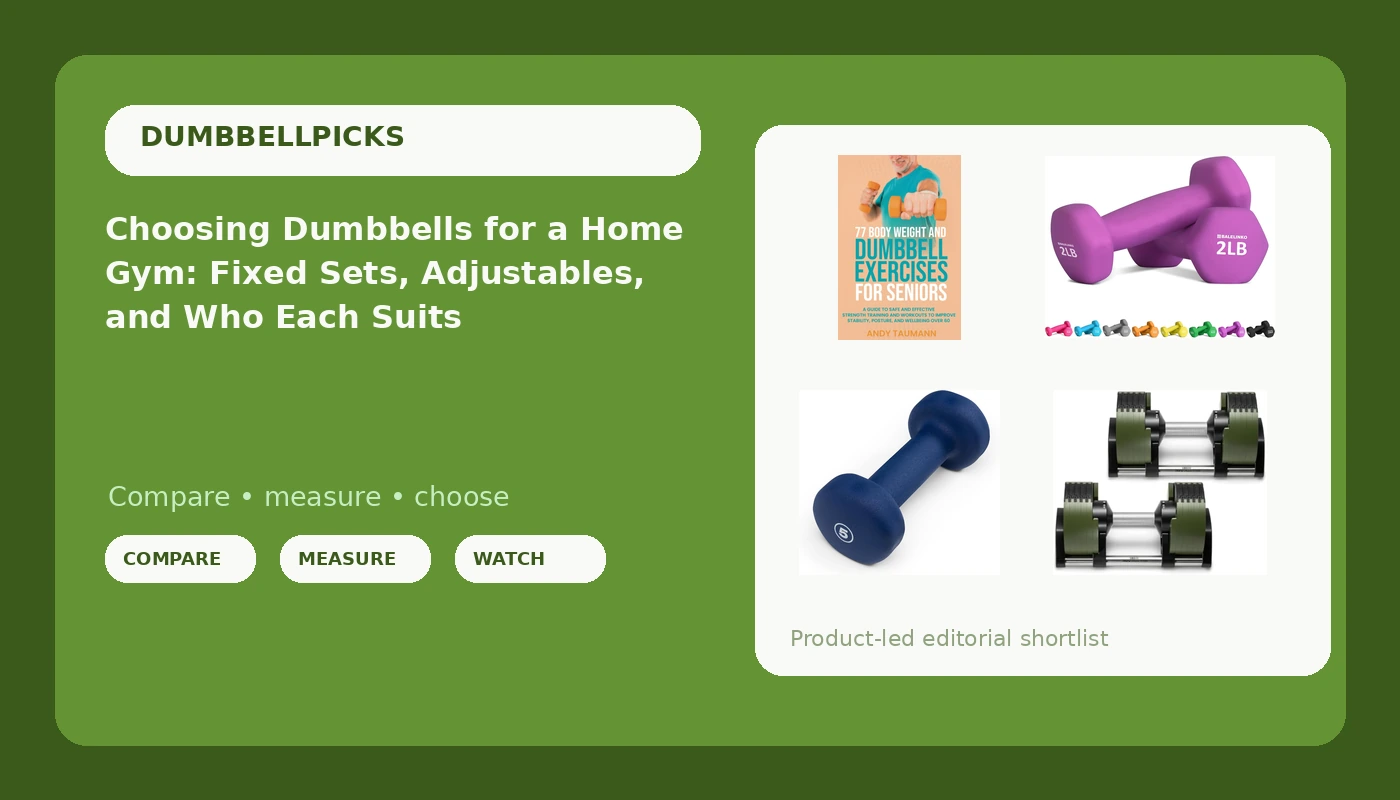
The four products below sit at four different points on that map: a wide-range adjustable set, a light fixed hand weight sold by the single, an inexpensive starter set, and a training book aimed at older lifters. Each one solves a real problem, and each one is the wrong answer to somebody else's problem.
Related: Adjustable vs Fixed Dumbbells: Which Belongs in a Small Home Gym →
Quick answer
There is no single winner here, because these four products do genuinely different jobs. If you want one pair that covers a wide range of loads without eating your floor space, the NUOBELL adjustable set is the first thing to look at. If you want light, easy-to-grab weights for high-rep, rehab, or walking work, Marcy's neoprene hand weights let you buy exactly the weight you need, one at a time. If the goal is simply to start training at home on a small budget, the Balelinko set is an entry point. And if the missing piece is a plan rather than hardware, the seniors-focused exercise book is the least expensive fix on this list.
Four useful options
| Model | Best fit | What stands out |
|---|---|---|
| SMRTFT NUOBELL Adjustable Dumbbells 5-100 lb Set | One pair covering a wide range of loads | 26 weights in 1, steel-knurled handle, 2-year warranty |
| Marcy Colored Neoprene Dumbbell Hand Weights | Light, high-rep, and rehab-style work | Sold in singles, neoprene coated |
| Balelinko Home Gym Equipment Dumbbell Set | A first set on a tight budget | Sold as a set for strength, Pilates, and yoga |
| 77 Body Weight and Dumbbell Exercises for Seniors | Structure and programming for older lifters | 77 exercises aimed at adults over 60 |
The wide-range adjustable: SMRTFT NUOBELL Adjustable Dumbbells
An adjustable pair is the only way to get from a 10-pound warm-up curl to a heavy set of rows without turning a garage wall into a dumbbell rack. The trade-off is mechanical. Fixed pairs have no moving parts to foul, and a wide-range adjustable lives or dies on the change mechanism and how it holds up to chalk, dust, and being set down hard between sets. It also costs more upfront than one pair of fixed dumbbells, and you feel that cost before you feel the convenience. If you train alone, change loads constantly, and have limited space, that math usually works. If you plan to drop the dumbbells from waist height after every set, fixed rubber hex pairs are the more forgiving route.
The light fixed pair: Marcy Colored Neoprene Dumbbell Hand Weights
Light fixed weights are a real category, not a starter toy. They belong in warm-ups, rehab protocols, high-rep shoulder work, walking and hiking training, and any program where the point is controlled movement rather than maximum load. Buying singles is the underrated part: many people need a 7 or a 12 on one side and not on the other, and pairs force you to pay for a duplicate you will not use. The limit is obvious and worth saying plainly. A light neoprene pair is not a strength-building tool for someone who can already press real weight, and it is not meant to be. It is the right purchase when light is the whole assignment.
The budget starter set: Balelinko Home Gym Equipment Dumbbell Set
A budget set is a beginning, and beginnings are worth something. The thing to understand before you buy is the ceiling. Sets in this category are built around light loads and general conditioning, so they will serve mobility work, higher-rep circuits, and someone who has never trained before. They will not serve a lifter who wants to progress a goblet squat or a row for months on end, because the working weight climbs past what the set offers. That is not a flaw in the product, it is a mismatch in expectations. If you know you will want heavy dumbbells within a year, put the money toward the adjustable pair instead.
The programming companion: 77 Body Weight and Dumbbell Exercises for Seniors
Most home gyms do not fail because of bad equipment. They fail because nobody wrote down what to do on Tuesday. A structured book solves that problem for less than the cost of a single dumbbell, and it works alongside any of the three options above. Two things to check before buying: whether the exercises call for dumbbells you actually own, and whether the progression matches where you are starting from. A book written for adults over 60 is not a beginner-only book, but it does assume a conservative starting point and a focus on joint health and stability rather than maximum load.
Prices and availability may change. Product images, names, and retailer links must be matched by verified ASIN. Do not state a current price, rating, stock status, or measured result without current evidence.
What knurling and handle shape actually change
Knurling is the texture cut into a dumbbell handle, and it is the difference between a dumbbell that feels like a tool and one that feels like a bar of soap. A diamond pattern bites harder than a straight milled pattern, and a finer pitch generally feels sharper against the palm than a coarser one. Chrome plating looks good in photos and gets slick once your hands get sweaty, which is why lifters keep chalk nearby: chalk fills the valleys of the texture and improves friction without adding sharpness.
Handle diameter matters as much as the pattern. A thicker handle spreads the load across a wider palm and asks more of your grip, which is fine for carries and rows and annoying for high-rep pressing. A thinner handle lets your fingers wrap further around, which most people find easier to hold. The practical test is simple: grip the handle before you buy it if you can, and ask whether the texture feels like it is helping you hold on or punishing your calluses. Aggressive knurling on a dumbbell you use for 20-rep sets is a mistake, and so is a polished handle on something you plan to row heavy.
Head shape is the other half of the grip story. Hex heads sit still on the floor, on a bench, and on the top of your shoe between sets. Round heads roll, and a rolling dumbbell is a dumbbell you chase across the garage at 6 a.m. This is why rubber hex has become the home gym default, and it is worth applying the same logic to lighter hand weights too.
Adjustable mechanisms versus fixed pairs
The core trade-off is simple. Fixed pairs give you one weight per dumbbell, no moving parts, and nothing to adjust. Adjustables give you many weights in one pair, which costs less per pound and takes up far less floor space, in exchange for a mechanism that has to work every single time.
Three things decide whether an adjustable set works for you. The first is the mechanism itself, because that is the part that fails. A dial or selector that moves cleanly when your hands are chalky and tired is worth more than a wider weight range. The second is the weight increments. A set that jumps in 10-pound steps is a poor match for upper-body pressing, where a 5-pound jump is already significant; the number of settings matters less than whether the settings land where your lifts actually live. The third is storage. Most adjustable sets live in a cradle or tray, and that tray occupies permanent floor space, so measure before you commit.
Fixed pairs win on durability and feel. There is no selector to jam, no plate to wobble loose, and nothing to remember. What they cost you is space and money as the weights climb. A realistic path for many home gyms is a wide-range adjustable pair for the bulk of the work plus one or two light fixed pairs for warm-ups, rehab, and anything where grabbing and going matters more than load.
Five steps to make this decision without guessing:
- Write down the lifts you will actually train and the working weight for each one today.
- Project those numbers forward 12 months and note the heaviest load you expect to need.
- Decide the smallest weight jump your program requires, then check whether the options you are considering can make it.
- Measure the floor space you can give up permanently, including any stand or tray.
- Set a budget for the whole path, not just the first purchase, and decide whether you would rather buy twice or buy once.
Practical guidance before you order
- Buy singles when you need an odd weight. Paying for a duplicate dumbbell you will never pick up is the most common wasted dollar in a home gym.
- Give the dumbbells a permanent home. A rack, tray, or shelf keeps hex heads off the floor and stops light weights from migrating under the car.
- Treat chalk and hand care as part of the purchase. A wire brush and a pumice stone keep calluses from tearing on aggressive texture.
- Do not buy for the top of the weight range. Buy for the range you will use in the next six months, then check that the next step up is available.
- Write the program down before the equipment arrives. A book or a simple plan turns three pairs of dumbbells into an actual training block.
Which option should you choose?
Choose the SMRTFT NUOBELL Adjustable Dumbbells 5-100 lb Set when you want one pair to cover a wide spread of loads, you train alone, and floor space is the constraint. Choose the Marcy Colored Neoprene Dumbbell Hand Weights when your work is light and high-rep, when you need a single odd weight rather than a pair, or when you want something comfortable to grab for warm-ups, walking, and rehab. Choose the Balelinko Home Gym Equipment Dumbbell Set when you are starting from zero, the budget is tight, and general conditioning rather than heavy progressive loading is the goal. Choose 77 Body Weight and Dumbbell Exercises for Seniors when you already have weights and what you are missing is a structured, joint-friendly plan.
One honest caveat: the guidance above is based on product specifications and general training principles, not on a long-term durability test of these specific items. The mechanism inside an adjustable set and the weld inside a fixed dumbbell are the parts that decide how long it lasts, and neither is visible in a product photo. Buy from a seller with a workable return policy, inspect what arrives, and treat the first month as an audition.
The bottom line
There is no universal best dumbbell, only the right dumbbell for the job you are hiring it to do. A wide-range adjustable pair buys you range and saves you space. A light neoprene single buys you the exact weight you need and nothing more. A budget starter set buys you a low-risk way to begin. And a training book buys you the part most home gyms never get around to: a plan. Decide which of those four problems is actually yours, and the choice stops being complicated.