I started lifting in a two-car garage in Denver with a mismatched pile of hex dumbbells and a wooden rack I built badly. Twelve years and a 4,000-square-foot facility later, I still judge iron the same way I did back then: would I hand this to a paying client at 6 a.m. and never think about it again? That question is why this comparison exists. Choosing a dumbbell rack for home gym use looks like a storage decision. It is actually a training decision, because the rack you buy decides which dumbbells you can own, and the dumbbells you own decide which programs you can run.
Here is the honest framing before the four options below. If you already own fixed dumbbells, buy a stand and be done with it. If you own nothing, buy a set that ships with a rack built for those exact heads, because matching a stand to odd-size hex heads after the fact is where most home gyms go wrong. And if your training space is a spare bedroom rather than a garage, an adjustable set with a connector will buy you more exercises per square foot than any fixed set ever will.
Related: Adjustable Dumbbells vs Fixed Hex: Which Belongs in a Home Gym
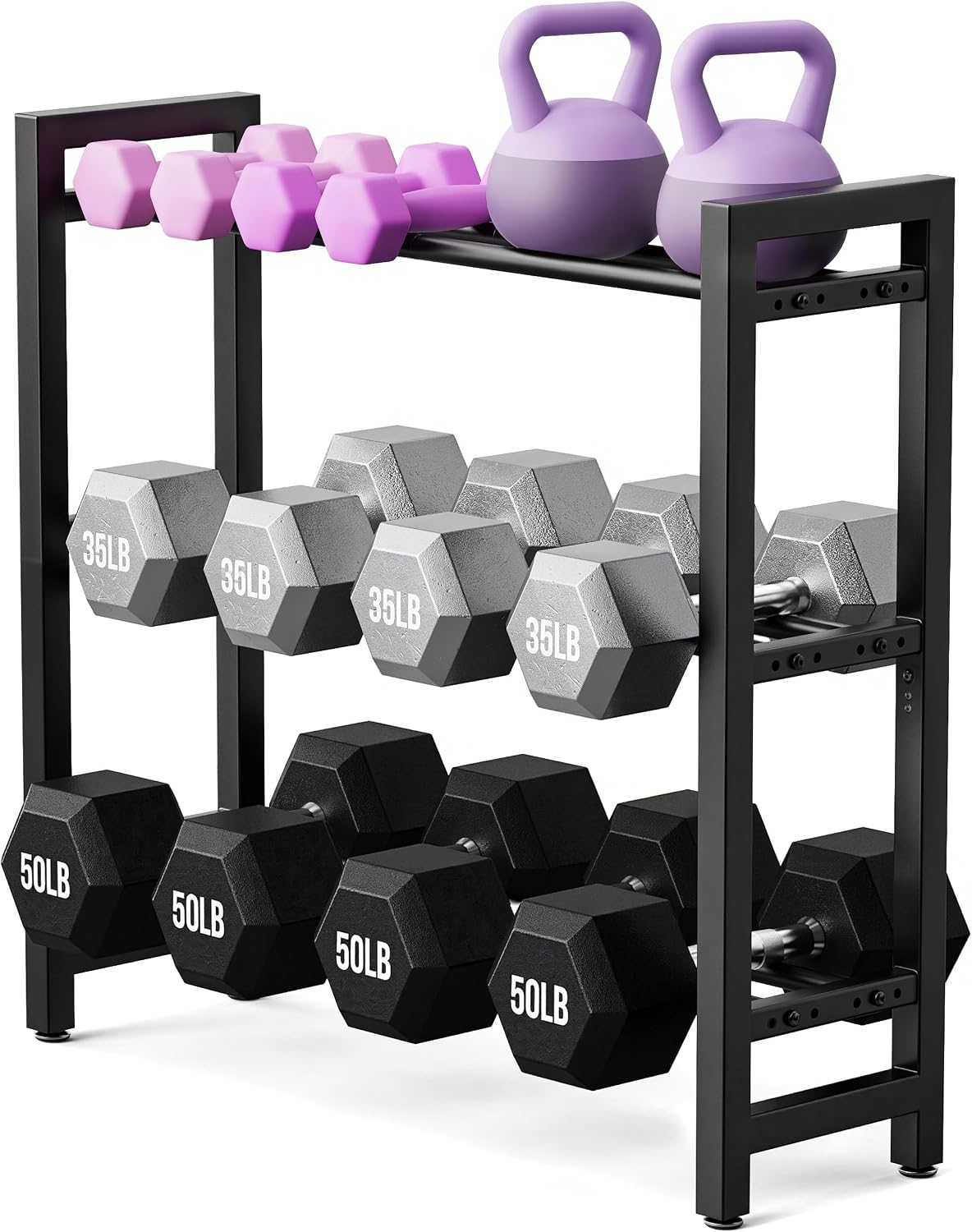
3 Tier Dumbbell Rack, Weight Rack for Home Gym
The simplest way to get weights off the floor: three tiers, a plain frame, nothing to adjust and nothing to fail
Fixed tier spacing means it suits the head sizes it was designed around and not much else
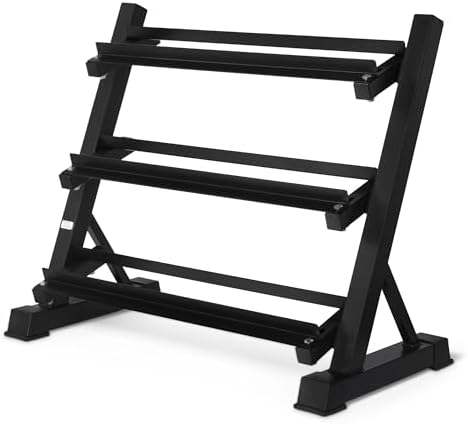
Amazon Basics 3-Tier Adjustable Dumbbell Weight Rack, Sturdy Steel Stand Only, Black
Adjustable tiers mean the stand can grow with your set instead of being outgrown by it
Stand only, so it does nothing for you until you already own dumbbells
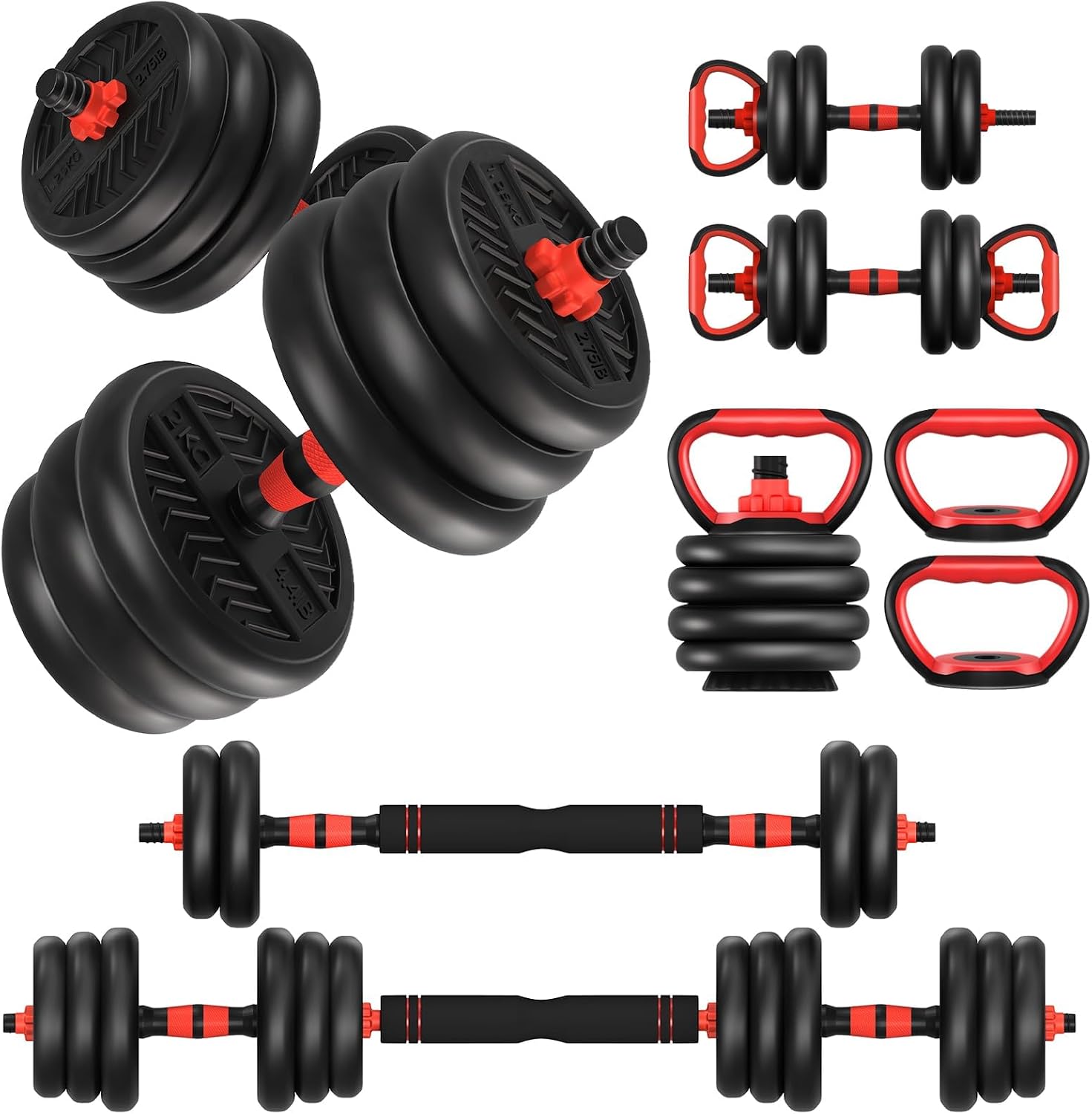
Adjustable Dumbbells, 20/30/40/60/80lbs Free Weight Set with Connector, 4 in 1 Dumbbells Set Used as Barbell/Kettlebells/Push up Stand
One purchase covers dumbbells, a connector barbell, kettlebell and push-up configurations, which is a lot of training per square foot
Plate changes cost time mid-session, and a connector is not a real barbell
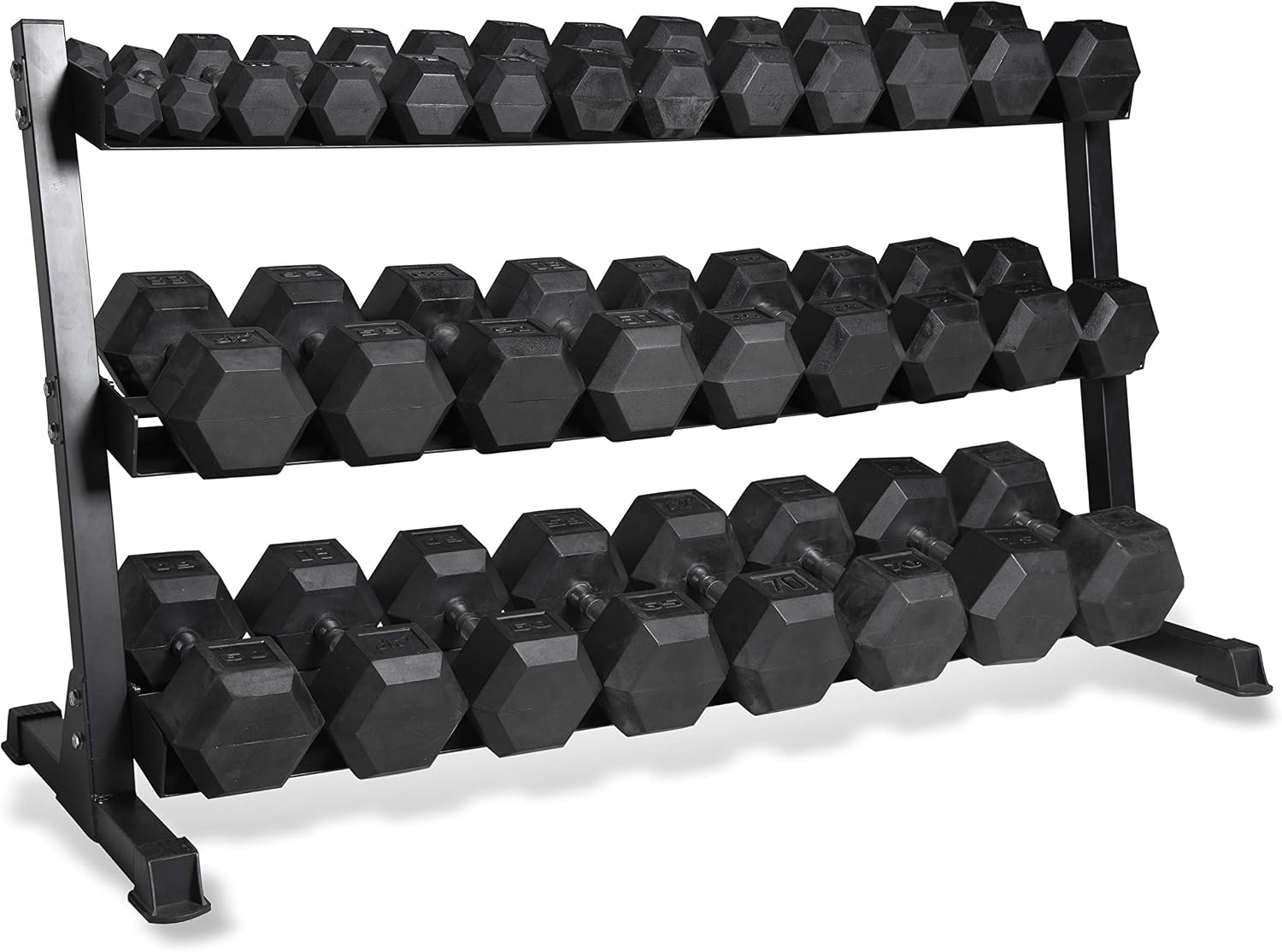
CAP 280 LB, 550 LB, 1200 LB Dumbbell Set with Horizontal 2-3 Tier Rack, Rubber Hex Free Weights, Home Gym Weight Set for Strength Training
Set and rack ship matched, so the heads and the tiers were designed for each other
The largest footprint and heaviest freight here, and the biggest configurations are a real commitment
Prices and availability were captured from Amazon Creators API and may change.
What separates a rack you keep from a rack you resell
Every stand gets the same four questions from me. Does it hold a loaded pair without flexing at the joints? Are the tiers spaced so a light head and a heavy head both sit flat instead of one resting on top of the other? Does the base footprint match the weight the frame is meant to carry, or is it a tall narrow thing that wants to tip when you rack a pair one-handed? And can you reach the bottom tier without folding past your knees?
Those questions are boring. They are also the difference between a stand that survives a decade of early clients and one that shows up on marketplace in month three. Steel gauge matters, but so does geometry, and geometry is the part you can judge from a product photo before you spend a dollar.
The other thing I check is whether a rack assumes a specific dumbbell length. Fixed hex sets vary in handle length and head diameter, and a stand with narrow gaps will not accept a fat head no matter how sturdy the frame is. That is the single most common mistake I see in home gyms: people buy the stand first, then buy weights that do not fit it.
Amazon Basics 3-Tier Adjustable Dumbbell Weight Rack: the flexible stand
This is the stand I point people toward when they want storage that will not need replacing. The name tells you the important part: the tiers adjust. That matters more than it sounds. A rack with fixed spacing is a rack for the dumbbells you own today. A rack with adjustable tiers is a rack for the dumbbells you own in three years, after you have added heavier pairs and your old light ones have moved to the bottom.
It is sold as the stand only, and that is the honest limitation. If you have not bought weights yet, this purchase sits in a box until you do. Buy it as step two, not step one.
What I like about it as a piece of home gym furniture is the restraint. Steel stand, three tiers, black finish, no gimmicks. In a category full of racks that try to be benches and shelves and storage all at once, a stand that just holds weights and holds them level is the right answer for most garages. Pair it with rubber hex heads and you have a corner that looks intentional rather than improvised.
If you already own a mixed pile of dumbbells, start here: check the Amazon Basics rack on Amazon.
3 Tier Dumbbell Rack: the straightforward option
The three tier dumbbell rack is the other side of that coin. Three tiers, a weight rack frame, and no suggestion in the product name that anything adjusts. That is not a flaw, it is a use case. If you own one set of hex dumbbells in a range you are not planning to expand, fixed spacing is fine, and a simpler frame usually means less money and less assembly.
Where I would be careful is expansion. Fixed tiers are built around a head size, and if you later add a pair with a fatter head or a longer handle, you may find the top tier is the only one that accepts them. That is not a reason to avoid the rack. It is a reason to decide, before you buy, whether your dumbbell collection is finished or still growing.
For a starter setup, a set of lighter rubber hex pairs, or a garage that also stores kettlebells and wants a simple place to put them, this does the job without asking for much floor space or much money. For a lifter who is already planning to add a 60 and a 70 next year, the adjustable stand above is the safer buy.
CAP 280 LB, 550 LB, 1200 LB set: rack included, geometry matched
This is the option I recommend to people who are starting from zero, and it is the one that costs the most thought rather than the most money. The CAP set ships as rubber hex free weights with a horizontal 2-3 tier rack, in 280, 550, and 1200 pound configurations. The rack is part of the package, which means the heads and the tiers were designed together. No gap guessing, no returning a stand because your handles are a quarter inch too long.
Rubber hex is the home gym standard for a reason I have repeated until my clients can recite it: round heads roll away, hex heads stay where you put them. When you rack a pair at the end of a set, you want it to stay racked. That single property is why hex rubber beats every clever alternative in a garage with a sloped floor.
The configuration choice is the real decision. The smallest set covers a beginner through a long stretch of training. The largest is a different animal entirely: it is closer to equipping a small studio than outfitting a corner, and it brings the freight and the footprint to match. Be honest about which one you are. Most home lifters who buy the biggest option are buying for an imagined future gym, not the one in their garage.
If you want the whole problem solved in one order, this is the path: see the CAP dumbbell set with rack on Amazon.
Adjustable Dumbbells 4 in 1 set: the small-space answer
This set takes the opposite approach. Instead of one fixed weight per dumbbell, you get plates and a mechanism, in 20, 30, 40, 60, and 80 pound configurations, plus a connector that turns a pair into a short barbell, kettlebell and push-up stand configurations, and a footprint small enough to live in a closet. The product name lists youth, women and men as the audience, and that tracks: the appeal here is range without a wall of iron.
The trade-off is time. Every fixed pair can be picked up and put down in a second. Every adjustable pair asks you to change plates, and that cost shows up in the middle of a superset when you are breathing hard. For straight sets of curls, presses, rows and lunges, the delay is trivial. For drop sets and circuits, it is annoying enough that some people stop using the set, and a set you stop using is the most expensive thing in your gym.
The connector deserves a straight answer. It turns two dumbbells into a short barbell, and that is genuinely useful for pressing and rowing variations when space is tight. It is not a replacement for a real barbell, and I would not program heavy squats or pulls around it. Treat it as a bonus movement option, not a power rack substitute.
For a spare bedroom, an apartment, or a lifter who wants to test whether home training sticks before committing to a wall of hex heads, this is the low-risk entry: check the adjustable 4 in 1 dumbbell set on Amazon.
Fixed hex or adjustable? Decide this before anything else
If you take one thing from this comparison, take this: the weights decide the rack, not the other way around.
Fixed hex dumbbells are the better training tool. They are faster to use, they feel like a real dumbbell in the hand, and they hold their value. The cost is money and floor space, and the space cost is why the CAP set and the two stands exist in the first place.
Adjustable sets are the better space tool. They cover a wider weight range in a fraction of the footprint, and the 4 in 1 set goes further than most by adding the connector and the alternate configurations. The cost is time per set and a mechanism that eventually wears.
My rule for clients is unglamorous. If you train three or more days a week and you have a garage or a basement, buy fixed hex and a stand. If you train in a shared room, if you are testing the habit, or if you are buying for a teenager who may lose interest, buy adjustable and revisit in a year.
The storage math nobody does before ordering
Measure the space before you order anything. Not the room, the actual corner. A three tier stand needs vertical clearance above the top tier for you to lift a pair off it without banging a joist, and it needs enough depth that the heads are not hanging over the front edge where you walk. A rack that fits the weights but not the room is still the wrong rack.
Then count your pairs. Three tiers hold roughly three rows of dumbbells, which sounds obvious until you realize you own nine pairs and have planned for six. If your collection is still growing, the adjustable stand is the one that will not punish you for it.
Finally, think about the drop. Clients drop dumbbells at the end of a set. That is not a discipline problem, it is what happens at the end of a hard set of rows. Whatever you buy, the rack should be stable enough that a dropped pair near the base does not send the whole stand walking across the floor.
What I would tell a client
If you own nothing and you have the space: the CAP set with the matching rack, sized honestly to the training you actually do.
If you own dumbbells already and you want them off the floor: the Amazon Basics adjustable rack, because the tiers will still fit whatever you buy next.
If you own one finished set and you want the cheapest tidy solution: the three tier dumbbell rack.
If your gym is a bedroom, or you are not sure home training will stick: the adjustable 4 in 1 set, and add a fixed pair later if you outgrow it.
Bottom line
None of these four is the right answer for everyone, and any list that tells you otherwise is selling you something. The right rack is the one that matches the weights you own or plan to own, fits the corner you actually have, and does not wobble when you rack a heavy pair at the end of a long set. Get that part right and the rest of the home gym gets easier, because the weights are where you left them and the floor is clear enough to train on.