Most people build a home dumbbell setup backwards. They buy the heaviest thing they can afford, drop it in the corner of a garage, and find out three months later that the handles chew their palms, the collars back out halfway through a set, and there is nowhere to put anything down. The equipment is rarely the hard part. The order is. Get the sequence right and a small pile of gear covers years of training. Get it wrong and you end up with four hundred dollars of iron you avoid.
This is not a ranking. It is a walk through four different jobs a home gym has to fill: a light and mid-range adjustable set, one adjustable unit that can carry real load, a place to store it all, and a reference that tells you what to do with it. Each one solves a different problem, and skipping any of them creates a gap you will notice in week six.
Related: How to Choose Adjustable Dumbbells for a Small Home Gym →
Quick answer
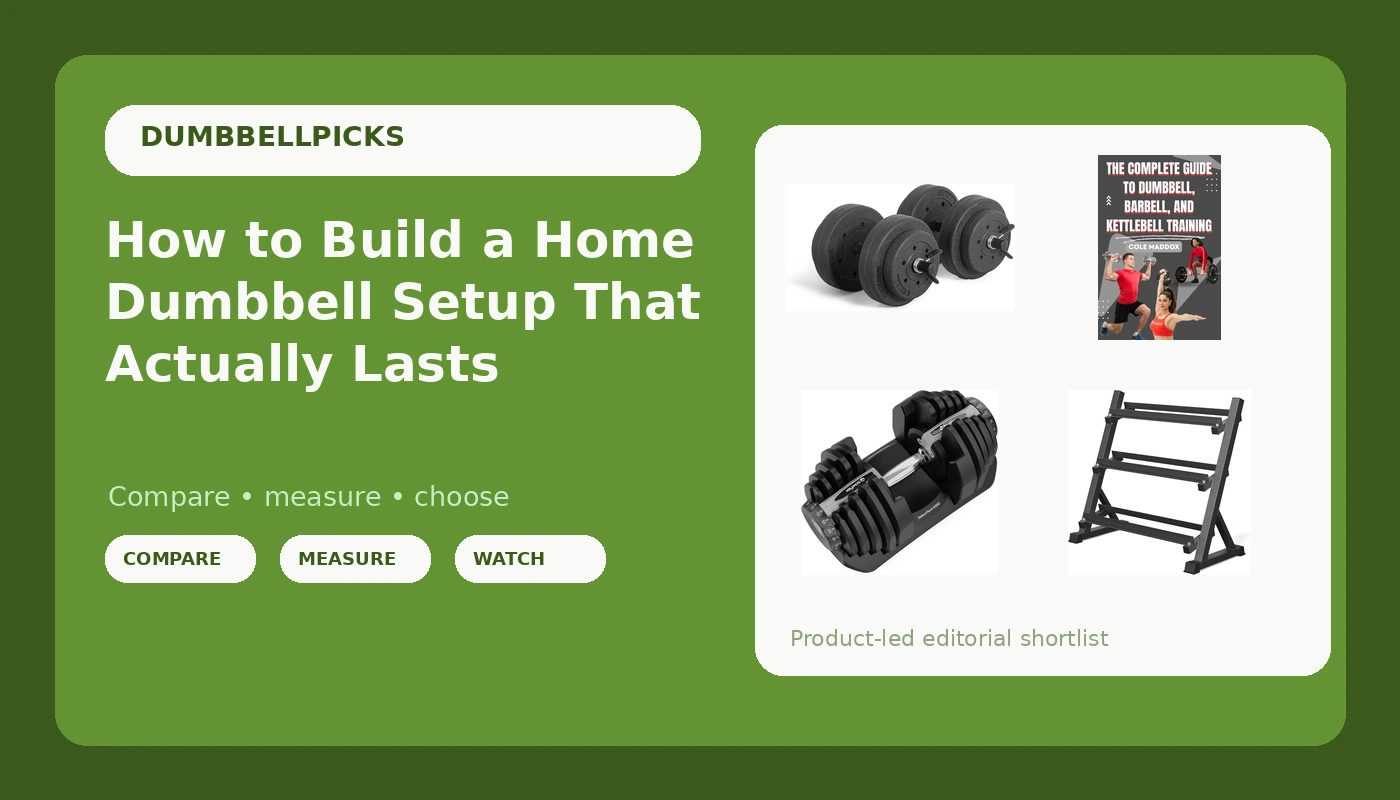
A workable home dumbbell setup covers three things: enough load to progress, a handle that holds chalk and skin, and a place to store the weights so they are not on the floor. The CAP 40 LB Adjustable Cement Dumbbell Set covers the light and mid-range work cheaply. The BowFlex Results Series 1090 SelectTech Single Dumbbell covers the heavier end as a single unit, so you can buy one at a time. The Dumbbell Rack keeps both off the ground. The Complete Guide to Dumbbell, Barbell, and Kettlebell Training is the cheapest item here and the one that changes how you use the other three.
Four useful options
| Model | Best fit | What stands out |
|---|---|---|
| CAP 40 LB Adjustable Cement Dumbbell Set, Vinyl Coated, Black | First set, light and mid-range work, tight budgets | Adjustable design at an entry-level price point |
| THE COMPLETE GUIDE TO DUMBBELL, BARBELL, AND KETTLEBELL TRAINING | Programming and exercise selection | Covers three free weight tools in one volume |
| BowFlex Results Series 1090 SelectTech Single Dumbbell | Heavier work without a full fixed set | Sold as a single dumbbell, so you scale one at a time |
| Dumbbell Rack, Dumbbell Weight Rack for Home Gym, Dumbbell Rack Stand Only | Storage and floor space | Stand only, so it pairs with whatever dumbbells you own |
The budget entry point: CAP 40 LB Adjustable Cement Dumbbell Set
Here is the honest trade-off with cement and vinyl: it is the least expensive way to put adjustable load in your hands, and it behaves like it. Cement-filled plates are bulkier than iron at the same weight, so the heads get in the way on close-grip movements. Vinyl coating is there to protect floors and reduce noise, not to survive a drop test. Treat this set as a starting point for accessory work and higher-rep sets, not as the last dumbbell you will ever buy. The people who get burned by this category are the ones who expect a forty dollar set to behave like a four hundred dollar one. If your program is mostly sets of 8 to 15 on smaller movements, it does the job. If you are trying to press heavy, you will outgrow it fast.
The reference: THE COMPLETE GUIDE TO DUMBBELL, BARBELL, AND KETTLEBELL TRAINING
I have watched more home gyms die from bad programming than from bad equipment. Someone buys a set, does the same three exercises for a month, stops seeing progress, and blames the dumbbells. A book like this one exists to break that loop. The value is not in any single workout. It is in learning how to substitute a dumbbell for a barbell when you only own one of them, how to structure a week when you cannot load a bar heavy, and how to keep adding reps or sets when you cannot add plates. That skill outlasts every piece of gear in this article. Buy it before you upgrade anything.
The heavier end: BowFlex Results Series 1090 SelectTech Single Dumbbell
The mechanism is the whole product. On any adjustable dumbbell, the dial, crank, or lock that changes the weight is the part that fails, and it is the part you interact with five hundred times in a training block. A smooth selector that indexes cleanly when your hands are chalky is worth more than a wider weight range with a mechanism that jams. The single-unit listing is a genuine advantage for a home gym on a budget: start with one, use it for split squats, one-arm rows, and single-arm presses, then add the second when the money is there. The trade-off is the same as every adjustable. You are accepting plastic and moving parts in exchange for floor space and money. If you want something that survives being thrown, buy fixed hex dumbbells and a bigger rack.
The storage piece: Dumbbell Rack, Dumbbell Weight Rack for Home Gym
Storage sounds like the boring line item until you trip over a dumbbell at 6 AM. A rack does three things beyond tidiness: it keeps handles off cold concrete, it keeps weights out of the walking path, and it makes the set visible, which means you actually use it. The caveat is that "stand only" means exactly that. Check the dimensions and the weight it is rated for against what you own before buying, and check whether the tray spacing suits the head shape of your dumbbells. Adjustable units with bulky cement heads and slim fixed hex heads do not sit the same way.
Prices and availability may change. Product images, names, and retailer links must be matched by verified ASIN. Do not state a current price, rating, stock status, or measured result without current evidence.
What actually fails on a dumbbell
Buyers obsess over weight range and ignore the four things that decide whether a dumbbell is pleasant to train with.
The first is the handle. Knurling is the textured pattern cut into the shaft, and it is the difference between a confident grip and a constant fight. Too smooth and you are squeezing harder than you are pulling. Too aggressive and you are taping your palms by week two. Diamond patterns bite more than straight ones at the same depth, and a coarse knurl on a light dumbbell is wasted because you never need to hold it that hard.
The second is the adjustable mechanism. A dial, a pin, a crank, or a collar, it does not matter which, because all of them are wear items. The question is whether the mechanism indexes positively, meaning it locks where you intended without a wiggle, and whether it still does that when your hands are dusty or chalky. Mechanisms that rely on fine tolerances are the ones that jam.
The third is plate security. On any adjustable set, the weight should not shift inside the head during a set. If you feel a clunk at the bottom of a press, something is loose, and loose is how plates end up on your foot.
The fourth is head shape. Six-sided heads stay where you put them. Round heads roll. In a garage or a spare bedroom, that single geometric fact decides whether you are chasing a dumbbell across the floor between sets.
How to match the weight to your program
The most common buying mistake is chasing a wide weight range you will never use. A set that runs from very light to very heavy costs more, takes up more space, and spends most of its life at the same three settings.
Think in terms of movements instead. Light dumbbells handle lateral raises, rear delt work, curls, and rotator cuff prehab. Mid-range handles rows, presses, lunges, and most accessory work. Heavy handles goblet squats, split squats, Romanian deadlifts, and farmer carries. If you cannot yet press the heaviest setting you own, you did not buy a heavy dumbbell. You bought furniture.
Then think about increments. Progress on dumbbells comes from small jumps and rep increases. If your set jumps in large steps, you will stall between settings. If it jumps in small steps, you can run a linear progression for months.
Finally, be honest about space. A fixed set from light to heavy is the gold standard for feel, and it is also several feet of rack and a serious amount of money. Adjustables trade some of that feel for a footprint you can fit in a closet.
- List the five movements you actually train most, and the load each one needs.
- Decide whether you need a pair or can start with a single dumbbell and add the second later.
- Check the increment between settings, not just the top weight.
- Handle the grip and the mechanism before you commit to a full set.
- Buy storage at the same time, or the weights end up on the floor and stay there.
Practical guidance for a first setup
- Start with the light and mid-range work. It is where most of your training volume lives, and it is where a cheap set is genuinely fine.
- Spend on the mechanism before you spend on the weight range. A smooth selector at a modest top weight beats a jammed one at a big number.
- Buy the reference material early. Programming knowledge transfers to every dumbbell you will ever own. Equipment does not.
- Plan storage before the gear arrives. A rack is cheaper than replacing a floor, and much cheaper than a broken toe.
- Keep a training log from day one. The log tells you when a set has stopped being useful, which is the only real signal to upgrade.
Which option should you choose?
Choose the CAP 40 LB Adjustable Cement Dumbbell Set when you are starting out, training mostly higher-rep accessory work, and want load in your hands for the least money. Choose THE COMPLETE GUIDE TO DUMBBELL, BARBELL, AND KETTLEBELL TRAINING when you already own some weights and your progress has stalled because you do not know what to do with them. Choose the BowFlex Results Series 1090 SelectTech Single Dumbbell when you need heavier loading, want to buy one unit at a time, and value a clean selection mechanism over the feel of fixed iron. Choose the Dumbbell Rack when the weights are already piling up on the floor and you want them visible, organized, and out of the way.
None of these are lifetime purchases in the way a good barbell is. Cement and vinyl will not survive the abuse a commercial set survives, and every adjustable mechanism is a wear item. Buy accordingly, and check the current specifications and dimensions on the listing before you commit, because weight ranges and build details change between versions.
The bottom line
A home dumbbell setup does not need to be impressive. It needs to be complete. That means enough load to progress, a handle you can hold without fighting it, a mechanism that indexes the same way on rep five hundred as it did on rep one, and somewhere to put the weights when you are done. The CAP set covers the light and mid-range work at the lowest cost. The SelectTech single covers heavier loading and lets you scale one unit at a time. The rack keeps it all usable. The training guide is what turns three pieces of equipment into an actual program. Buy the book, buy the storage, then buy the dumbbells you can afford today and upgrade when the log tells you to.