Most home lifters buy the wrong thing first. They buy a rack of fixed dumbbells, realize the 25s and 30s are the only pairs they touch, and end up with two hundred pounds of iron parked under a bench like a monument to good intentions. Or they buy the cheapest adjustable set on the market, feel a collar back off during an overhead press, and spend the next month training scared of their own equipment.
An adjustable dumbbell home workout solves both problems if you set it up correctly. Two dumbbells, one storage case, and a floor space the size of a yoga mat is enough to run a real strength program for a year, provided the mechanism holds and the weight ceiling matches your lifts.
I have spent twelve years coaching in Denver, first out of a garage, then out of a 4,000 square foot facility. Below is how I would set up a dumbbell program at home, the two sets I would start with, and the eight steps that keep the whole thing from turning into a rattling pile of plates.
Why you should trust me
I'm Cole. Twelve years as a strength coach, most of it in Denver, Colorado. The garage gym I started in grew into a 4,000 square foot facility, and the programming there runs from 14-year-old athletes to 70-year-old grandmothers. Same dumbbells, different loads.
I test dumbbells the way clients use them: drop tests on the platform at 6 AM, knurling checks with chalk on my hands, and full training blocks that run from curls to farmer carries. I keep a log of which handles hold chalk and which ones shred skin by the third set.
What that taught me is boring and useful. Knurling is the soul of a dumbbell. Too smooth and you fight grip all set. Too sharp and you bleed. The second lesson is that adjustable sets live or die on the mechanism, not the weight range. A smooth, predictable lock beats a clever design that jams the moment your hands are chalky.
How I picked and how I tested
Every dumbbell that comes through my gym gets the same four questions, in this order.
Does the knurling hold chalk, or does it just look textured? Cosmetic knurling is the most common lie in home gym gear. Run a thumb down the handle. You should feel a pattern that catches skin, not a painted-on diamond.
Does the adjustable mechanism survive 500 changes? That is roughly two years of three-day-a-week training with a handful of weight changes per session. If a mechanism feels vague on change 20, it will feel broken on change 200.
Do the plates stay tight mid-set? Wobble is the tell. If a plate shifts under load, the weld or the collar is lying to you, and a dumbbell that wobbles is a dumbbell you stop trusting over your face.
Would I put it in a paying client's hands? That is the final filter, and it eliminates a lot of gear that reviews well and trains badly.
For this guide I stayed focused on what a home lifter actually needs in the first year: a set with a usable range, a way to load heavier for legs and rows, and a footprint that fits a spare room. Everything below passed those questions or came with a caveat you should know before you order.
The two dumbbells worth starting with
You need one adjustable set for range and one or two fixed pairs for the lifts that outgrow it. That combination covers more ground than any single purchase.
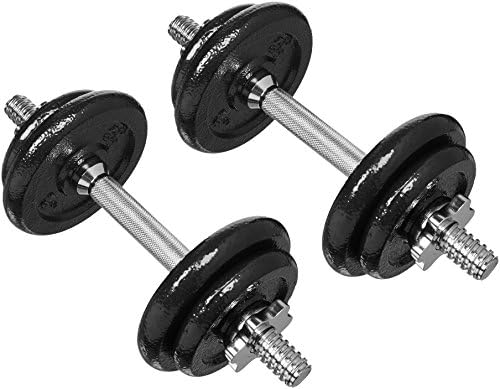
Best for small spaces and lighter loads: Amazon Basics Adjustable Dumbbell Hand Weight Set with Storage Case, Portable, Secure, 38 Pounds, Black
 Visit on Amazon →
This is the set I would hand a client who trains in an apartment, a dorm room, or the corner of a bedroom. The whole thing lives in a storage case, so the plates stop migrating across your floor, and the footprint is small enough that you can keep it under a bed and still use it four days a week.
The adjustability is the point. You get a range of loads out of one pair of handles, which means lateral raises, curls, split squats, and floor presses all come from the same set instead of four separate purchases. For accessory work and the first several months of general strength training, that is exactly what you need.
Two things to plan around. First, the total load is modest. This is a light-to-moderate set, not a heavy one, so a lifter who can already row and press big numbers will run out of weight on the compound movements before the year is out. Second, any adjustable set with collars deserves a habit: check them after the first working set, every session. Chalk and threads do not mix well, so wipe the collars down if your hands are dusty.
Flaws but not dealbreakers: The ceiling is the real limitation here. It will not be your last dumbbell purchase if you stick with training, but it can absolutely be your first one, and the storage case means you are not tripping over it while you decide what comes next.
Anyone in a small space, anyone starting a first program, and anyone who wants a set they can put away should start here.
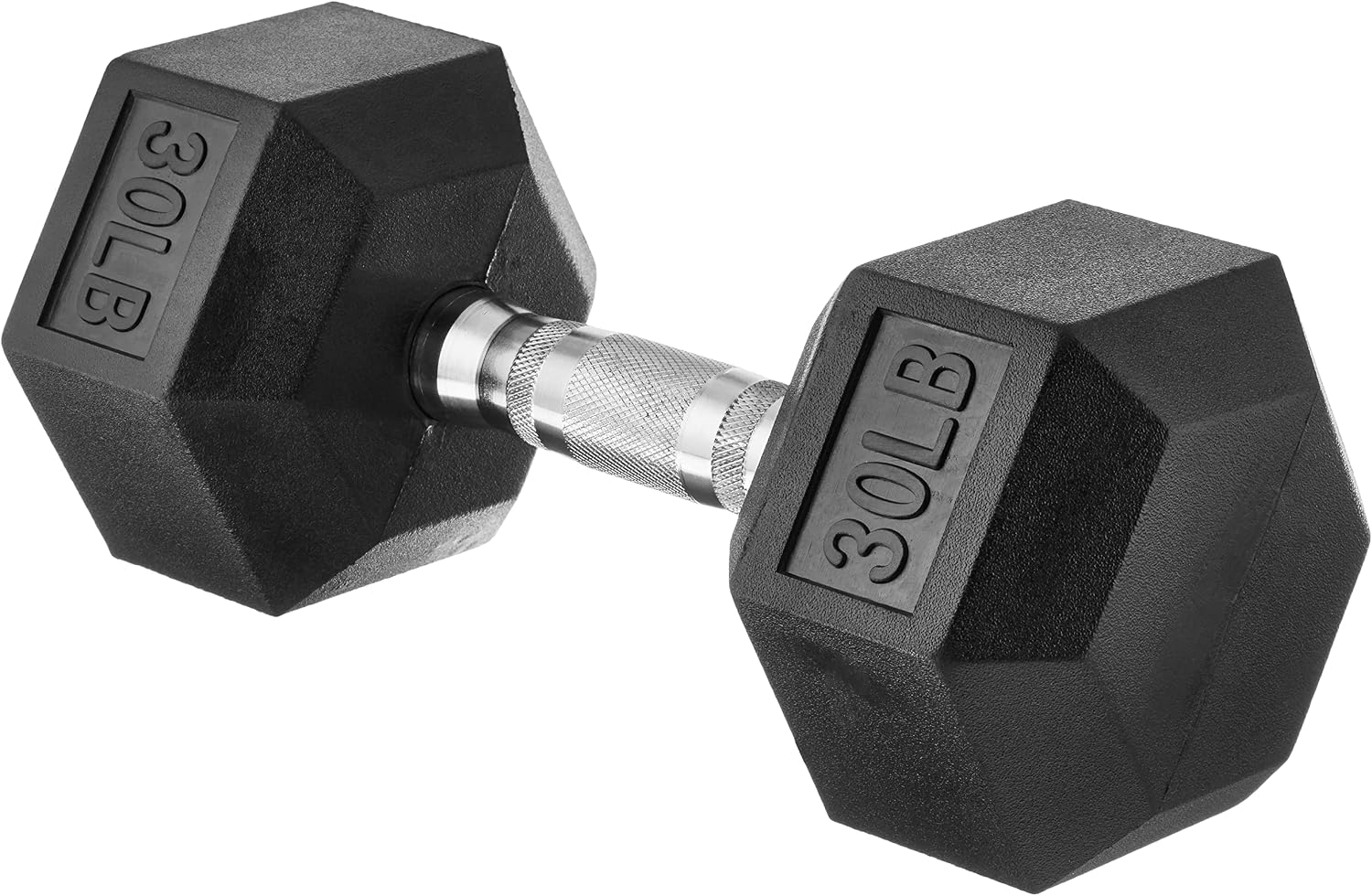
Best fixed-weight pick for the money: Amazon Basics Rubber Hex Dumbbell Hand Weight
 Visit on Amazon →
Hex rubber is the home gym standard for a reason. Round heads roll away from you mid-set, and rolling dumbbells are how people get hurt in garages. A six-sided rubber head stays where you put it, sits flat on a mat, and takes a set-down without cracking your floor.
These are the dumbbells I would buy in the two or three weights you actually use. For most people that means a pair for rows and presses, plus a heavier pair for goblet squats, Romanian deadlifts, and farmer carries. Fixed weight means zero mechanism, zero collars, and zero chance of a plate shifting while it is over your head. You pick it up, you put it down, you repeat that for a decade.
A note on ordering: the listing is for a single hand weight, so a pair means ordering two. Check the weight you select before you check out, because it is easy to end up with one 25 and no training partner for it.
Flaws but not dealbreakers: New rubber can smell like a tire fire for the first week or two. Leave them in the garage or on a porch for a few days before you bring them inside. And they are fixed, so they cannot grow with you. That is the trade you make for a dumbbell that will never rattle.
Anyone who wants two or three pairs that never need adjusting, and anyone pairing a heavier fixed pair with a lighter adjustable set, should grab these.
How to set up the adjustable dumbbell home workout
Now the part that actually builds the training. This works with any adjustable set and a couple of fixed pairs.
Step one: Claim your floor space. Six feet by six feet is plenty. Put a rubber mat down over concrete or carpet, keep a wall or bench within reach, and set the storage case at the edge of the mat so plates never travel across the room. The case is not decoration. It is the reason your plates are where you left them.
Step two: Pick working weights, not a range. Most beginners live between 10 and 35 pounds per hand for the first year. Write down the three loads you use most, and if your set tops out under the top of that range per hand, plan to add a heavier fixed pair later. Buying range you never touch is how home gyms get cluttered.
Step three: Learn the mechanism cold before you load it. Change the weight 20 times in a row with no reps in between. Feel where it seats, where it catches, and where it lies to you. Do this once, sober, on a Tuesday, not for the first time at the top of a press. If the set uses threaded collars, get in the habit of checking them after the first working set of every session, because a collar that backs off is the one failure mode that can actually hurt you.
Step four: Build the program around six movements. Goblet squat, one-arm row, floor press, Romanian deadlift, standing curl, and farmer carry. Three days a week, three sets of eight to twelve reps, and you have covered legs, back, chest, arms, and grip with two dumbbells. That is a real program, not a compromise.
Step five: Progress by reps first, then load. Stay at the same weight until you hit the top of the rep range on all three sets with clean form. Then move up one increment. Log it. People who log reps get stronger than people who chase weight, every single time.
Step six: Respect grip and knurling. Grip fails before the target muscle does on rows and carries. Use chalk if your gym allows it, or keep a towel nearby, and pay attention to how the handle feels on set three versus set one. If a handle tears your hands up, tape it or glove up. If it slips, the knurling is cosmetic and you should know that before you buy more from that line.
Step seven: Set a drop rule and enforce it. Fixed hex dumbbells can take a controlled set-down. Adjustable sets should never be dropped, because you are dropping a mechanism, not a chunk of iron. If you train hard enough that you want to drop weight, do it with the hex pair.
Step eight: Inspect and store after every session. Collars tight, plates seated, rubber wiped down, everything back in the case. Thirty seconds of maintenance is the difference between a set that lasts five years and a set that wobbles by month four.
Step nine: Add load where the program demands it. When your goblet squat and Romanian deadlift outgrow the adjustable set, buy the heavier fixed pair instead of a whole new system. One pair at a time, as the training asks for it.
The competition and why it lost
The premium adjustables get a lot of attention, and some of them earn it. Bowflex SelectTech owns the dial mechanism and a range that covers a decade of training for most people. NUOBELL feels like a real dumbbell in the hand, which matters more than the spec sheet suggests. PowerBlock is space efficient and close to bombproof, though the cage feel is not for everyone.
None of them belong in a first-set recommendation for a small room, for one reason: cost and complexity before you know what you need. If you have trained for a couple of years and know your working weights, those sets are worth the money. If you are starting out, they are a large bet on a habit you have not built yet.
Rubber hex sets from the serious brands are the gold standard for a real gym. They are also priced like it, and they take up floor space you probably do not have. Fixed pairs in the weights you use are the smarter version of that idea at home.
And the cheap spinlock sets you see in hotel gyms and big box stores? The collars loosen mid-set, the plates clang, and you spend the session thinking about the equipment instead of the lift. Skip that category entirely.
What this all costs
Here is the honest math without a single number, because prices move and the labels on this page do not.
An adjustable set plus one or two fixed pairs costs a fraction of what a full rack of pairs costs, and it covers the same training for the first year or two. That is the entire argument for starting this way. You are buying coverage, not tonnage.
Spread over a year of three-day-a-week training, any of these purchases works out to pocket change per session. Spread over five years, which is how long a well-treated set lasts, the number gets almost silly. Check current Amazon price on each set before you commit, since the gap between the two options here is smaller than most people expect.
The mistake is not spending too little or too much. It is buying weight you never touch. Two dumbbells you use four days a week beat twenty pairs you walk past.
That is the job. Pick the set that fits your space, learn the mechanism before you load it, log your reps, and let the program do the work.